

Role of Radiation Treatment as a Cost-Effective Tool for Cotton …
325
used to dye irradiated fabric at 60 °C for 55 min. It is concluded that, at these optimum conditions the shade made, upon the exposure to fastness agencies. It has been
revealed that microwave irradiation has improved the rating of fastness properties.
It is reported that at a greyscale on compassion these characteristics were improved
and microwave irradiation has an excellent potential to improve the color strength
and dyeing properties below insignificant conditions.
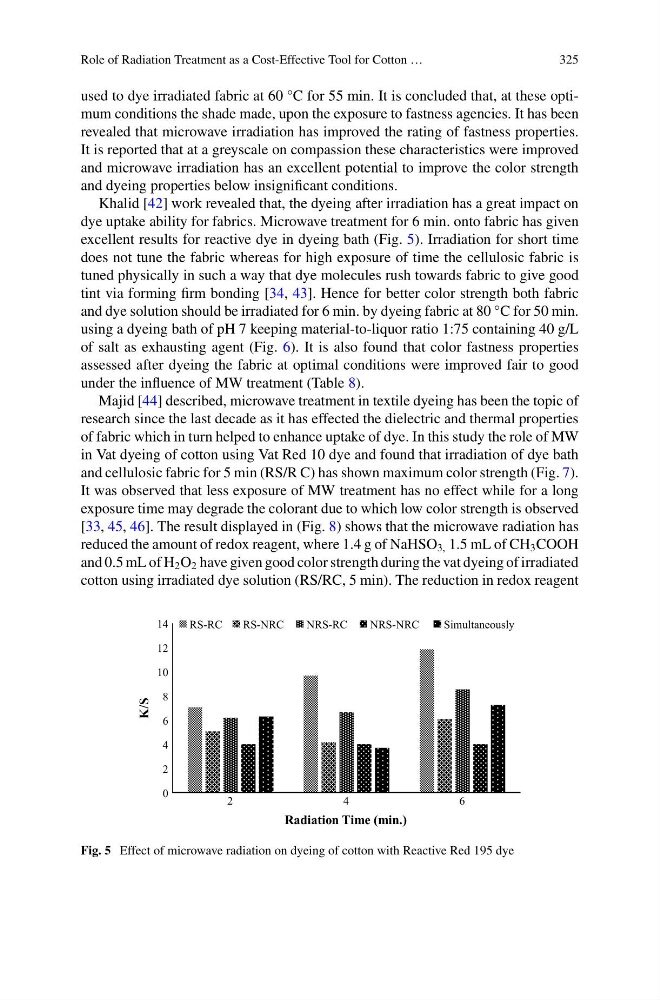
Khalid [42] work revealed that, the dyeing after irradiation has a great impact on
dye uptake ability for fabrics. Microwave treatment for 6 min. onto fabric has given
excellent results for reactive dye in dyeing bath (Fig. 5). Irradiation for short time
does not tune the fabric whereas for high exposure of time the cellulosic fabric is
tuned physically in such a way that dye molecules rush towards fabric to give good
tint via forming firm bonding [34, 43]. Hence for better color strength both fabric
and dye solution should be irradiated for 6 min. by dyeing fabric at 80 °C for 50 min.
using a dyeing bath of pH 7 keeping material-to-liquor ratio 1:75 containing 40 g/L
of salt as exhausting agent (Fig. 6). It is also found that color fastness properties
assessed after dyeing the fabric at optimal conditions were improved fair to good
under the influence of MW treatment (Table 8).
Majid [44] described, microwave treatment in textile dyeing has been the topic of
research since the last decade as it has effected the dielectric and thermal properties
of fabric which in turn helped to enhance uptake of dye. In this study the role of MW
in Vat dyeing of cotton using Vat Red 10 dye and found that irradiation of dye bath
and cellulosic fabric for 5 min (RS/R C) has shown maximum color strength (Fig. 7).
It was observed that less exposure of MW treatment has no effect while for a long
exposure time may degrade the colorant due to which low color strength is observed
[33, 45, 46]. The result displayed in (Fig. 8) shows that the microwave radiation has
reduced the amount of redox reagent, where 1.4 g of NaHSO 3, 1.5 mL of CH 3 COOH
and 0.5 mL of H 2 O 2 have given good color strength during the vat dyeing of irradiated
cotton using irradiated dye solution (RS/RC, 5 min). The reduction in redox reagent
0
2
4
6
8
10
12
14
2
4
6
K/S
Radiation Time (min.)
RS-RC
RS-NRC
NRS-RC
NRS-NRC
Simultaneously
Fig. 5 Effect of microwave radiation on dyeing of cotton with Reactive Red 195 dye
325
used to dye irradiated fabric at 60 °C for 55 min. It is concluded that, at these optimum conditions the shade made, upon the exposure to fastness agencies. It has been
revealed that microwave irradiation has improved the rating of fastness properties.
It is reported that at a greyscale on compassion these characteristics were improved
and microwave irradiation has an excellent potential to improve the color strength
and dyeing properties below insignificant conditions.
Khalid [42] work revealed that, the dyeing after irradiation has a great impact on
dye uptake ability for fabrics. Microwave treatment for 6 min. onto fabric has given
excellent results for reactive dye in dyeing bath (Fig. 5). Irradiation for short time
does not tune the fabric whereas for high exposure of time the cellulosic fabric is
tuned physically in such a way that dye molecules rush towards fabric to give good
tint via forming firm bonding [34, 43]. Hence for better color strength both fabric
and dye solution should be irradiated for 6 min. by dyeing fabric at 80 °C for 50 min.
using a dyeing bath of pH 7 keeping material-to-liquor ratio 1:75 containing 40 g/L
of salt as exhausting agent (Fig. 6). It is also found that color fastness properties
assessed after dyeing the fabric at optimal conditions were improved fair to good
under the influence of MW treatment (Table 8).
Majid [44] described, microwave treatment in textile dyeing has been the topic of
research since the last decade as it has effected the dielectric and thermal properties
of fabric which in turn helped to enhance uptake of dye. In this study the role of MW
in Vat dyeing of cotton using Vat Red 10 dye and found that irradiation of dye bath
and cellulosic fabric for 5 min (RS/R C) has shown maximum color strength (Fig. 7).
It was observed that less exposure of MW treatment has no effect while for a long
exposure time may degrade the colorant due to which low color strength is observed
[33, 45, 46]. The result displayed in (Fig. 8) shows that the microwave radiation has
reduced the amount of redox reagent, where 1.4 g of NaHSO 3, 1.5 mL of CH 3 COOH
and 0.5 mL of H 2 O 2 have given good color strength during the vat dyeing of irradiated
cotton using irradiated dye solution (RS/RC, 5 min). The reduction in redox reagent
0
2
4
6
8
10
12
14
2
4
6
K/S
Radiation Time (min.)
RS-RC
RS-NRC
NRS-RC
NRS-NRC
Simultaneously
Fig. 5 Effect of microwave radiation on dyeing of cotton with Reactive Red 195 dye