

Role of Radiation Treatment as a Cost-Effective Tool for Cotton …
315
2 Pretreatment of Raw Greige Cotton
In the textile industry during the manufacturing process, pretreatment is one of the
most important procedures. For satisfactory consequential processes, such as printing, textile dyeing, and finishing, and the important purpose of the pretreatment is to
remove most of the impurities from the textiles. Generally, the pretreatment process
includes chemical and mechanical processing wherein the mechanical pretreatments
consist of checking, stitching, cleaning, collecting and distribution, or even singeing
processes, etc. For good preparation, wet-chemical pretreatment processes have been
done such as desizing, scouring, bleaching, and mercerization, which improve the
quality of ultimate products [6, 7].
3 Chemistry of Cotton
The cotton fabric is the most comfortable and easily available fabric found in the
textile world. Mostly the cotton fabric is cellulosic and non-cellulosic in nature,
where the major part of cotton fibres contains α-cellulose up to 96.5%. The noncellulosic part is found either on the outer layer or inside the lumen of the fibers [8].
The non-cellulosic part contains proteins (1.9%), wax (1.2%), Inorganic material
(1.6%) and other substances (8%). The degree of polymerization of the primary
wall ranges 2000–6000 and their distribution is broader similarly for secondary cell
wall it is about 14,000 with molecular weight of uniform distribution [9]. Cotton
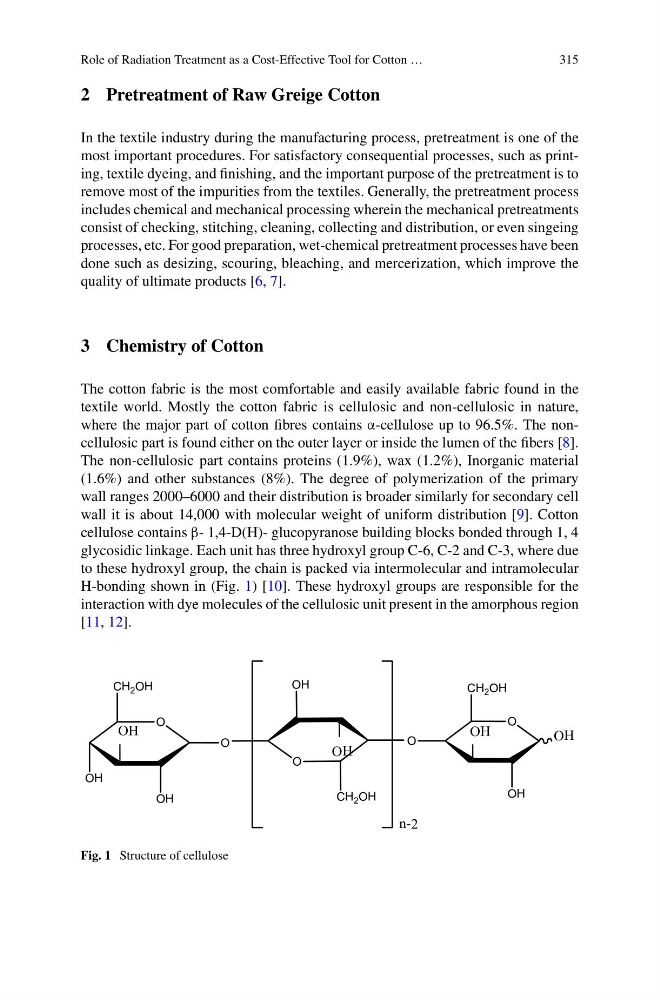
cellulose contains β- 1,4-D(H)- glucopyranose building blocks bonded through 1, 4
glycosidic linkage. Each unit has three hydroxyl group C-6, C-2 and C-3, where due
to these hydroxyl group, the chain is packed via intermolecular and intramolecular
H-bonding shown in (Fig. 1) [10]. These hydroxyl groups are responsible for the
interaction with dye molecules of the cellulosic unit present in the amorphous region
[11, 12].
O
CH 2 OH
OH
n-2
OH
O
O
CH 2 OH
OH
OH
OH
O
O
CH 2 OH
OH
OH
OH
Fig. 1 Structure of cellulose
315
2 Pretreatment of Raw Greige Cotton
In the textile industry during the manufacturing process, pretreatment is one of the
most important procedures. For satisfactory consequential processes, such as printing, textile dyeing, and finishing, and the important purpose of the pretreatment is to
remove most of the impurities from the textiles. Generally, the pretreatment process
includes chemical and mechanical processing wherein the mechanical pretreatments
consist of checking, stitching, cleaning, collecting and distribution, or even singeing
processes, etc. For good preparation, wet-chemical pretreatment processes have been
done such as desizing, scouring, bleaching, and mercerization, which improve the
quality of ultimate products [6, 7].
3 Chemistry of Cotton
The cotton fabric is the most comfortable and easily available fabric found in the
textile world. Mostly the cotton fabric is cellulosic and non-cellulosic in nature,
where the major part of cotton fibres contains α-cellulose up to 96.5%. The noncellulosic part is found either on the outer layer or inside the lumen of the fibers [8].
The non-cellulosic part contains proteins (1.9%), wax (1.2%), Inorganic material
(1.6%) and other substances (8%). The degree of polymerization of the primary
wall ranges 2000–6000 and their distribution is broader similarly for secondary cell
wall it is about 14,000 with molecular weight of uniform distribution [9]. Cotton
cellulose contains β- 1,4-D(H)- glucopyranose building blocks bonded through 1, 4
glycosidic linkage. Each unit has three hydroxyl group C-6, C-2 and C-3, where due
to these hydroxyl group, the chain is packed via intermolecular and intramolecular
H-bonding shown in (Fig. 1) [10]. These hydroxyl groups are responsible for the
interaction with dye molecules of the cellulosic unit present in the amorphous region
[11, 12].
O
CH 2 OH
OH
n-2
OH
O
O
CH 2 OH
OH
OH
OH
O
O
CH 2 OH
OH
OH
OH
Fig. 1 Structure of cellulose