

A. Patil et al
301
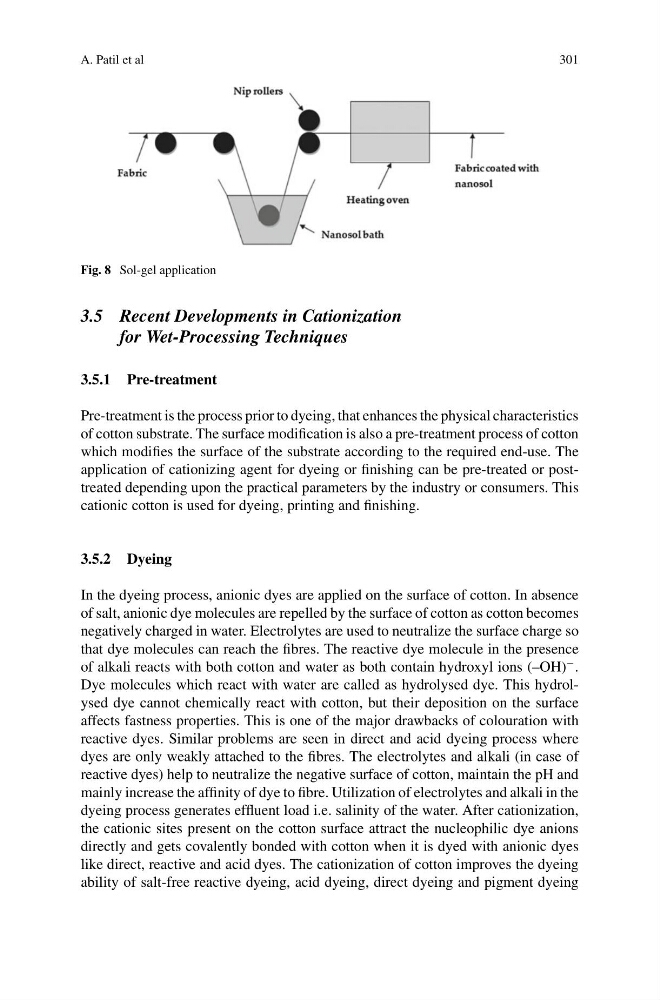
Fig. 8 Sol-gel application
3.5 Recent Developments in Cationization
for Wet-Processing Techniques
3.5.1 Pre-treatment
Pre-treatment is the process prior to dyeing, that enhances the physical characteristics
of cotton substrate. The surface modification is also a pre-treatment process of cotton
which modifies the surface of the substrate according to the required end-use. The
application of cationizing agent for dyeing or finishing can be pre-treated or posttreated depending upon the practical parameters by the industry or consumers. This
cationic cotton is used for dyeing, printing and finishing.
3.5.2 Dyeing
In the dyeing process, anionic dyes are applied on the surface of cotton. In absence
of salt, anionic dye molecules are repelled by the surface of cotton as cotton becomes
negatively charged in water. Electrolytes are used to neutralize the surface charge so
that dye molecules can reach the fibres. The reactive dye molecule in the presence
of alkali reacts with both cotton and water as both contain hydroxyl ions (–OH)
− .
Dye molecules which react with water are called as hydrolysed dye. This hydrolysed dye cannot chemically react with cotton, but their deposition on the surface
affects fastness properties. This is one of the major drawbacks of colouration with
reactive dyes. Similar problems are seen in direct and acid dyeing process where
dyes are only weakly attached to the fibres. The electrolytes and alkali (in case of
reactive dyes) help to neutralize the negative surface of cotton, maintain the pH and
mainly increase the affinity of dye to fibre. Utilization of electrolytes and alkali in the
dyeing process generates effluent load i.e. salinity of the water. After cationization,
the cationic sites present on the cotton surface attract the nucleophilic dye anions
directly and gets covalently bonded with cotton when it is dyed with anionic dyes
like direct, reactive and acid dyes. The cationization of cotton improves the dyeing
ability of salt-free reactive dyeing, acid dyeing, direct dyeing and pigment dyeing
301
Fig. 8 Sol-gel application
3.5 Recent Developments in Cationization
for Wet-Processing Techniques
3.5.1 Pre-treatment
Pre-treatment is the process prior to dyeing, that enhances the physical characteristics
of cotton substrate. The surface modification is also a pre-treatment process of cotton
which modifies the surface of the substrate according to the required end-use. The
application of cationizing agent for dyeing or finishing can be pre-treated or posttreated depending upon the practical parameters by the industry or consumers. This
cationic cotton is used for dyeing, printing and finishing.
3.5.2 Dyeing
In the dyeing process, anionic dyes are applied on the surface of cotton. In absence
of salt, anionic dye molecules are repelled by the surface of cotton as cotton becomes
negatively charged in water. Electrolytes are used to neutralize the surface charge so
that dye molecules can reach the fibres. The reactive dye molecule in the presence
of alkali reacts with both cotton and water as both contain hydroxyl ions (–OH)
− .
Dye molecules which react with water are called as hydrolysed dye. This hydrolysed dye cannot chemically react with cotton, but their deposition on the surface
affects fastness properties. This is one of the major drawbacks of colouration with
reactive dyes. Similar problems are seen in direct and acid dyeing process where
dyes are only weakly attached to the fibres. The electrolytes and alkali (in case of
reactive dyes) help to neutralize the negative surface of cotton, maintain the pH and
mainly increase the affinity of dye to fibre. Utilization of electrolytes and alkali in the
dyeing process generates effluent load i.e. salinity of the water. After cationization,
the cationic sites present on the cotton surface attract the nucleophilic dye anions
directly and gets covalently bonded with cotton when it is dyed with anionic dyes
like direct, reactive and acid dyes. The cationization of cotton improves the dyeing
ability of salt-free reactive dyeing, acid dyeing, direct dyeing and pigment dyeing