

Plasma Treatment Technology for Surface Modification …
279
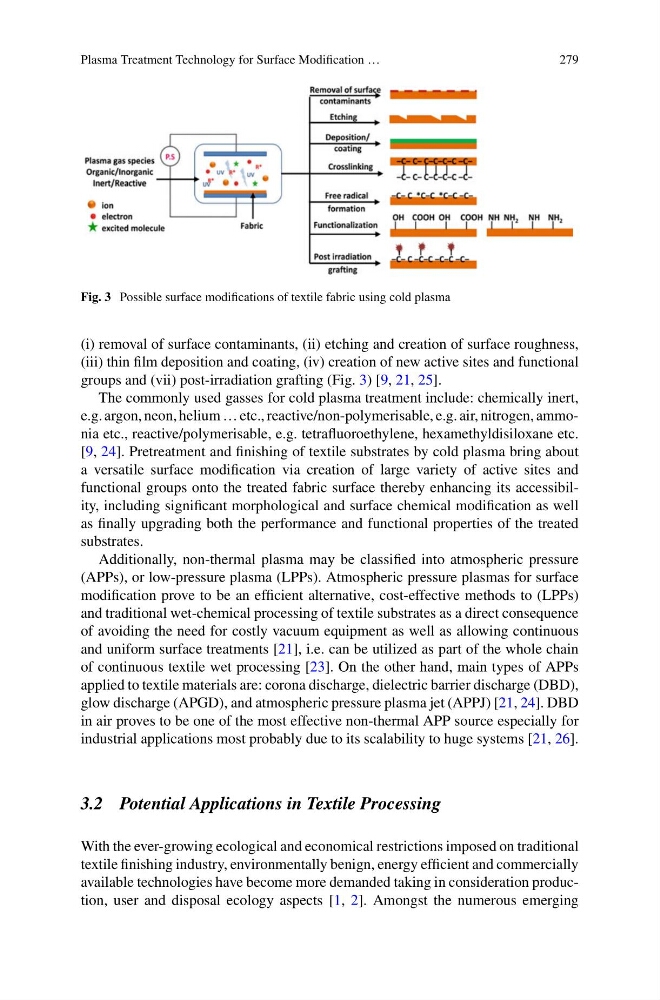
Fig. 3 Possible surface modifications of textile fabric using cold plasma
(i) removal of surface contaminants, (ii) etching and creation of surface roughness,
(iii) thin film deposition and coating, (iv) creation of new active sites and functional
groups and (vii) post-irradiation grafting (Fig. 3) [9, 21, 25].
The commonly used gasses for cold plasma treatment include: chemically inert,
e.g. argon, neon, helium … etc., reactive/non-polymerisable, e.g. air, nitrogen, ammonia etc., reactive/polymerisable, e.g. tetrafluoroethylene, hexamethyldisiloxane etc.
[9, 24]. Pretreatment and finishing of textile substrates by cold plasma bring about
a versatile surface modification via creation of large variety of active sites and
functional groups onto the treated fabric surface thereby enhancing its accessibility, including significant morphological and surface chemical modification as well
as finally upgrading both the performance and functional properties of the treated
substrates.
Additionally, non-thermal plasma may be classified into atmospheric pressure
(APPs), or low-pressure plasma (LPPs). Atmospheric pressure plasmas for surface
modification prove to be an efficient alternative, cost-effective methods to (LPPs)
and traditional wet-chemical processing of textile substrates as a direct consequence
of avoiding the need for costly vacuum equipment as well as allowing continuous
and uniform surface treatments [21], i.e. can be utilized as part of the whole chain
of continuous textile wet processing [23]. On the other hand, main types of APPs
applied to textile materials are: corona discharge, dielectric barrier discharge (DBD),
glow discharge (APGD), and atmospheric pressure plasma jet (APPJ) [21, 24]. DBD
in air proves to be one of the most effective non-thermal APP source especially for
industrial applications most probably due to its scalability to huge systems [21, 26].
3.2 Potential Applications in Textile Processing
With the ever-growing ecological and economical restrictions imposed on traditional
textile finishing industry, environmentally benign, energy efficient and commercially
available technologies have become more demanded taking in consideration production, user and disposal ecology aspects [1, 2]. Amongst the numerous emerging
279
Fig. 3 Possible surface modifications of textile fabric using cold plasma
(i) removal of surface contaminants, (ii) etching and creation of surface roughness,
(iii) thin film deposition and coating, (iv) creation of new active sites and functional
groups and (vii) post-irradiation grafting (Fig. 3) [9, 21, 25].
The commonly used gasses for cold plasma treatment include: chemically inert,
e.g. argon, neon, helium … etc., reactive/non-polymerisable, e.g. air, nitrogen, ammonia etc., reactive/polymerisable, e.g. tetrafluoroethylene, hexamethyldisiloxane etc.
[9, 24]. Pretreatment and finishing of textile substrates by cold plasma bring about
a versatile surface modification via creation of large variety of active sites and
functional groups onto the treated fabric surface thereby enhancing its accessibility, including significant morphological and surface chemical modification as well
as finally upgrading both the performance and functional properties of the treated
substrates.
Additionally, non-thermal plasma may be classified into atmospheric pressure
(APPs), or low-pressure plasma (LPPs). Atmospheric pressure plasmas for surface
modification prove to be an efficient alternative, cost-effective methods to (LPPs)
and traditional wet-chemical processing of textile substrates as a direct consequence
of avoiding the need for costly vacuum equipment as well as allowing continuous
and uniform surface treatments [21], i.e. can be utilized as part of the whole chain
of continuous textile wet processing [23]. On the other hand, main types of APPs
applied to textile materials are: corona discharge, dielectric barrier discharge (DBD),
glow discharge (APGD), and atmospheric pressure plasma jet (APPJ) [21, 24]. DBD
in air proves to be one of the most effective non-thermal APP source especially for
industrial applications most probably due to its scalability to huge systems [21, 26].
3.2 Potential Applications in Textile Processing
With the ever-growing ecological and economical restrictions imposed on traditional
textile finishing industry, environmentally benign, energy efficient and commercially
available technologies have become more demanded taking in consideration production, user and disposal ecology aspects [1, 2]. Amongst the numerous emerging