

264
T. A. Khattab and M. S. Abdelrahman
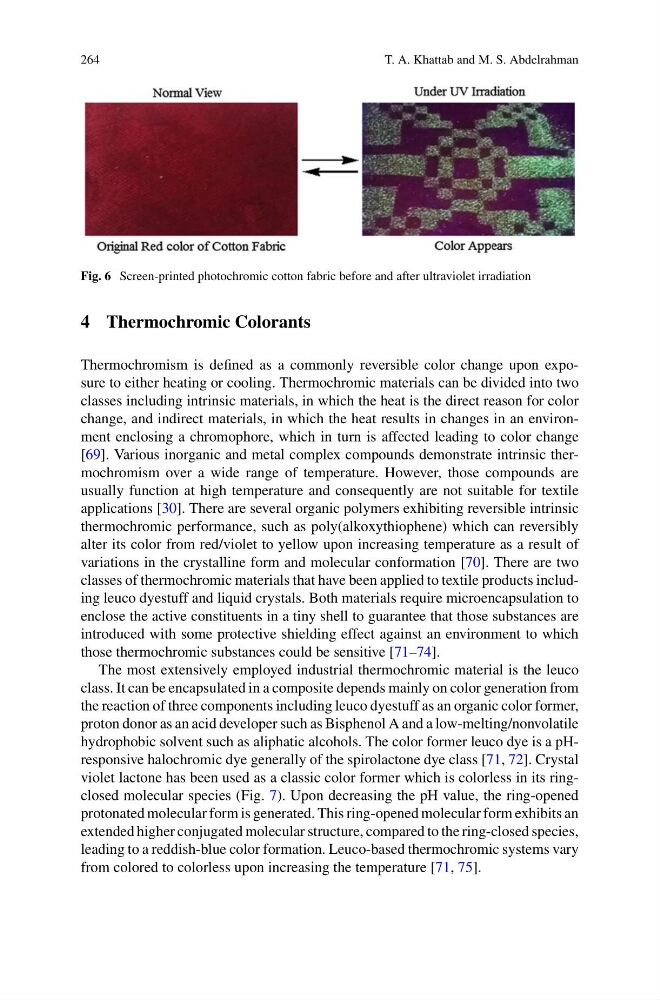
Fig. 6 Screen-printed photochromic cotton fabric before and after ultraviolet irradiation
4 Thermochromic Colorants
Thermochromism is defined as a commonly reversible color change upon exposure to either heating or cooling. Thermochromic materials can be divided into two
classes including intrinsic materials, in which the heat is the direct reason for color
change, and indirect materials, in which the heat results in changes in an environment enclosing a chromophore, which in turn is affected leading to color change
[69]. Various inorganic and metal complex compounds demonstrate intrinsic thermochromism over a wide range of temperature. However, those compounds are
usually function at high temperature and consequently are not suitable for textile
applications [30]. There are several organic polymers exhibiting reversible intrinsic
thermochromic performance, such as poly(alkoxythiophene) which can reversibly
alter its color from red/violet to yellow upon increasing temperature as a result of
variations in the crystalline form and molecular conformation [70]. There are two
classes of thermochromic materials that have been applied to textile products including leuco dyestuff and liquid crystals. Both materials require microencapsulation to
enclose the active constituents in a tiny shell to guarantee that those substances are
introduced with some protective shielding effect against an environment to which
those thermochromic substances could be sensitive [71–74].
The most extensively employed industrial thermochromic material is the leuco
class. It can be encapsulated in a composite depends mainly on color generation from
the reaction of three components including leuco dyestuff as an organic color former,
proton donor as an acid developer such as Bisphenol A and a low-melting/nonvolatile
hydrophobic solvent such as aliphatic alcohols. The color former leuco dye is a pHresponsive halochromic dye generally of the spirolactone dye class [71, 72]. Crystal
violet lactone has been used as a classic color former which is colorless in its ringclosed molecular species (Fig. 7). Upon decreasing the pH value, the ring-opened
protonated molecular form is generated. This ring-opened molecular form exhibits an
extended higher conjugated molecular structure, compared to the ring-closed species,
leading to a reddish-blue color formation. Leuco-based thermochromic systems vary
from colored to colorless upon increasing the temperature [71, 75].
T. A. Khattab and M. S. Abdelrahman
Fig. 6 Screen-printed photochromic cotton fabric before and after ultraviolet irradiation
4 Thermochromic Colorants
Thermochromism is defined as a commonly reversible color change upon exposure to either heating or cooling. Thermochromic materials can be divided into two
classes including intrinsic materials, in which the heat is the direct reason for color
change, and indirect materials, in which the heat results in changes in an environment enclosing a chromophore, which in turn is affected leading to color change
[69]. Various inorganic and metal complex compounds demonstrate intrinsic thermochromism over a wide range of temperature. However, those compounds are
usually function at high temperature and consequently are not suitable for textile
applications [30]. There are several organic polymers exhibiting reversible intrinsic
thermochromic performance, such as poly(alkoxythiophene) which can reversibly
alter its color from red/violet to yellow upon increasing temperature as a result of
variations in the crystalline form and molecular conformation [70]. There are two
classes of thermochromic materials that have been applied to textile products including leuco dyestuff and liquid crystals. Both materials require microencapsulation to
enclose the active constituents in a tiny shell to guarantee that those substances are
introduced with some protective shielding effect against an environment to which
those thermochromic substances could be sensitive [71–74].
The most extensively employed industrial thermochromic material is the leuco
class. It can be encapsulated in a composite depends mainly on color generation from
the reaction of three components including leuco dyestuff as an organic color former,
proton donor as an acid developer such as Bisphenol A and a low-melting/nonvolatile
hydrophobic solvent such as aliphatic alcohols. The color former leuco dye is a pHresponsive halochromic dye generally of the spirolactone dye class [71, 72]. Crystal
violet lactone has been used as a classic color former which is colorless in its ringclosed molecular species (Fig. 7). Upon decreasing the pH value, the ring-opened
protonated molecular form is generated. This ring-opened molecular form exhibits an
extended higher conjugated molecular structure, compared to the ring-closed species,
leading to a reddish-blue color formation. Leuco-based thermochromic systems vary
from colored to colorless upon increasing the temperature [71, 75].