

Surface Modification of Textiles with Nanomaterials …
19
Flame retardancy is also one of the promising applications of surface modified
textiles. Active research on this aspect is going on to find an active material that
could withstand higher temperature and find a suitable technique to impregnate such
a material onto the cotton textile. In this aspect, Bentis et al. [95] investigated the
different ionic liquids (ILs) modified textile surface through sol-gel synthesis and
pad-dry process. The sol-gel synthesis of organosilanes based ILs were deposited
by means of padding method onto the cotton surface. From the obtained results, it
was noted that incorporation of ILs onto cotton fabrics enhanced its flame-retardant
properties and thermal stability without affecting its mechanical properties when
compared to control fabric [95].
3.3.3 Spray Pyrolysis
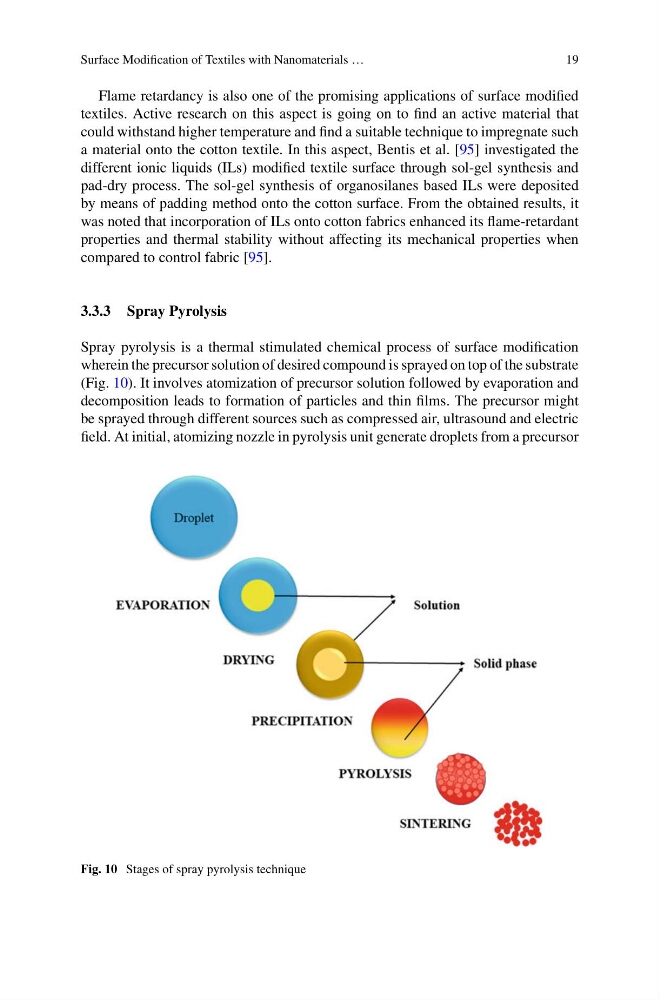
Spray pyrolysis is a thermal stimulated chemical process of surface modification
wherein the precursor solution of desired compound is sprayed on top of the substrate
(Fig. 10). It involves atomization of precursor solution followed by evaporation and
decomposition leads to formation of particles and thin films. The precursor might
be sprayed through different sources such as compressed air, ultrasound and electric
field. At initial, atomizing nozzle in pyrolysis unit generate droplets from a precursor
Fig. 10 Stages of spray pyrolysis technique
19
Flame retardancy is also one of the promising applications of surface modified
textiles. Active research on this aspect is going on to find an active material that
could withstand higher temperature and find a suitable technique to impregnate such
a material onto the cotton textile. In this aspect, Bentis et al. [95] investigated the
different ionic liquids (ILs) modified textile surface through sol-gel synthesis and
pad-dry process. The sol-gel synthesis of organosilanes based ILs were deposited
by means of padding method onto the cotton surface. From the obtained results, it
was noted that incorporation of ILs onto cotton fabrics enhanced its flame-retardant
properties and thermal stability without affecting its mechanical properties when
compared to control fabric [95].
3.3.3 Spray Pyrolysis
Spray pyrolysis is a thermal stimulated chemical process of surface modification
wherein the precursor solution of desired compound is sprayed on top of the substrate
(Fig. 10). It involves atomization of precursor solution followed by evaporation and
decomposition leads to formation of particles and thin films. The precursor might
be sprayed through different sources such as compressed air, ultrasound and electric
field. At initial, atomizing nozzle in pyrolysis unit generate droplets from a precursor
Fig. 10 Stages of spray pyrolysis technique