

Self-cleaning Finishes for Functional and Value …
221
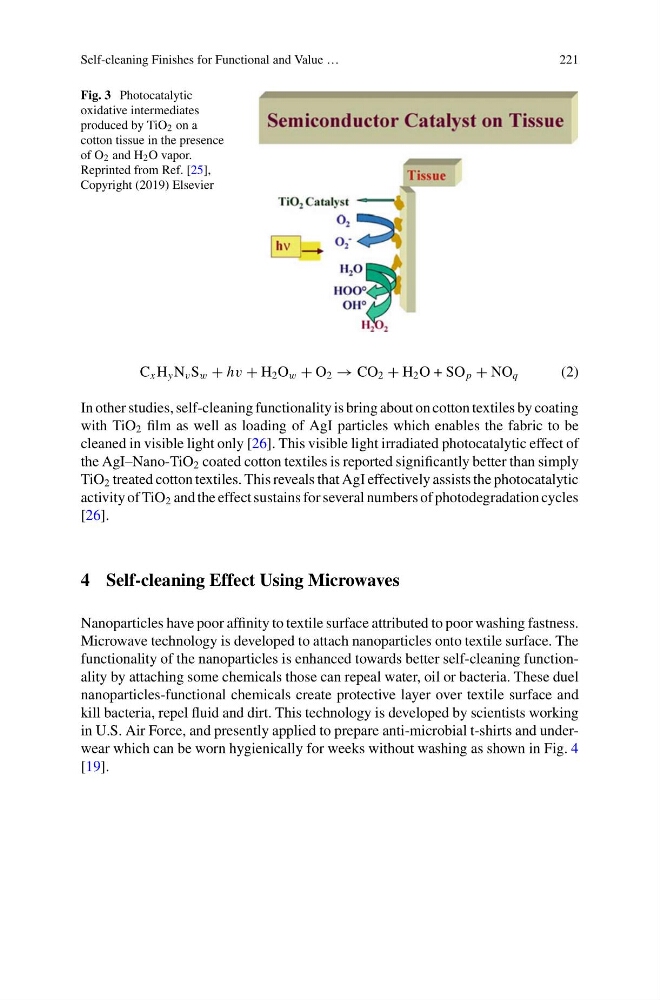
Fig. 3 Photocatalytic
oxidative intermediates
produced by TiO 2 on a
cotton tissue in the presence
of O 2 and H 2 O vapor.
Reprinted from Ref. [25],
Copyright (2019) Elsevier
C x H y N v S w + hv + H 2 O w + O 2 → CO 2 + H 2 O + SO p + NO q
(2)
In other studies, self-cleaning functionality is bring about on cotton textiles by coating
with TiO 2 film as well as loading of AgI particles which enables the fabric to be
cleaned in visible light only [26]. This visible light irradiated photocatalytic effect of
the AgI–Nano-TiO 2 coated cotton textiles is reported significantly better than simply
TiO 2 treated cotton textiles. This reveals that AgI effectively assists the photocatalytic
activity of TiO 2 and the effect sustains for several numbers of photodegradation cycles
[26].
4 Self-cleaning Effect Using Microwaves
Nanoparticles have poor affinity to textile surface attributed to poor washing fastness.
Microwave technology is developed to attach nanoparticles onto textile surface. The
functionality of the nanoparticles is enhanced towards better self-cleaning functionality by attaching some chemicals those can repeal water, oil or bacteria. These duel
nanoparticles-functional chemicals create protective layer over textile surface and
kill bacteria, repel fluid and dirt. This technology is developed by scientists working
in U.S. Air Force, and presently applied to prepare anti-microbial t-shirts and underwear which can be worn hygienically for weeks without washing as shown in Fig. 4
[19].
221
Fig. 3 Photocatalytic
oxidative intermediates
produced by TiO 2 on a
cotton tissue in the presence
of O 2 and H 2 O vapor.
Reprinted from Ref. [25],
Copyright (2019) Elsevier
C x H y N v S w + hv + H 2 O w + O 2 → CO 2 + H 2 O + SO p + NO q
(2)
In other studies, self-cleaning functionality is bring about on cotton textiles by coating
with TiO 2 film as well as loading of AgI particles which enables the fabric to be
cleaned in visible light only [26]. This visible light irradiated photocatalytic effect of
the AgI–Nano-TiO 2 coated cotton textiles is reported significantly better than simply
TiO 2 treated cotton textiles. This reveals that AgI effectively assists the photocatalytic
activity of TiO 2 and the effect sustains for several numbers of photodegradation cycles
[26].
4 Self-cleaning Effect Using Microwaves
Nanoparticles have poor affinity to textile surface attributed to poor washing fastness.
Microwave technology is developed to attach nanoparticles onto textile surface. The
functionality of the nanoparticles is enhanced towards better self-cleaning functionality by attaching some chemicals those can repeal water, oil or bacteria. These duel
nanoparticles-functional chemicals create protective layer over textile surface and
kill bacteria, repel fluid and dirt. This technology is developed by scientists working
in U.S. Air Force, and presently applied to prepare anti-microbial t-shirts and underwear which can be worn hygienically for weeks without washing as shown in Fig. 4
[19].