

220
S. Maity et al.
3 Photo-Catalytic Self-cleaning Effect
Unlike hydrophobic surfaces which are based on rolling over of water droplets to
clean the adhering dirt from the surface, hydrophilic coatings of a photo-catalyst
chemically break down the dirt/foreign molecules in the exposure of sunlight. This
is the photocatalytic self-cleaning effect. Titanium dioxide (TiO 2 ) and zinc oxide
(ZnO) nano particles are commonly coated over textile surface which are acting as
photocatalysts. The thickness of the coating is typically in the range of 20 nm. When
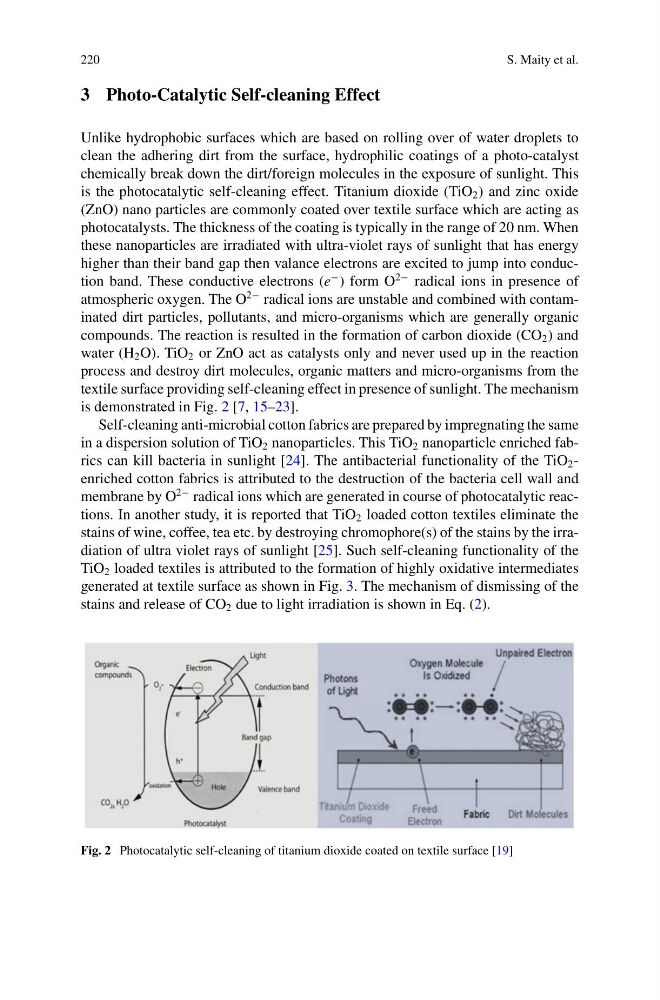
these nanoparticles are irradiated with ultra-violet rays of sunlight that has energy
higher than their band gap then valance electrons are excited to jump into conduction band. These conductive electrons (e
− ) form O
2− radical ions in presence of
atmospheric oxygen. The O
2− radical ions are unstable and combined with contaminated dirt particles, pollutants, and micro-organisms which are generally organic
compounds. The reaction is resulted in the formation of carbon dioxide (CO 2 ) and
water (H 2 O). TiO 2 or ZnO act as catalysts only and never used up in the reaction
process and destroy dirt molecules, organic matters and micro-organisms from the
textile surface providing self-cleaning effect in presence of sunlight. The mechanism
is demonstrated in Fig. 2 [7, 15–23].
Self-cleaning anti-microbial cotton fabrics are prepared by impregnating the same
in a dispersion solution of TiO 2 nanoparticles. This TiO 2 nanoparticle enriched fabrics can kill bacteria in sunlight [24]. The antibacterial functionality of the TiO 2 -
enriched cotton fabrics is attributed to the destruction of the bacteria cell wall and
membrane by O
2− radical ions which are generated in course of photocatalytic reactions. In another study, it is reported that TiO 2 loaded cotton textiles eliminate the
stains of wine, coffee, tea etc. by destroying chromophore(s) of the stains by the irradiation of ultra violet rays of sunlight [25]. Such self-cleaning functionality of the
TiO 2 loaded textiles is attributed to the formation of highly oxidative intermediates
generated at textile surface as shown in Fig. 3. The mechanism of dismissing of the
stains and release of CO 2 due to light irradiation is shown in Eq. (2).
Fig. 2 Photocatalytic self-cleaning of titanium dioxide coated on textile surface [19]
S. Maity et al.
3 Photo-Catalytic Self-cleaning Effect
Unlike hydrophobic surfaces which are based on rolling over of water droplets to
clean the adhering dirt from the surface, hydrophilic coatings of a photo-catalyst
chemically break down the dirt/foreign molecules in the exposure of sunlight. This
is the photocatalytic self-cleaning effect. Titanium dioxide (TiO 2 ) and zinc oxide
(ZnO) nano particles are commonly coated over textile surface which are acting as
photocatalysts. The thickness of the coating is typically in the range of 20 nm. When
these nanoparticles are irradiated with ultra-violet rays of sunlight that has energy
higher than their band gap then valance electrons are excited to jump into conduction band. These conductive electrons (e
− ) form O
2− radical ions in presence of
atmospheric oxygen. The O
2− radical ions are unstable and combined with contaminated dirt particles, pollutants, and micro-organisms which are generally organic
compounds. The reaction is resulted in the formation of carbon dioxide (CO 2 ) and
water (H 2 O). TiO 2 or ZnO act as catalysts only and never used up in the reaction
process and destroy dirt molecules, organic matters and micro-organisms from the
textile surface providing self-cleaning effect in presence of sunlight. The mechanism
is demonstrated in Fig. 2 [7, 15–23].
Self-cleaning anti-microbial cotton fabrics are prepared by impregnating the same
in a dispersion solution of TiO 2 nanoparticles. This TiO 2 nanoparticle enriched fabrics can kill bacteria in sunlight [24]. The antibacterial functionality of the TiO 2 -
enriched cotton fabrics is attributed to the destruction of the bacteria cell wall and
membrane by O
2− radical ions which are generated in course of photocatalytic reactions. In another study, it is reported that TiO 2 loaded cotton textiles eliminate the
stains of wine, coffee, tea etc. by destroying chromophore(s) of the stains by the irradiation of ultra violet rays of sunlight [25]. Such self-cleaning functionality of the
TiO 2 loaded textiles is attributed to the formation of highly oxidative intermediates
generated at textile surface as shown in Fig. 3. The mechanism of dismissing of the
stains and release of CO 2 due to light irradiation is shown in Eq. (2).
Fig. 2 Photocatalytic self-cleaning of titanium dioxide coated on textile surface [19]