

Surface Modification of Textiles with Nanomaterials …
15
PLD has been used to deposit superhydrophobic polytetrafluoroethylene (PTFE)
thin films. By analysing the surface morphology, it was identified that surface roughness has a major part in enhancing hydrophobicity [84]. A similar study if conducted
on textile substrates could offer several insights in the present-day demands related
to industries and smart homes. Yet another study on ZnO was conducted to develop
antifungal and UV protective clothing for biomedical applications [85]. Adhesion
can be achieved when the substrate is pre-treated with glow discharge [86].
3.2.1 Thermal Evaporation
This technique involves vaporization of the material by resistive heating. The vaporised material is subsequently deposited on the desired target as a thin film. This
process relies on the presence of a finite vapour pressure over the material surface
when the material is heated particularly under reduced pressure. Thermal energy is
supplied by passing a large current through a crucible/basket (a thermally tolerant
material such as tungsten) holding the source material. The resistivity of the crucible
generates sufficient heat such that the source material is vaporized as atom. The
vaporized source material traverses a low-pressure space, to become incident on the
textile, where it condenses to form a coating [87].
The source either sublimes (a solid to vapour transition), or evaporates (liquid
to vapour transition via intermediate melting from solid to liquid). The process is
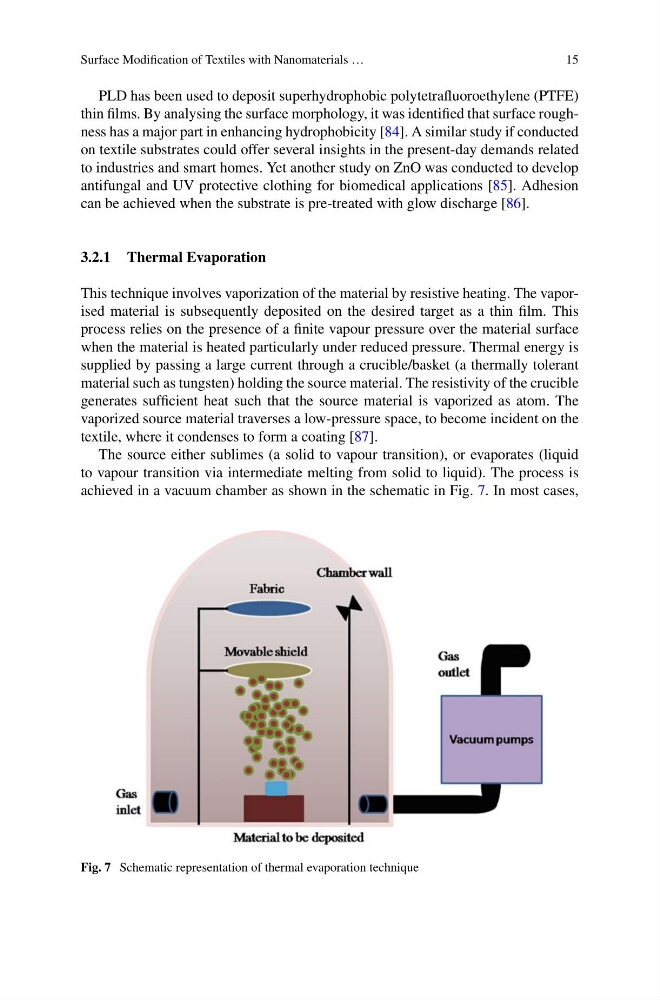
achieved in a vacuum chamber as shown in the schematic in Fig. 7. In most cases,
Fig. 7 Schematic representation of thermal evaporation technique
15
PLD has been used to deposit superhydrophobic polytetrafluoroethylene (PTFE)
thin films. By analysing the surface morphology, it was identified that surface roughness has a major part in enhancing hydrophobicity [84]. A similar study if conducted
on textile substrates could offer several insights in the present-day demands related
to industries and smart homes. Yet another study on ZnO was conducted to develop
antifungal and UV protective clothing for biomedical applications [85]. Adhesion
can be achieved when the substrate is pre-treated with glow discharge [86].
3.2.1 Thermal Evaporation
This technique involves vaporization of the material by resistive heating. The vaporised material is subsequently deposited on the desired target as a thin film. This
process relies on the presence of a finite vapour pressure over the material surface
when the material is heated particularly under reduced pressure. Thermal energy is
supplied by passing a large current through a crucible/basket (a thermally tolerant
material such as tungsten) holding the source material. The resistivity of the crucible
generates sufficient heat such that the source material is vaporized as atom. The
vaporized source material traverses a low-pressure space, to become incident on the
textile, where it condenses to form a coating [87].
The source either sublimes (a solid to vapour transition), or evaporates (liquid
to vapour transition via intermediate melting from solid to liquid). The process is
achieved in a vacuum chamber as shown in the schematic in Fig. 7. In most cases,
Fig. 7 Schematic representation of thermal evaporation technique