

14
D. K. Subbiah et al.
3.2 Pulsed LASER Deposition (PLD)
Pulsed Laser Deposition is yet another type of PVD technique, which uses electromagnetic radiation from a high intensity pulsed laser as its source. The high-power
pulsed laser source is used to vaporize the material that is to be coated onto the textile surface. In the case of solid substrates, sufficient thermal energy can be supplied
to the substrate in order to orient or align the surface deposited atoms as desired. This
additional energy is used in phonon creation, which in-turn helps in the arrangement
of atoms. The atoms that are vaporized tend to form a plasma plume that is then
focused onto the surface of the substrate. The entire procedure is preferably carried
out in vacuum. But in order to suit the desired application, the chamber can also be
filled with a suitable reactive species such as oxygen and nitrogen [82].
In the process of PLD, the incident laser on the source materials results in the
excitation of electrons in-turn lead to thermal energy, which favours the evaporation of
elements from the source materials and the ejected elements form the nanostructured
thin films of desired properties. Thin films deposited with this technique are observed
to have desired composition, structure, thickness, crystallinity, conductivity, optical
properties, mechanical properties, biocompatibility and roughness. Parameters of
deposition, like the target material, temperature, gas/vacuum pressure, target-sample
distance, laser wavelength, pulse width, pulse rate and radiation intensity can be
controlled and optimized to achieve the desired film properties [83]. PVD techniques
such as sputtering and PLD generally favour the deposition of seed layers which
can then be grown to produce different morphologies with the help of post thermal
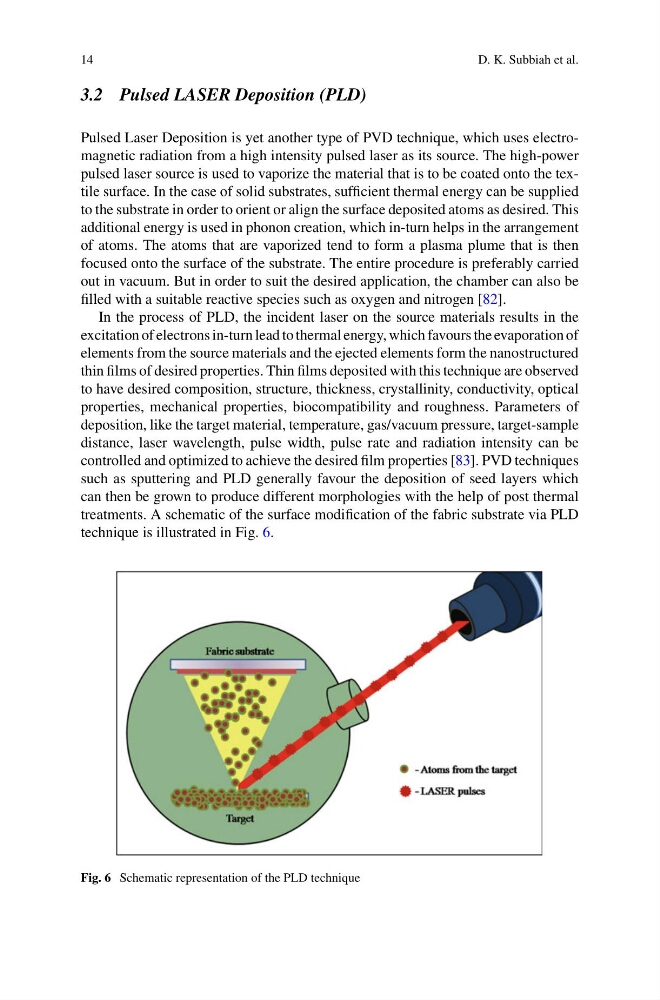
treatments. A schematic of the surface modification of the fabric substrate via PLD
technique is illustrated in Fig. 6.
Fig. 6 Schematic representation of the PLD technique
D. K. Subbiah et al.
3.2 Pulsed LASER Deposition (PLD)
Pulsed Laser Deposition is yet another type of PVD technique, which uses electromagnetic radiation from a high intensity pulsed laser as its source. The high-power
pulsed laser source is used to vaporize the material that is to be coated onto the textile surface. In the case of solid substrates, sufficient thermal energy can be supplied
to the substrate in order to orient or align the surface deposited atoms as desired. This
additional energy is used in phonon creation, which in-turn helps in the arrangement
of atoms. The atoms that are vaporized tend to form a plasma plume that is then
focused onto the surface of the substrate. The entire procedure is preferably carried
out in vacuum. But in order to suit the desired application, the chamber can also be
filled with a suitable reactive species such as oxygen and nitrogen [82].
In the process of PLD, the incident laser on the source materials results in the
excitation of electrons in-turn lead to thermal energy, which favours the evaporation of
elements from the source materials and the ejected elements form the nanostructured
thin films of desired properties. Thin films deposited with this technique are observed
to have desired composition, structure, thickness, crystallinity, conductivity, optical
properties, mechanical properties, biocompatibility and roughness. Parameters of
deposition, like the target material, temperature, gas/vacuum pressure, target-sample
distance, laser wavelength, pulse width, pulse rate and radiation intensity can be
controlled and optimized to achieve the desired film properties [83]. PVD techniques
such as sputtering and PLD generally favour the deposition of seed layers which
can then be grown to produce different morphologies with the help of post thermal
treatments. A schematic of the surface modification of the fabric substrate via PLD
technique is illustrated in Fig. 6.
Fig. 6 Schematic representation of the PLD technique