

Fabrication of Superhydrophobic Textiles
201
As the lotus leaf has self-cleaning property but, the self-cleaning does not happen
if the water droplet slides on the rough surface of lotus leaf but arises only when the
water droplet rolls off as shown in Fig. 3e. During the rolling off the dirt clings to the
dropping water drops making the surface clean. The water droplet could be rolled off
at the surface of leaf if the nano-scaled structures has enough softness to avoid the
droplet’s puncturing, sufficient strength to hold the water, and enough association
to impulse the drop’s rolling [17]. The air trapped in grooves and wax needles at
nano-structures further reduce the chances of water droplet to stick on it, increasing
the water contact angle making the surface superhydrophobic according to the real
time conditions of Cassie-Baxter model.
2.2 Superhydrophibic Textiles
The textiles with water contact angle of more than 150° and contact angle hysteresis
lower than 10° have been developed commercially for different indoor and outdoor
activities. In past the main emphasis was on lowering the surface energy by coating
some repellent agent. But, now the researchers have been mimicking the nature and
creation of hierarchical nanoroughness at microfibrous surface is mainly emphasized.
Thus, different inorganic metal and metal oxide nanoparticles have been coated along
with surface energy lowering chemicals to make superhydrophobic textiles. The
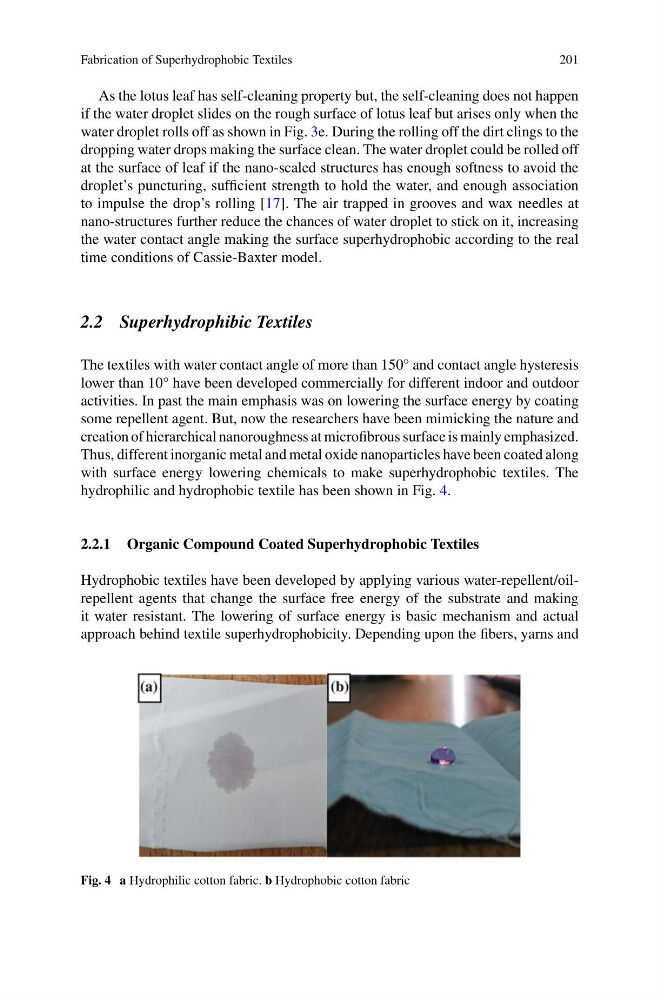
hydrophilic and hydrophobic textile has been shown in Fig. 4.
2.2.1 Organic Compound Coated Superhydrophobic Textiles
Hydrophobic textiles have been developed by applying various water-repellent/oilrepellent agents that change the surface free energy of the substrate and making
it water resistant. The lowering of surface energy is basic mechanism and actual
approach behind textile superhydrophobicity. Depending upon the fibers, yarns and
Fig. 4 a Hydrophilic cotton fabric. b Hydrophobic cotton fabric
201
As the lotus leaf has self-cleaning property but, the self-cleaning does not happen
if the water droplet slides on the rough surface of lotus leaf but arises only when the
water droplet rolls off as shown in Fig. 3e. During the rolling off the dirt clings to the
dropping water drops making the surface clean. The water droplet could be rolled off
at the surface of leaf if the nano-scaled structures has enough softness to avoid the
droplet’s puncturing, sufficient strength to hold the water, and enough association
to impulse the drop’s rolling [17]. The air trapped in grooves and wax needles at
nano-structures further reduce the chances of water droplet to stick on it, increasing
the water contact angle making the surface superhydrophobic according to the real
time conditions of Cassie-Baxter model.
2.2 Superhydrophibic Textiles
The textiles with water contact angle of more than 150° and contact angle hysteresis
lower than 10° have been developed commercially for different indoor and outdoor
activities. In past the main emphasis was on lowering the surface energy by coating
some repellent agent. But, now the researchers have been mimicking the nature and
creation of hierarchical nanoroughness at microfibrous surface is mainly emphasized.
Thus, different inorganic metal and metal oxide nanoparticles have been coated along
with surface energy lowering chemicals to make superhydrophobic textiles. The
hydrophilic and hydrophobic textile has been shown in Fig. 4.
2.2.1 Organic Compound Coated Superhydrophobic Textiles
Hydrophobic textiles have been developed by applying various water-repellent/oilrepellent agents that change the surface free energy of the substrate and making
it water resistant. The lowering of surface energy is basic mechanism and actual
approach behind textile superhydrophobicity. Depending upon the fibers, yarns and
Fig. 4 a Hydrophilic cotton fabric. b Hydrophobic cotton fabric