

200
M. Ashraf and S. Riaz
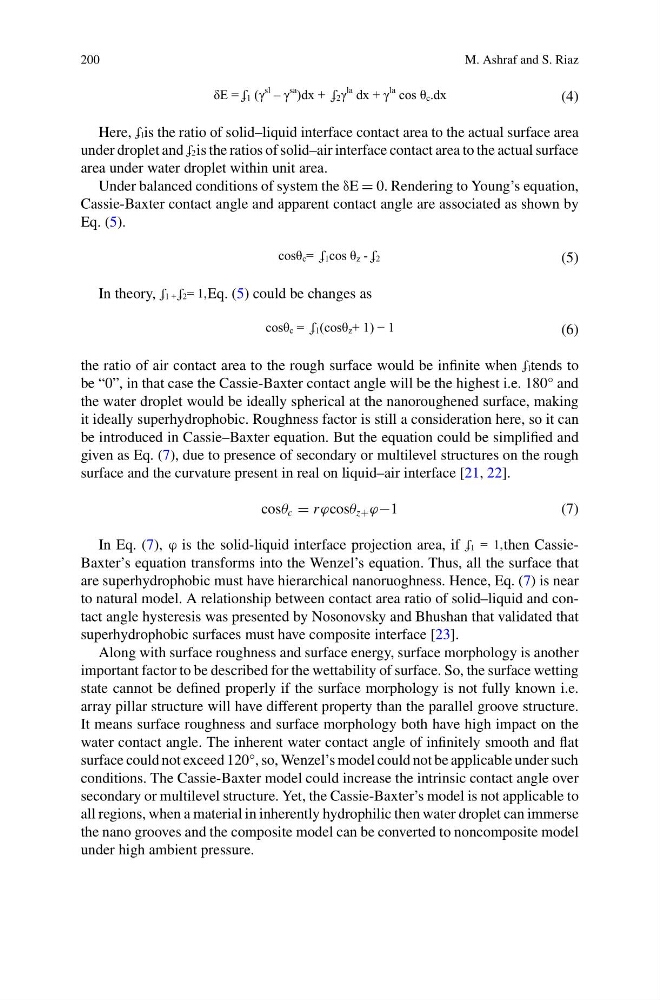
δE = ʄ 1 (γ
sl – γ
sa )dx + ʄ 2 γ
la dx + γ
la cos θ c .dx
(4)
Here, is the ratio of solid–liquid interface contact area to the actual surface area
under droplet and is the ratios of solid–air interface contact area to the actual surface
area under water droplet within unit area.
Under balanced conditions of system the δE = 0. Rendering to Young’s equation,
Cassie-Baxter contact angle and apparent contact angle are associated as shown by
Eq. (5).
cosθ c = ʄ 1 cos θ z - ʄ 2
(5)
In theory,
Eq. (5) could be changes as
cosθ c = ʄ 1 cosθ z + 1) − 1
(
(6)
the ratio of air contact area to the rough surface would be infinite when tends to
be “0”, in that case the Cassie-Baxter contact angle will be the highest i.e. 180° and
the water droplet would be ideally spherical at the nanoroughened surface, making
it ideally superhydrophobic. Roughness factor is still a consideration here, so it can
be introduced in Cassie–Baxter equation. But the equation could be simplified and
given as Eq. (7), due to presence of secondary or multilevel structures on the rough
surface and the curvature present in real on liquid–air interface [21, 22].
cosθ c = r ϕcosθ z+ ϕ−1
( 7 )
In Eq. (7), ϕ is the solid-liquid interface projection area, if
then CassieBaxter’s equation transforms into the Wenzel’s equation. Thus, all the surface that
are superhydrophobic must have hierarchical nanoruoghness. Hence, Eq. (7) is near
to natural model. A relationship between contact area ratio of solid–liquid and contact angle hysteresis was presented by Nosonovsky and Bhushan that validated that
superhydrophobic surfaces must have composite interface [23].
Along with surface roughness and surface energy, surface morphology is another
important factor to be described for the wettability of surface. So, the surface wetting
state cannot be defined properly if the surface morphology is not fully known i.e.
array pillar structure will have different property than the parallel groove structure.
It means surface roughness and surface morphology both have high impact on the
water contact angle. The inherent water contact angle of infinitely smooth and flat
surface could not exceed 120°, so, Wenzel’s model could not be applicable under such
conditions. The Cassie-Baxter model could increase the intrinsic contact angle over
secondary or multilevel structure. Yet, the Cassie-Baxter’s model is not applicable to
all regions, when a material in inherently hydrophilic then water droplet can immerse
the nano grooves and the composite model can be converted to noncomposite model
under high ambient pressure.
M. Ashraf and S. Riaz
δE = ʄ 1 (γ
sl – γ
sa )dx + ʄ 2 γ
la dx + γ
la cos θ c .dx
(4)
Here, is the ratio of solid–liquid interface contact area to the actual surface area
under droplet and is the ratios of solid–air interface contact area to the actual surface
area under water droplet within unit area.
Under balanced conditions of system the δE = 0. Rendering to Young’s equation,
Cassie-Baxter contact angle and apparent contact angle are associated as shown by
Eq. (5).
cosθ c = ʄ 1 cos θ z - ʄ 2
(5)
In theory,
Eq. (5) could be changes as
cosθ c = ʄ 1 cosθ z + 1) − 1
(
(6)
the ratio of air contact area to the rough surface would be infinite when tends to
be “0”, in that case the Cassie-Baxter contact angle will be the highest i.e. 180° and
the water droplet would be ideally spherical at the nanoroughened surface, making
it ideally superhydrophobic. Roughness factor is still a consideration here, so it can
be introduced in Cassie–Baxter equation. But the equation could be simplified and
given as Eq. (7), due to presence of secondary or multilevel structures on the rough
surface and the curvature present in real on liquid–air interface [21, 22].
cosθ c = r ϕcosθ z+ ϕ−1
( 7 )
In Eq. (7), ϕ is the solid-liquid interface projection area, if
then CassieBaxter’s equation transforms into the Wenzel’s equation. Thus, all the surface that
are superhydrophobic must have hierarchical nanoruoghness. Hence, Eq. (7) is near
to natural model. A relationship between contact area ratio of solid–liquid and contact angle hysteresis was presented by Nosonovsky and Bhushan that validated that
superhydrophobic surfaces must have composite interface [23].
Along with surface roughness and surface energy, surface morphology is another
important factor to be described for the wettability of surface. So, the surface wetting
state cannot be defined properly if the surface morphology is not fully known i.e.
array pillar structure will have different property than the parallel groove structure.
It means surface roughness and surface morphology both have high impact on the
water contact angle. The inherent water contact angle of infinitely smooth and flat
surface could not exceed 120°, so, Wenzel’s model could not be applicable under such
conditions. The Cassie-Baxter model could increase the intrinsic contact angle over
secondary or multilevel structure. Yet, the Cassie-Baxter’s model is not applicable to
all regions, when a material in inherently hydrophilic then water droplet can immerse
the nano grooves and the composite model can be converted to noncomposite model
under high ambient pressure.