

198
M. Ashraf and S. Riaz
showing the hydrophilic nature of the surface. If γ
sa
−γ
sl
> 0 then the 0
◦
< θ z < 90
◦
still the surface is hydrophilic. But when the γ
sa
−γ
sl
< 0 then the 90
◦
< θ z < 180
◦
would exhibit the hydrophobic nature and with ideally superhydrophobic nature of
the solid surface with γ
sa
−γ
sl
= −γ
la .
This ideal young’s model could be perfect only for infinitely smooth and flat surfaces where the influence of surface structure of hydrophobicity is totally neglected
and the chemical composition of the surface is only consideration along with some
environmental effect. There were some limitations of this model because a textiles
treated even with C9 perfluorocarbon to attain lowest possible surface free energy
(5–10 dyne/cm) exhibited a maximum contact angle of 120° [16] but, there were
some plant leaves that exhibited water contact angle greater than 160° thus, nanoroughness of the surface was also another consideration along with lower surface free
energy that should be taken into account [17, 18] Because the water contact angle
calculated through Young’s equation was different from the actual contact angle of
the surface due to the presence of surface roughness therefore, surface roughness
was considered for the actual contact angle of the same superhydrophobic surface.
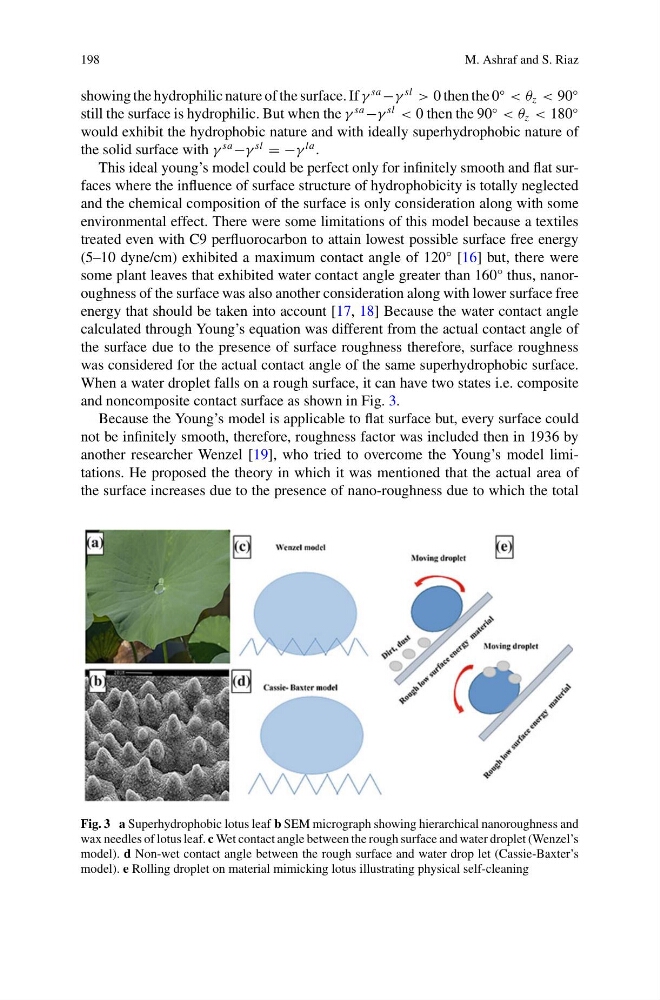
When a water droplet falls on a rough surface, it can have two states i.e. composite
and noncomposite contact surface as shown in Fig. 3.
Because the Young’s model is applicable to flat surface but, every surface could
not be infinitely smooth, therefore, roughness factor was included then in 1936 by
another researcher Wenzel [19], who tried to overcome the Young’s model limitations. He proposed the theory in which it was mentioned that the actual area of
the surface increases due to the presence of nano-roughness due to which the total
Fig. 3 a Superhydrophobic lotus leaf b SEM micrograph showing hierarchical nanoroughness and
wax needles of lotus leaf. c Wet contact angle between the rough surface and water droplet (Wenzel’s
model). d Non-wet contact angle between the rough surface and water drop let (Cassie-Baxter’s
model). e Rolling droplet on material mimicking lotus illustrating physical self-cleaning
M. Ashraf and S. Riaz
showing the hydrophilic nature of the surface. If γ
sa
−γ
sl
> 0 then the 0
◦
< θ z < 90
◦
still the surface is hydrophilic. But when the γ
sa
−γ
sl
< 0 then the 90
◦
< θ z < 180
◦
would exhibit the hydrophobic nature and with ideally superhydrophobic nature of
the solid surface with γ
sa
−γ
sl
= −γ
la .
This ideal young’s model could be perfect only for infinitely smooth and flat surfaces where the influence of surface structure of hydrophobicity is totally neglected
and the chemical composition of the surface is only consideration along with some
environmental effect. There were some limitations of this model because a textiles
treated even with C9 perfluorocarbon to attain lowest possible surface free energy
(5–10 dyne/cm) exhibited a maximum contact angle of 120° [16] but, there were
some plant leaves that exhibited water contact angle greater than 160° thus, nanoroughness of the surface was also another consideration along with lower surface free
energy that should be taken into account [17, 18] Because the water contact angle
calculated through Young’s equation was different from the actual contact angle of
the surface due to the presence of surface roughness therefore, surface roughness
was considered for the actual contact angle of the same superhydrophobic surface.
When a water droplet falls on a rough surface, it can have two states i.e. composite
and noncomposite contact surface as shown in Fig. 3.
Because the Young’s model is applicable to flat surface but, every surface could
not be infinitely smooth, therefore, roughness factor was included then in 1936 by
another researcher Wenzel [19], who tried to overcome the Young’s model limitations. He proposed the theory in which it was mentioned that the actual area of
the surface increases due to the presence of nano-roughness due to which the total
Fig. 3 a Superhydrophobic lotus leaf b SEM micrograph showing hierarchical nanoroughness and
wax needles of lotus leaf. c Wet contact angle between the rough surface and water droplet (Wenzel’s
model). d Non-wet contact angle between the rough surface and water drop let (Cassie-Baxter’s
model). e Rolling droplet on material mimicking lotus illustrating physical self-cleaning