

Fabrication of Superhydrophobic Textiles
197
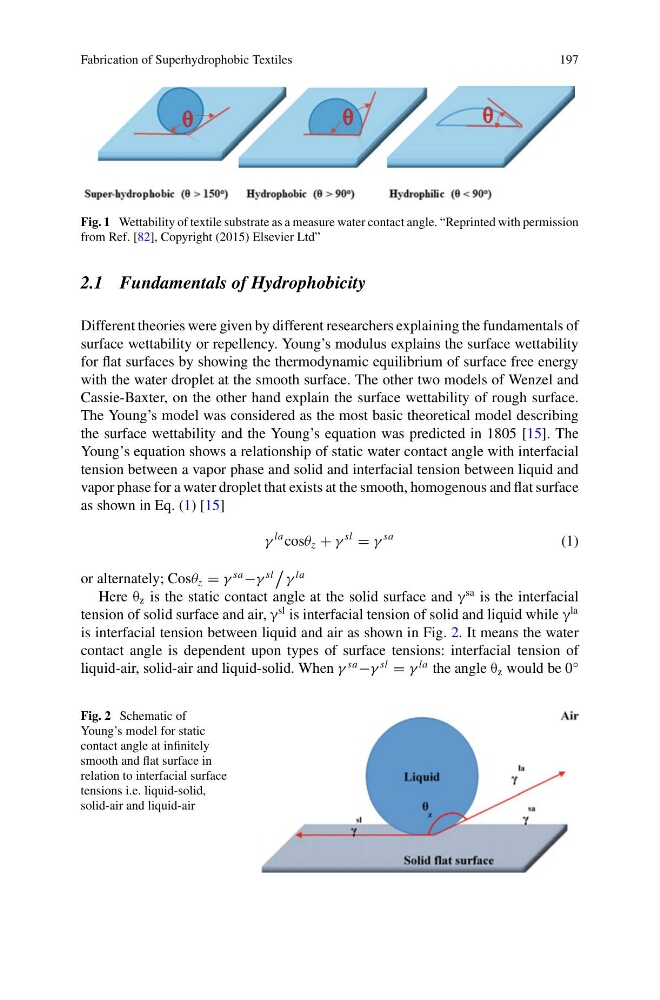
Fig. 1 Wettability of textile substrate as a measure water contact angle. “Reprinted with permission
from Ref. [82], Copyright (2015) Elsevier Ltd”
2.1 Fundamentals of Hydrophobicity
Different theories were given by different researchers explaining the fundamentals of
surface wettability or repellency. Young’s modulus explains the surface wettability
for flat surfaces by showing the thermodynamic equilibrium of surface free energy
with the water droplet at the smooth surface. The other two models of Wenzel and
Cassie-Baxter, on the other hand explain the surface wettability of rough surface.
The Young’s model was considered as the most basic theoretical model describing
the surface wettability and the Young’s equation was predicted in 1805 [15]. The
Young’s equation shows a relationship of static water contact angle with interfacial
tension between a vapor phase and solid and interfacial tension between liquid and
vapor phase for a water droplet that exists at the smooth, homogenous and flat surface
as shown in Eq. (1) [15]
γ
la cosθ z + γ
sl
= γ
sa
(1)
or alternately; Cosθ z = γ
sa
−γ
sl
γ
la
Here θ z is the static contact angle at the solid surface and γ
sa is the interfacial
tension of solid surface and air, γ
sl is interfacial tension of solid and liquid while γ
la
is interfacial tension between liquid and air as shown in Fig. 2. It means the water
contact angle is dependent upon types of surface tensions: interfacial tension of
liquid-air, solid-air and liquid-solid. When γ
sa
−γ
sl
= γ
la the angle θ z would be 0°
Fig. 2 Schematic of
Young’s model for static
contact angle at infinitely
smooth and flat surface in
relation to interfacial surface
tensions i.e. liquid-solid,
solid-air and liquid-air
197
Fig. 1 Wettability of textile substrate as a measure water contact angle. “Reprinted with permission
from Ref. [82], Copyright (2015) Elsevier Ltd”
2.1 Fundamentals of Hydrophobicity
Different theories were given by different researchers explaining the fundamentals of
surface wettability or repellency. Young’s modulus explains the surface wettability
for flat surfaces by showing the thermodynamic equilibrium of surface free energy
with the water droplet at the smooth surface. The other two models of Wenzel and
Cassie-Baxter, on the other hand explain the surface wettability of rough surface.
The Young’s model was considered as the most basic theoretical model describing
the surface wettability and the Young’s equation was predicted in 1805 [15]. The
Young’s equation shows a relationship of static water contact angle with interfacial
tension between a vapor phase and solid and interfacial tension between liquid and
vapor phase for a water droplet that exists at the smooth, homogenous and flat surface
as shown in Eq. (1) [15]
γ
la cosθ z + γ
sl
= γ
sa
(1)
or alternately; Cosθ z = γ
sa
−γ
sl
γ
la
Here θ z is the static contact angle at the solid surface and γ
sa is the interfacial
tension of solid surface and air, γ
sl is interfacial tension of solid and liquid while γ
la
is interfacial tension between liquid and air as shown in Fig. 2. It means the water
contact angle is dependent upon types of surface tensions: interfacial tension of
liquid-air, solid-air and liquid-solid. When γ
sa
−γ
sl
= γ
la the angle θ z would be 0°
Fig. 2 Schematic of
Young’s model for static
contact angle at infinitely
smooth and flat surface in
relation to interfacial surface
tensions i.e. liquid-solid,
solid-air and liquid-air