

12
D. K. Subbiah et al.
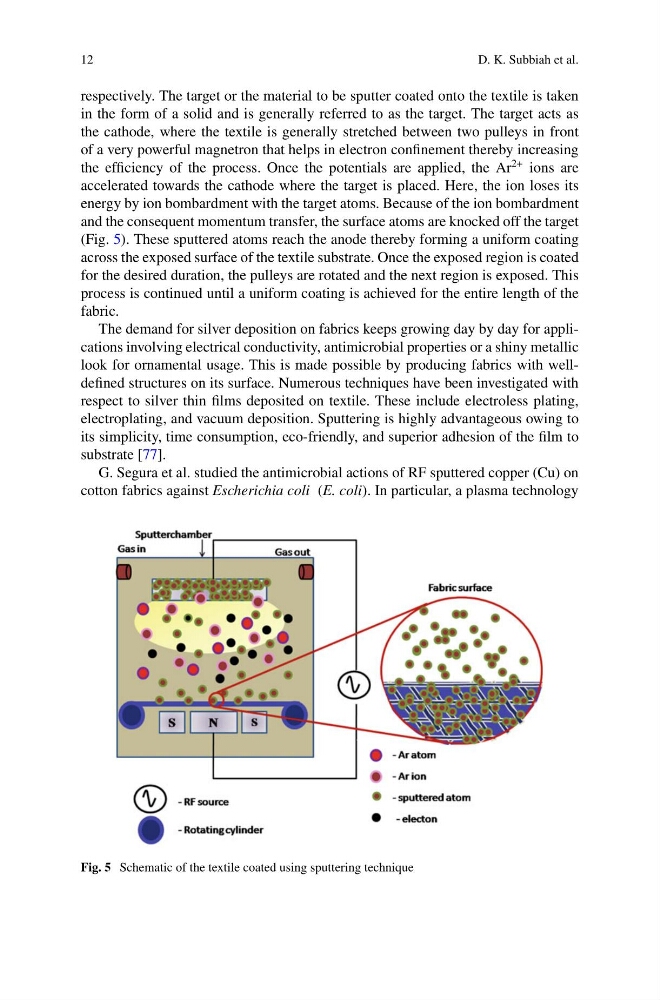
respectively. The target or the material to be sputter coated onto the textile is taken
in the form of a solid and is generally referred to as the target. The target acts as
the cathode, where the textile is generally stretched between two pulleys in front
of a very powerful magnetron that helps in electron confinement thereby increasing
the efficiency of the process. Once the potentials are applied, the Ar
2+ ions are
accelerated towards the cathode where the target is placed. Here, the ion loses its
energy by ion bombardment with the target atoms. Because of the ion bombardment
and the consequent momentum transfer, the surface atoms are knocked off the target
(Fig. 5). These sputtered atoms reach the anode thereby forming a uniform coating
across the exposed surface of the textile substrate. Once the exposed region is coated
for the desired duration, the pulleys are rotated and the next region is exposed. This
process is continued until a uniform coating is achieved for the entire length of the
fabric.
The demand for silver deposition on fabrics keeps growing day by day for applications involving electrical conductivity, antimicrobial properties or a shiny metallic
look for ornamental usage. This is made possible by producing fabrics with welldefined structures on its surface. Numerous techniques have been investigated with
respect to silver thin films deposited on textile. These include electroless plating,
electroplating, and vacuum deposition. Sputtering is highly advantageous owing to
its simplicity, time consumption, eco-friendly, and superior adhesion of the film to
substrate [77].
G. Segura et al. studied the antimicrobial actions of RF sputtered copper (Cu) on
cotton fabrics against Escherichia coli (E. coli). In particular, a plasma technology
Fig. 5 Schematic of the textile coated using sputtering technique
D. K. Subbiah et al.
respectively. The target or the material to be sputter coated onto the textile is taken
in the form of a solid and is generally referred to as the target. The target acts as
the cathode, where the textile is generally stretched between two pulleys in front
of a very powerful magnetron that helps in electron confinement thereby increasing
the efficiency of the process. Once the potentials are applied, the Ar
2+ ions are
accelerated towards the cathode where the target is placed. Here, the ion loses its
energy by ion bombardment with the target atoms. Because of the ion bombardment
and the consequent momentum transfer, the surface atoms are knocked off the target
(Fig. 5). These sputtered atoms reach the anode thereby forming a uniform coating
across the exposed surface of the textile substrate. Once the exposed region is coated
for the desired duration, the pulleys are rotated and the next region is exposed. This
process is continued until a uniform coating is achieved for the entire length of the
fabric.
The demand for silver deposition on fabrics keeps growing day by day for applications involving electrical conductivity, antimicrobial properties or a shiny metallic
look for ornamental usage. This is made possible by producing fabrics with welldefined structures on its surface. Numerous techniques have been investigated with
respect to silver thin films deposited on textile. These include electroless plating,
electroplating, and vacuum deposition. Sputtering is highly advantageous owing to
its simplicity, time consumption, eco-friendly, and superior adhesion of the film to
substrate [77].
G. Segura et al. studied the antimicrobial actions of RF sputtered copper (Cu) on
cotton fabrics against Escherichia coli (E. coli). In particular, a plasma technology
Fig. 5 Schematic of the textile coated using sputtering technique