

158
S. Riaz and M. Ashraf
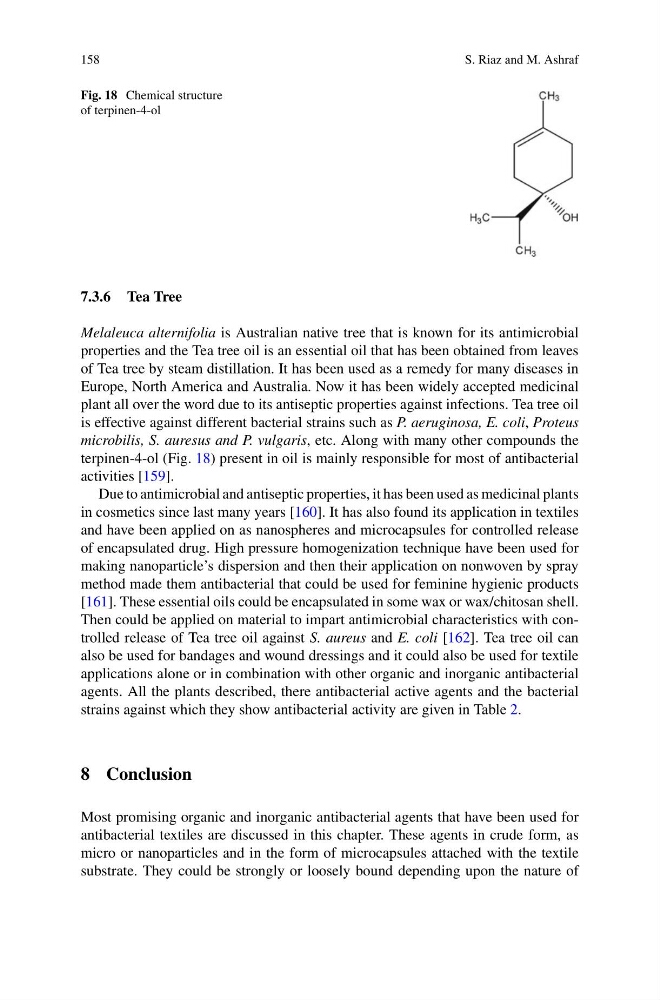
Fig. 18 Chemical structure
of terpinen-4-ol
7.3.6 Tea Tree
Melaleuca alternifolia is Australian native tree that is known for its antimicrobial
properties and the Tea tree oil is an essential oil that has been obtained from leaves
of Tea tree by steam distillation. It has been used as a remedy for many diseases in
Europe, North America and Australia. Now it has been widely accepted medicinal
plant all over the word due to its antiseptic properties against infections. Tea tree oil
is effective against different bacterial strains such as P. aeruginosa, E. coli, Proteus
microbilis, S. auresus and P. vulgaris, etc. Along with many other compounds the
terpinen-4-ol (Fig. 18) present in oil is mainly responsible for most of antibacterial
activities [159].
Due to antimicrobial and antiseptic properties, it has been used as medicinal plants
in cosmetics since last many years [160]. It has also found its application in textiles
and have been applied on as nanospheres and microcapsules for controlled release
of encapsulated drug. High pressure homogenization technique have been used for
making nanoparticle’s dispersion and then their application on nonwoven by spray
method made them antibacterial that could be used for feminine hygienic products
[161]. These essential oils could be encapsulated in some wax or wax/chitosan shell.
Then could be applied on material to impart antimicrobial characteristics with controlled release of Tea tree oil against S. aureus and E. coli [162]. Tea tree oil can
also be used for bandages and wound dressings and it could also be used for textile
applications alone or in combination with other organic and inorganic antibacterial
agents. All the plants described, there antibacterial active agents and the bacterial
strains against which they show antibacterial activity are given in Table 2.
8 Conclusion
Most promising organic and inorganic antibacterial agents that have been used for
antibacterial textiles are discussed in this chapter. These agents in crude form, as
micro or nanoparticles and in the form of microcapsules attached with the textile
substrate. They could be strongly or loosely bound depending upon the nature of
S. Riaz and M. Ashraf
Fig. 18 Chemical structure
of terpinen-4-ol
7.3.6 Tea Tree
Melaleuca alternifolia is Australian native tree that is known for its antimicrobial
properties and the Tea tree oil is an essential oil that has been obtained from leaves
of Tea tree by steam distillation. It has been used as a remedy for many diseases in
Europe, North America and Australia. Now it has been widely accepted medicinal
plant all over the word due to its antiseptic properties against infections. Tea tree oil
is effective against different bacterial strains such as P. aeruginosa, E. coli, Proteus
microbilis, S. auresus and P. vulgaris, etc. Along with many other compounds the
terpinen-4-ol (Fig. 18) present in oil is mainly responsible for most of antibacterial
activities [159].
Due to antimicrobial and antiseptic properties, it has been used as medicinal plants
in cosmetics since last many years [160]. It has also found its application in textiles
and have been applied on as nanospheres and microcapsules for controlled release
of encapsulated drug. High pressure homogenization technique have been used for
making nanoparticle’s dispersion and then their application on nonwoven by spray
method made them antibacterial that could be used for feminine hygienic products
[161]. These essential oils could be encapsulated in some wax or wax/chitosan shell.
Then could be applied on material to impart antimicrobial characteristics with controlled release of Tea tree oil against S. aureus and E. coli [162]. Tea tree oil can
also be used for bandages and wound dressings and it could also be used for textile
applications alone or in combination with other organic and inorganic antibacterial
agents. All the plants described, there antibacterial active agents and the bacterial
strains against which they show antibacterial activity are given in Table 2.
8 Conclusion
Most promising organic and inorganic antibacterial agents that have been used for
antibacterial textiles are discussed in this chapter. These agents in crude form, as
micro or nanoparticles and in the form of microcapsules attached with the textile
substrate. They could be strongly or loosely bound depending upon the nature of