

Recent Advances in Development of Antimicrobial Textiles
135
5.3 Microencapsulation Method
Functionalization of textiles by nanoparticle encapsulation is micropacking approach
to improve the properties as well as to impart the new characteristics in textile product
[27]. Nano/microcapsules can be used as phase change materials (PCMs) encapsulation, fire retardants, antimicrobial, fragrance finish, polychromic/thermochromics
etc. but here, only drug release (insect repellent, antibacterial, moisturizer, slimming
agents) and thermal comfort are stated. During encapsulation, tiny particles of solid,
liquid or gaseous components are entrapped as core material inside a shell material
[28]. Different active materials like drugs, enzymes, vitamins, pesticides, flavours,
skin softeners, PCM and catalysts have been successfully been encapsulated inside
nano balloons or nanocapsules made from a variety of polymeric and non-polymeric
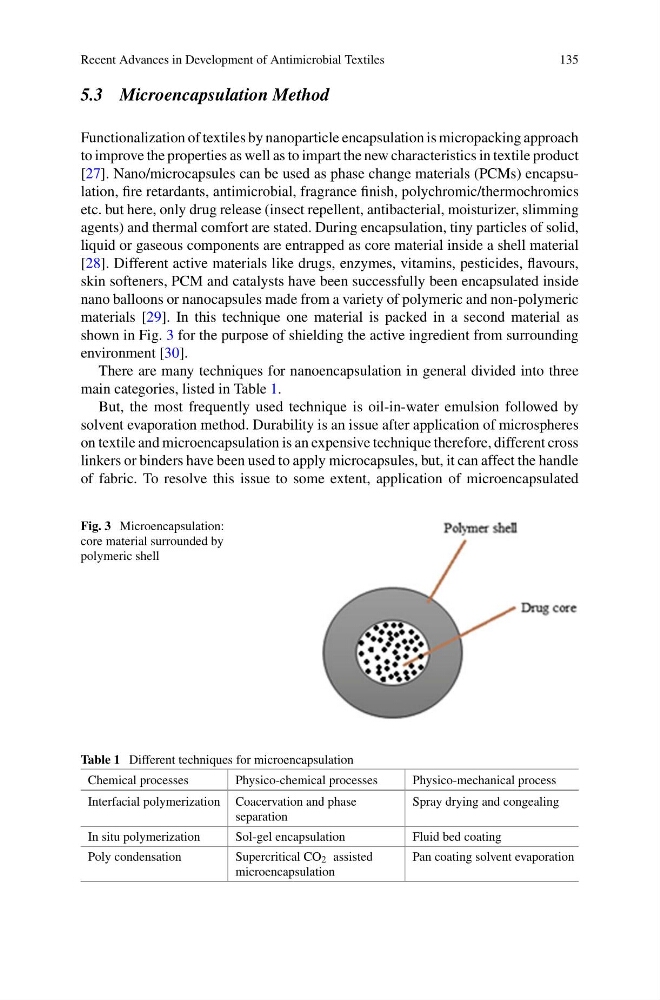
materials [29]. In this technique one material is packed in a second material as
shown in Fig. 3 for the purpose of shielding the active ingredient from surrounding
environment [30].
There are many techniques for nanoencapsulation in general divided into three
main categories, listed in Table 1.
But, the most frequently used technique is oil-in-water emulsion followed by
solvent evaporation method. Durability is an issue after application of microspheres
on textile and microencapsulation is an expensive technique therefore, different cross
linkers or binders have been used to apply microcapsules, but, it can affect the handle
of fabric. To resolve this issue to some extent, application of microencapsulated
Fig. 3 Microencapsulation:
core material surrounded by
polymeric shell
Table 1 Different techniques for microencapsulation
Chemical processes
Physico-chemical processes
Physico-mechanical process
Interfacial polymerization Coacervation and phase
separation
Spray drying and congealing
In situ polymerization
Sol-gel encapsulation
Fluid bed coating
Poly condensation
Supercritical CO 2 assisted
microencapsulation
Pan coating solvent evaporation
135
5.3 Microencapsulation Method
Functionalization of textiles by nanoparticle encapsulation is micropacking approach
to improve the properties as well as to impart the new characteristics in textile product
[27]. Nano/microcapsules can be used as phase change materials (PCMs) encapsulation, fire retardants, antimicrobial, fragrance finish, polychromic/thermochromics
etc. but here, only drug release (insect repellent, antibacterial, moisturizer, slimming
agents) and thermal comfort are stated. During encapsulation, tiny particles of solid,
liquid or gaseous components are entrapped as core material inside a shell material
[28]. Different active materials like drugs, enzymes, vitamins, pesticides, flavours,
skin softeners, PCM and catalysts have been successfully been encapsulated inside
nano balloons or nanocapsules made from a variety of polymeric and non-polymeric
materials [29]. In this technique one material is packed in a second material as
shown in Fig. 3 for the purpose of shielding the active ingredient from surrounding
environment [30].
There are many techniques for nanoencapsulation in general divided into three
main categories, listed in Table 1.
But, the most frequently used technique is oil-in-water emulsion followed by
solvent evaporation method. Durability is an issue after application of microspheres
on textile and microencapsulation is an expensive technique therefore, different cross
linkers or binders have been used to apply microcapsules, but, it can affect the handle
of fabric. To resolve this issue to some extent, application of microencapsulated
Fig. 3 Microencapsulation:
core material surrounded by
polymeric shell
Table 1 Different techniques for microencapsulation
Chemical processes
Physico-chemical processes
Physico-mechanical process
Interfacial polymerization Coacervation and phase
separation
Spray drying and congealing
In situ polymerization
Sol-gel encapsulation
Fluid bed coating
Poly condensation
Supercritical CO 2 assisted
microencapsulation
Pan coating solvent evaporation