

98
S. Adeel et al.
which are removed by desizing followed by a degumming process. Degumming can
be performed by
(i) soap
(ii) enzymes
(iii) water
(iv) alkali [121].
Clinical uses of silk-based biomaterials (SBBs) are being progressively used as
potential goods for biomedical textiles. Bio-compatibility, extra-ordinary mechanical
properties, controllable degradability and comfort processing nature, the silk-based
biomaterials (SBBs) have been explored for different medical materials such as heart
valves, arterial grafts, tendons, etc. [122]. To further expand the applications of SBBs
or to fulfill the demands of an increasing population, there is growing attentiveness for
bio-engineered silk fabrics. Furthermore, the biological properties of bio-engineered
silk-like thrombogenicity, biocompatibility, and antimicrobial behavior have been
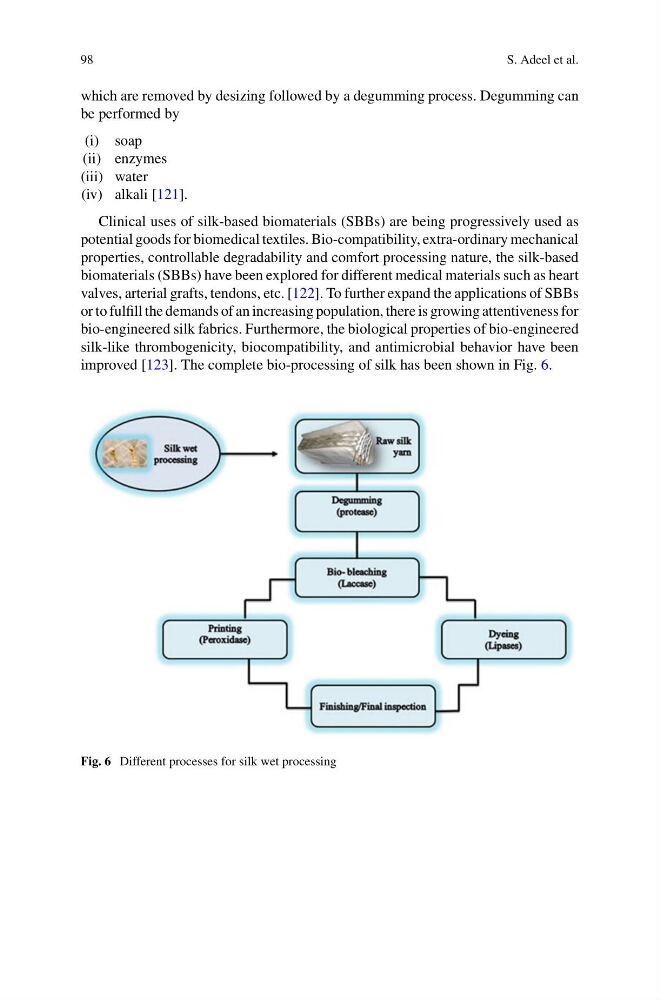
improved [123]. The complete bio-processing of silk has been shown in Fig. 6.
Fig. 6 Different processes for silk wet processing
S. Adeel et al.
which are removed by desizing followed by a degumming process. Degumming can
be performed by
(i) soap
(ii) enzymes
(iii) water
(iv) alkali [121].
Clinical uses of silk-based biomaterials (SBBs) are being progressively used as
potential goods for biomedical textiles. Bio-compatibility, extra-ordinary mechanical
properties, controllable degradability and comfort processing nature, the silk-based
biomaterials (SBBs) have been explored for different medical materials such as heart
valves, arterial grafts, tendons, etc. [122]. To further expand the applications of SBBs
or to fulfill the demands of an increasing population, there is growing attentiveness for
bio-engineered silk fabrics. Furthermore, the biological properties of bio-engineered
silk-like thrombogenicity, biocompatibility, and antimicrobial behavior have been
improved [123]. The complete bio-processing of silk has been shown in Fig. 6.
Fig. 6 Different processes for silk wet processing