

4.2 Particulate Silica Dispersion as Revealed by 3D-TEM
63
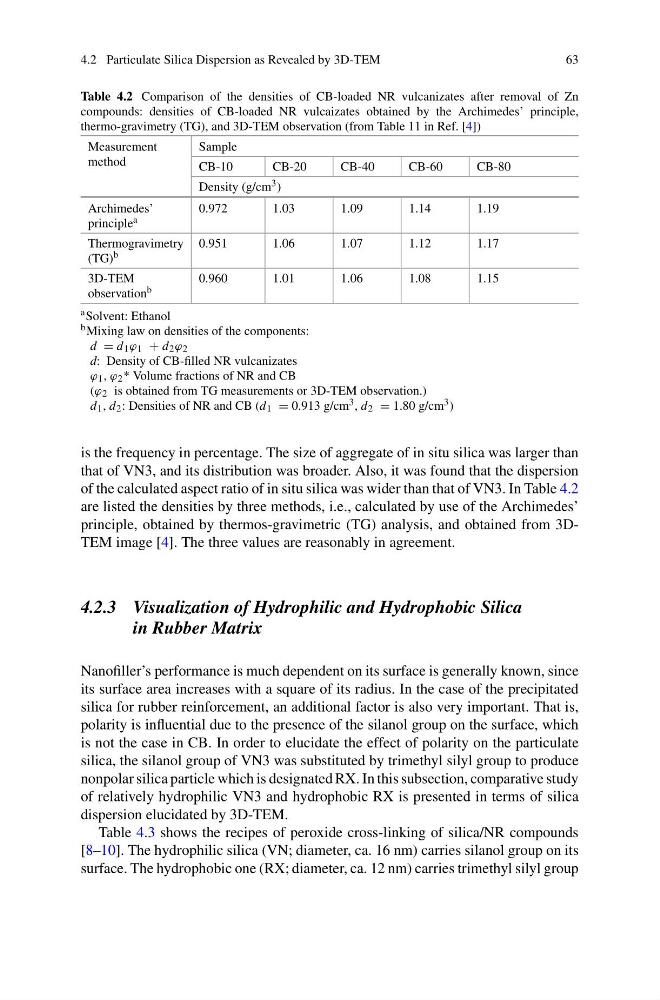
Table 4.2 Comparison of the densities of CB-loaded NR vulcanizates after removal of Zn
compounds: densities of CB-loaded NR vulcaizates obtained by the Archimedes’ principle,
thermo-gravimetry (TG), and 3D-TEM observation (from Table 11 in Ref. [4])
Measurement
method
Sample
CB-10
CB-20
CB-40
CB-60
CB-80
Density (g/cm 3 )
Archimedes’
principle a
0.972
1.03
1.09
1.14
1.19
Thermogravimetry
(TG) b
0.951
1.06
1.07
1.12
1.17
3D-TEM
observation b
0.960
1.01
1.06
1.08
1.15
a Solvent: Ethanol
b Mixing law on densities of the components:
d = d 1 ϕ 1 + d 2 ϕ 2
d: Density of CB-filled NR vulcanizates
ϕ 1 , ϕ 2 * Volume fractions of NR and CB
(ϕ 2 is obtained from TG measurements or 3D-TEM observation.)
d 1 , d 2 : Densities of NR and CB (d 1 = 0.913 g/cm 3 , d 2 = 1.80 g/cm 3 )
is the frequency in percentage. The size of aggregate of in situ silica was larger than
that of VN3, and its distribution was broader. Also, it was found that the dispersion
of the calculated aspect ratio of in situ silica was wider than that of VN3. In Table 4.2
are listed the densities by three methods, i.e., calculated by use of the Archimedes’
principle, obtained by thermos-gravimetric (TG) analysis, and obtained from 3DTEM image [4]. The three values are reasonably in agreement.
4.2.3 Visualization of Hydrophilic and Hydrophobic Silica
in Rubber Matrix
Nanofiller’s performance is much dependent on its surface is generally known, since
its surface area increases with a square of its radius. In the case of the precipitated
silica for rubber reinforcement, an additional factor is also very important. That is,
polarity is influential due to the presence of the silanol group on the surface, which
is not the case in CB. In order to elucidate the effect of polarity on the particulate
silica, the silanol group of VN3 was substituted by trimethyl silyl group to produce
nonpolar silica particle which is designated RX. In this subsection, comparative study
of relatively hydrophilic VN3 and hydrophobic RX is presented in terms of silica
dispersion elucidated by 3D-TEM.
Table 4.3 shows the recipes of peroxide cross-linking of silica/NR compounds
[8–10]. The hydrophilic silica (VN; diameter, ca. 16 nm) carries silanol group on its
surface. The hydrophobic one (RX; diameter, ca. 12 nm) carries trimethyl silyl group
63
Table 4.2 Comparison of the densities of CB-loaded NR vulcanizates after removal of Zn
compounds: densities of CB-loaded NR vulcaizates obtained by the Archimedes’ principle,
thermo-gravimetry (TG), and 3D-TEM observation (from Table 11 in Ref. [4])
Measurement
method
Sample
CB-10
CB-20
CB-40
CB-60
CB-80
Density (g/cm 3 )
Archimedes’
principle a
0.972
1.03
1.09
1.14
1.19
Thermogravimetry
(TG) b
0.951
1.06
1.07
1.12
1.17
3D-TEM
observation b
0.960
1.01
1.06
1.08
1.15
a Solvent: Ethanol
b Mixing law on densities of the components:
d = d 1 ϕ 1 + d 2 ϕ 2
d: Density of CB-filled NR vulcanizates
ϕ 1 , ϕ 2 * Volume fractions of NR and CB
(ϕ 2 is obtained from TG measurements or 3D-TEM observation.)
d 1 , d 2 : Densities of NR and CB (d 1 = 0.913 g/cm 3 , d 2 = 1.80 g/cm 3 )
is the frequency in percentage. The size of aggregate of in situ silica was larger than
that of VN3, and its distribution was broader. Also, it was found that the dispersion
of the calculated aspect ratio of in situ silica was wider than that of VN3. In Table 4.2
are listed the densities by three methods, i.e., calculated by use of the Archimedes’
principle, obtained by thermos-gravimetric (TG) analysis, and obtained from 3DTEM image [4]. The three values are reasonably in agreement.
4.2.3 Visualization of Hydrophilic and Hydrophobic Silica
in Rubber Matrix
Nanofiller’s performance is much dependent on its surface is generally known, since
its surface area increases with a square of its radius. In the case of the precipitated
silica for rubber reinforcement, an additional factor is also very important. That is,
polarity is influential due to the presence of the silanol group on the surface, which
is not the case in CB. In order to elucidate the effect of polarity on the particulate
silica, the silanol group of VN3 was substituted by trimethyl silyl group to produce
nonpolar silica particle which is designated RX. In this subsection, comparative study
of relatively hydrophilic VN3 and hydrophobic RX is presented in terms of silica
dispersion elucidated by 3D-TEM.
Table 4.3 shows the recipes of peroxide cross-linking of silica/NR compounds
[8–10]. The hydrophilic silica (VN; diameter, ca. 16 nm) carries silanol group on its
surface. The hydrophobic one (RX; diameter, ca. 12 nm) carries trimethyl silyl group