

58
4 Nanofiller Dispersion in Rubber as Revealed by 3D-TEM
significant reinforcer of rubber so far, the readers may be puzzled by the silica first.
However, this is a matter of convenience, and please read through in situ silica as
the first example of nanofillers. In particular, the pretreatment of the rubber vulcanizate samples has been found to be an indispensable process before the 3D-TEM
measurements, which was first conducted on in situ silica sample as described in
4.2.1.
In the last section, fillers except silica and CB are described too. Together with
Chaps. 2 and 7, the readers would understand that almost all fillers for rubber are
qualified objects for 3D-TEM measurement.
4.2 Particulate Silica Dispersion as Revealed by 3D-TEM
4.2.1 Pretreatment of Rubber Sample Cross-Linked
by Sulfur/Accelerator System
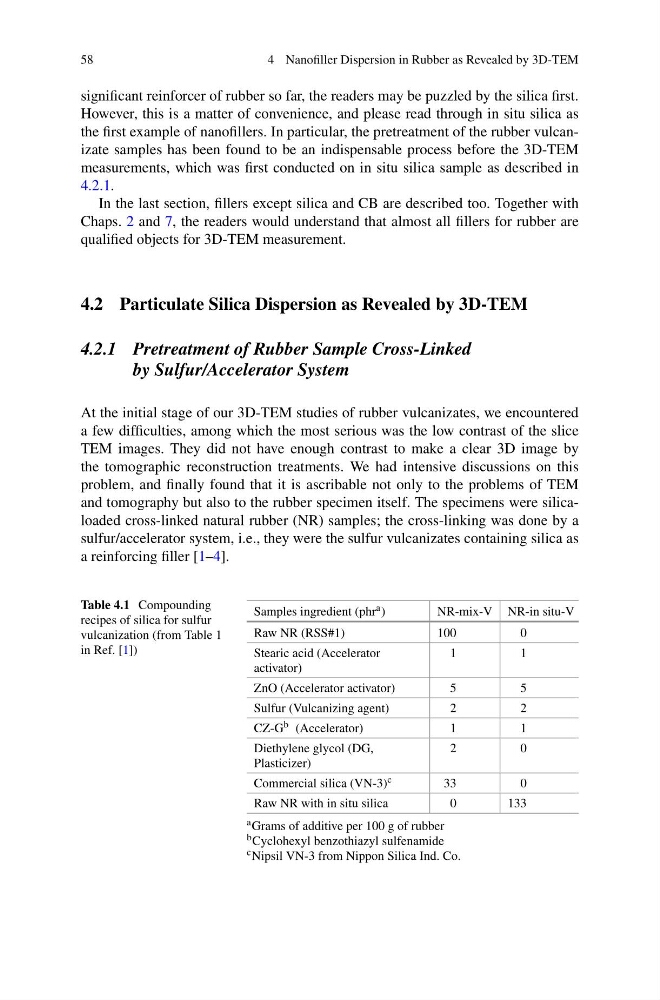
At the initial stage of our 3D-TEM studies of rubber vulcanizates, we encountered
a few difficulties, among which the most serious was the low contrast of the slice
TEM images. They did not have enough contrast to make a clear 3D image by
the tomographic reconstruction treatments. We had intensive discussions on this
problem, and finally found that it is ascribable not only to the problems of TEM
and tomography but also to the rubber specimen itself. The specimens were silicaloaded cross-linked natural rubber (NR) samples; the cross-linking was done by a
sulfur/accelerator system, i.e., they were the sulfur vulcanizates containing silica as
a reinforcing filler [1–4].
Table 4.1 Compounding
recipes of silica for sulfur
vulcanization (from Table 1
in Ref. [1])
Samples ingredient (phr a )
NR-mix-V NR-in situ-V
Raw NR (RSS#1)
100
0
Stearic acid (Accelerator
activator)
1
1
ZnO (Accelerator activator)
5
5
Sulfur (Vulcanizing agent)
2
2
CZ-G b (Accelerator)
1
1
Diethylene glycol (DG,
Plasticizer)
2
0
Commercial silica (VN-3) c
33
0
Raw NR with in situ silica
0
133
a Grams of additive per 100 g of rubber
b Cyclohexyl benzothiazyl sulfenamide
c Nipsil VN-3 from Nippon Silica Ind. Co.
4 Nanofiller Dispersion in Rubber as Revealed by 3D-TEM
significant reinforcer of rubber so far, the readers may be puzzled by the silica first.
However, this is a matter of convenience, and please read through in situ silica as
the first example of nanofillers. In particular, the pretreatment of the rubber vulcanizate samples has been found to be an indispensable process before the 3D-TEM
measurements, which was first conducted on in situ silica sample as described in
4.2.1.
In the last section, fillers except silica and CB are described too. Together with
Chaps. 2 and 7, the readers would understand that almost all fillers for rubber are
qualified objects for 3D-TEM measurement.
4.2 Particulate Silica Dispersion as Revealed by 3D-TEM
4.2.1 Pretreatment of Rubber Sample Cross-Linked
by Sulfur/Accelerator System
At the initial stage of our 3D-TEM studies of rubber vulcanizates, we encountered
a few difficulties, among which the most serious was the low contrast of the slice
TEM images. They did not have enough contrast to make a clear 3D image by
the tomographic reconstruction treatments. We had intensive discussions on this
problem, and finally found that it is ascribable not only to the problems of TEM
and tomography but also to the rubber specimen itself. The specimens were silicaloaded cross-linked natural rubber (NR) samples; the cross-linking was done by a
sulfur/accelerator system, i.e., they were the sulfur vulcanizates containing silica as
a reinforcing filler [1–4].
Table 4.1 Compounding
recipes of silica for sulfur
vulcanization (from Table 1
in Ref. [1])
Samples ingredient (phr a )
NR-mix-V NR-in situ-V
Raw NR (RSS#1)
100
0
Stearic acid (Accelerator
activator)
1
1
ZnO (Accelerator activator)
5
5
Sulfur (Vulcanizing agent)
2
2
CZ-G b (Accelerator)
1
1
Diethylene glycol (DG,
Plasticizer)
2
0
Commercial silica (VN-3) c
33
0
Raw NR with in situ silica
0
133
a Grams of additive per 100 g of rubber
b Cyclohexyl benzothiazyl sulfenamide
c Nipsil VN-3 from Nippon Silica Ind. Co.