

180
9 Reinforcement in the Twenty-First Century
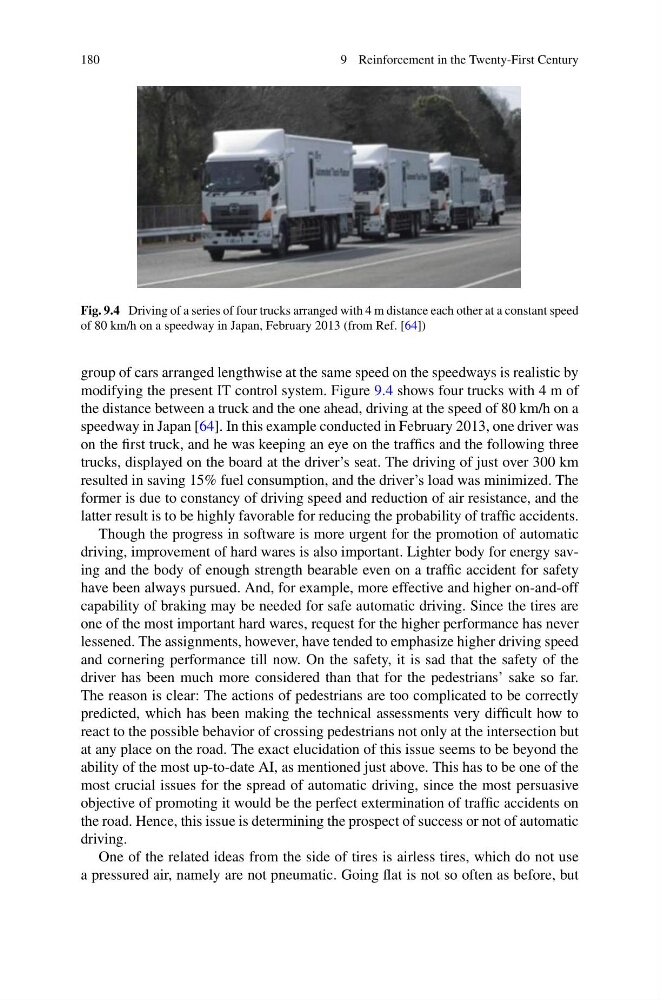
Fig. 9.4 Driving of a series of four trucks arranged with 4 m distance each other at a constant speed
of 80 km/h on a speedway in Japan, February 2013 (from Ref. [64])
group of cars arranged lengthwise at the same speed on the speedways is realistic by
modifying the present IT control system. Figure 9.4 shows four trucks with 4 m of
the distance between a truck and the one ahead, driving at the speed of 80 km/h on a
speedway in Japan [64]. In this example conducted in February 2013, one driver was
on the first truck, and he was keeping an eye on the traffics and the following three
trucks, displayed on the board at the driver’s seat. The driving of just over 300 km
resulted in saving 15% fuel consumption, and the driver’s load was minimized. The
former is due to constancy of driving speed and reduction of air resistance, and the
latter result is to be highly favorable for reducing the probability of traffic accidents.
Though the progress in software is more urgent for the promotion of automatic
driving, improvement of hard wares is also important. Lighter body for energy saving and the body of enough strength bearable even on a traffic accident for safety
have been always pursued. And, for example, more effective and higher on-and-off
capability of braking may be needed for safe automatic driving. Since the tires are
one of the most important hard wares, request for the higher performance has never
lessened. The assignments, however, have tended to emphasize higher driving speed
and cornering performance till now. On the safety, it is sad that the safety of the
driver has been much more considered than that for the pedestrians’ sake so far.
The reason is clear: The actions of pedestrians are too complicated to be correctly
predicted, which has been making the technical assessments very difficult how to
react to the possible behavior of crossing pedestrians not only at the intersection but
at any place on the road. The exact elucidation of this issue seems to be beyond the
ability of the most up-to-date AI, as mentioned just above. This has to be one of the
most crucial issues for the spread of automatic driving, since the most persuasive
objective of promoting it would be the perfect extermination of traffic accidents on
the road. Hence, this issue is determining the prospect of success or not of automatic
driving.
One of the related ideas from the side of tires is airless tires, which do not use
a pressured air, namely are not pneumatic. Going flat is not so often as before, but
9 Reinforcement in the Twenty-First Century
Fig. 9.4 Driving of a series of four trucks arranged with 4 m distance each other at a constant speed
of 80 km/h on a speedway in Japan, February 2013 (from Ref. [64])
group of cars arranged lengthwise at the same speed on the speedways is realistic by
modifying the present IT control system. Figure 9.4 shows four trucks with 4 m of
the distance between a truck and the one ahead, driving at the speed of 80 km/h on a
speedway in Japan [64]. In this example conducted in February 2013, one driver was
on the first truck, and he was keeping an eye on the traffics and the following three
trucks, displayed on the board at the driver’s seat. The driving of just over 300 km
resulted in saving 15% fuel consumption, and the driver’s load was minimized. The
former is due to constancy of driving speed and reduction of air resistance, and the
latter result is to be highly favorable for reducing the probability of traffic accidents.
Though the progress in software is more urgent for the promotion of automatic
driving, improvement of hard wares is also important. Lighter body for energy saving and the body of enough strength bearable even on a traffic accident for safety
have been always pursued. And, for example, more effective and higher on-and-off
capability of braking may be needed for safe automatic driving. Since the tires are
one of the most important hard wares, request for the higher performance has never
lessened. The assignments, however, have tended to emphasize higher driving speed
and cornering performance till now. On the safety, it is sad that the safety of the
driver has been much more considered than that for the pedestrians’ sake so far.
The reason is clear: The actions of pedestrians are too complicated to be correctly
predicted, which has been making the technical assessments very difficult how to
react to the possible behavior of crossing pedestrians not only at the intersection but
at any place on the road. The exact elucidation of this issue seems to be beyond the
ability of the most up-to-date AI, as mentioned just above. This has to be one of the
most crucial issues for the spread of automatic driving, since the most persuasive
objective of promoting it would be the perfect extermination of traffic accidents on
the road. Hence, this issue is determining the prospect of success or not of automatic
driving.
One of the related ideas from the side of tires is airless tires, which do not use
a pressured air, namely are not pneumatic. Going flat is not so often as before, but