

9.3 Soft Nanocomposites in the Twenty-First Century
179
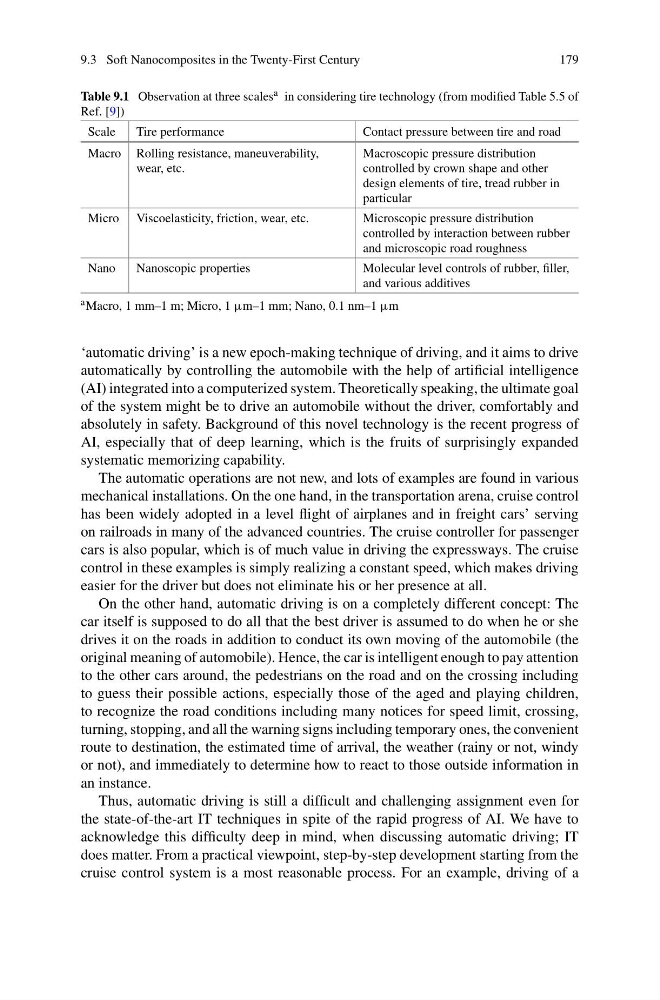
Table 9.1 Observation at three scales a in considering tire technology (from modified Table 5.5 of
Ref. [9])
Scale
Tire performance
Contact pressure between tire and road
Macro Rolling resistance, maneuverability,
wear, etc.
Macroscopic pressure distribution
controlled by crown shape and other
design elements of tire, tread rubber in
particular
Micro Viscoelasticity, friction, wear, etc.
Microscopic pressure distribution
controlled by interaction between rubber
and microscopic road roughness
Nano
Nanoscopic properties
Molecular level controls of rubber, filler,
and various additives
a Macro, 1 mm–1 m; Micro, 1 μm–1 mm; Nano, 0.1 nm–1 μm
‘automatic driving’ is a new epoch-making technique of driving, and it aims to drive
automatically by controlling the automobile with the help of artificial intelligence
(AI) integrated into a computerized system. Theoretically speaking, the ultimate goal
of the system might be to drive an automobile without the driver, comfortably and
absolutely in safety. Background of this novel technology is the recent progress of
AI, especially that of deep learning, which is the fruits of surprisingly expanded
systematic memorizing capability.
The automatic operations are not new, and lots of examples are found in various
mechanical installations. On the one hand, in the transportation arena, cruise control
has been widely adopted in a level flight of airplanes and in freight cars’ serving
on railroads in many of the advanced countries. The cruise controller for passenger
cars is also popular, which is of much value in driving the expressways. The cruise
control in these examples is simply realizing a constant speed, which makes driving
easier for the driver but does not eliminate his or her presence at all.
On the other hand, automatic driving is on a completely different concept: The
car itself is supposed to do all that the best driver is assumed to do when he or she
drives it on the roads in addition to conduct its own moving of the automobile (the
original meaning of automobile). Hence, the car is intelligent enough to pay attention
to the other cars around, the pedestrians on the road and on the crossing including
to guess their possible actions, especially those of the aged and playing children,
to recognize the road conditions including many notices for speed limit, crossing,
turning, stopping, and all the warning signs including temporary ones, the convenient
route to destination, the estimated time of arrival, the weather (rainy or not, windy
or not), and immediately to determine how to react to those outside information in
an instance.
Thus, automatic driving is still a difficult and challenging assignment even for
the state-of-the-art IT techniques in spite of the rapid progress of AI. We have to
acknowledge this difficulty deep in mind, when discussing automatic driving; IT
does matter. From a practical viewpoint, step-by-step development starting from the
cruise control system is a most reasonable process. For an example, driving of a
179
Table 9.1 Observation at three scales a in considering tire technology (from modified Table 5.5 of
Ref. [9])
Scale
Tire performance
Contact pressure between tire and road
Macro Rolling resistance, maneuverability,
wear, etc.
Macroscopic pressure distribution
controlled by crown shape and other
design elements of tire, tread rubber in
particular
Micro Viscoelasticity, friction, wear, etc.
Microscopic pressure distribution
controlled by interaction between rubber
and microscopic road roughness
Nano
Nanoscopic properties
Molecular level controls of rubber, filler,
and various additives
a Macro, 1 mm–1 m; Micro, 1 μm–1 mm; Nano, 0.1 nm–1 μm
‘automatic driving’ is a new epoch-making technique of driving, and it aims to drive
automatically by controlling the automobile with the help of artificial intelligence
(AI) integrated into a computerized system. Theoretically speaking, the ultimate goal
of the system might be to drive an automobile without the driver, comfortably and
absolutely in safety. Background of this novel technology is the recent progress of
AI, especially that of deep learning, which is the fruits of surprisingly expanded
systematic memorizing capability.
The automatic operations are not new, and lots of examples are found in various
mechanical installations. On the one hand, in the transportation arena, cruise control
has been widely adopted in a level flight of airplanes and in freight cars’ serving
on railroads in many of the advanced countries. The cruise controller for passenger
cars is also popular, which is of much value in driving the expressways. The cruise
control in these examples is simply realizing a constant speed, which makes driving
easier for the driver but does not eliminate his or her presence at all.
On the other hand, automatic driving is on a completely different concept: The
car itself is supposed to do all that the best driver is assumed to do when he or she
drives it on the roads in addition to conduct its own moving of the automobile (the
original meaning of automobile). Hence, the car is intelligent enough to pay attention
to the other cars around, the pedestrians on the road and on the crossing including
to guess their possible actions, especially those of the aged and playing children,
to recognize the road conditions including many notices for speed limit, crossing,
turning, stopping, and all the warning signs including temporary ones, the convenient
route to destination, the estimated time of arrival, the weather (rainy or not, windy
or not), and immediately to determine how to react to those outside information in
an instance.
Thus, automatic driving is still a difficult and challenging assignment even for
the state-of-the-art IT techniques in spite of the rapid progress of AI. We have to
acknowledge this difficulty deep in mind, when discussing automatic driving; IT
does matter. From a practical viewpoint, step-by-step development starting from the
cruise control system is a most reasonable process. For an example, driving of a