

8.2 Template Crystallization: Dynamic Mechanism …
149
chains are exhausted, the shish growth is discontinued. It may not impossible
to form a shish kebab-type crystallite, if enough longer chains are present near
the template. It may not impossible that a loop is formed by coordination of an
intramolecular distant S unit, too.
In order to substantiate the above scenario, quantitative kinetic and morphological
studies are indispensable in the near future. Because the crystallization rate is very
high, estimation of the diffusion constants of network chains is particularly important
in elucidating the rate-determining step. Also, the more details of extension of the
network chains to the fully extended state are to be subject to studies, particularly
including the effect of strain rate.
Per this modeling, the fully extended network chains continue to be produced with
tensile elongation. However, at the same time, the amount of available coordinating
longer network chains is rapidly decreasing, which limits the attainable degree of
crystallization. Empirically, the degrees of crystallization were about 20% or so.
This degree of crystallization suggests that majority of the chains are in dynamic
amorphous state even under a very high strain, and they form the continuous phase
even at the elongated state. This is the necessary condition for the specimen to contract
to the original amorphous state upon release of the stress, which has been exactly
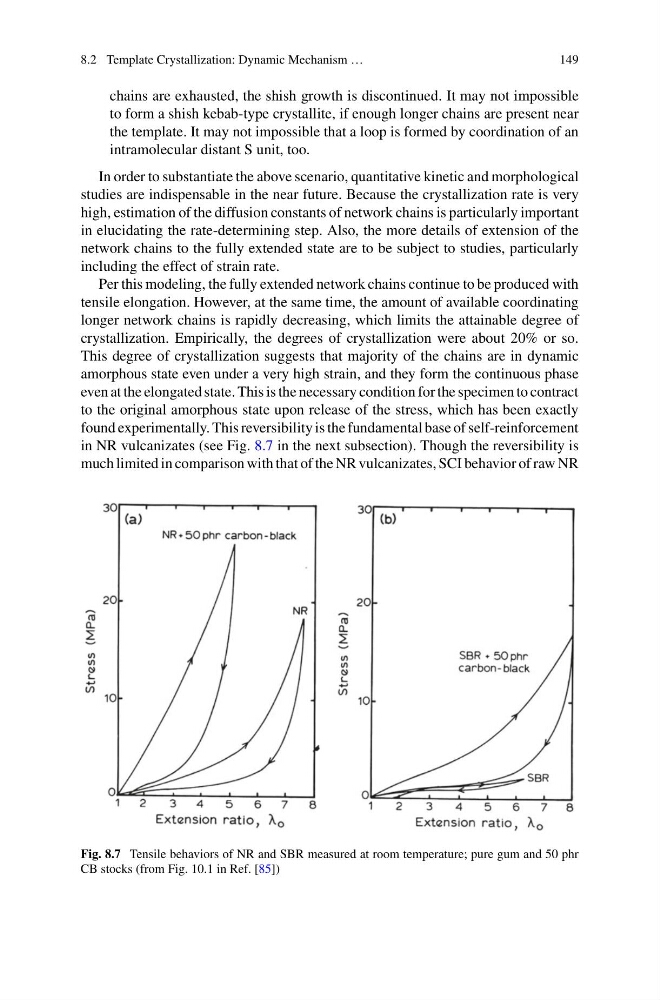
found experimentally. This reversibility is the fundamental base of self-reinforcement
in NR vulcanizates (see Fig. 8.7 in the next subsection). Though the reversibility is
much limited in comparison with that of the NR vulcanizates, SCI behavior of raw NR
Fig. 8.7 Tensile behaviors of NR and SBR measured at room temperature; pure gum and 50 phr
CB stocks (from Fig. 10.1 in Ref. [85])
149
chains are exhausted, the shish growth is discontinued. It may not impossible
to form a shish kebab-type crystallite, if enough longer chains are present near
the template. It may not impossible that a loop is formed by coordination of an
intramolecular distant S unit, too.
In order to substantiate the above scenario, quantitative kinetic and morphological
studies are indispensable in the near future. Because the crystallization rate is very
high, estimation of the diffusion constants of network chains is particularly important
in elucidating the rate-determining step. Also, the more details of extension of the
network chains to the fully extended state are to be subject to studies, particularly
including the effect of strain rate.
Per this modeling, the fully extended network chains continue to be produced with
tensile elongation. However, at the same time, the amount of available coordinating
longer network chains is rapidly decreasing, which limits the attainable degree of
crystallization. Empirically, the degrees of crystallization were about 20% or so.
This degree of crystallization suggests that majority of the chains are in dynamic
amorphous state even under a very high strain, and they form the continuous phase
even at the elongated state. This is the necessary condition for the specimen to contract
to the original amorphous state upon release of the stress, which has been exactly
found experimentally. This reversibility is the fundamental base of self-reinforcement
in NR vulcanizates (see Fig. 8.7 in the next subsection). Though the reversibility is
much limited in comparison with that of the NR vulcanizates, SCI behavior of raw NR
Fig. 8.7 Tensile behaviors of NR and SBR measured at room temperature; pure gum and 50 phr
CB stocks (from Fig. 10.1 in Ref. [85])