

148
8 Self-Reinforcement in Natural Rubber (NR): Template Crystallization
(OHPHQWDU\6WHSVLQ7HPSODWH&U\VWDOOL]DWLRQIRU.LQHWLFV
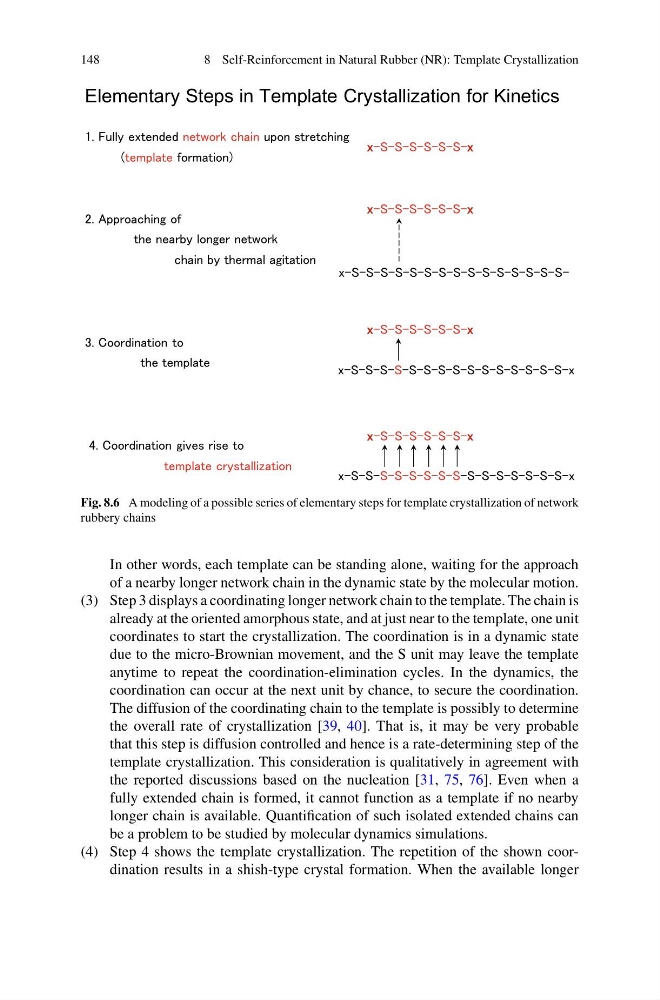
Fig. 8.6 A modeling of a possible series of elementary steps for template crystallization of network
rubbery chains
In other words, each template can be standing alone, waiting for the approach
of a nearby longer network chain in the dynamic state by the molecular motion.
(3) Step 3 displays a coordinating longer network chain to the template. The chain is
already at the oriented amorphous state, and at just near to the template, one unit
coordinates to start the crystallization. The coordination is in a dynamic state
due to the micro-Brownian movement, and the S unit may leave the template
anytime to repeat the coordination-elimination cycles. In the dynamics, the
coordination can occur at the next unit by chance, to secure the coordination.
The diffusion of the coordinating chain to the template is possibly to determine
the overall rate of crystallization [39, 40]. That is, it may be very probable
that this step is diffusion controlled and hence is a rate-determining step of the
template crystallization. This consideration is qualitatively in agreement with
the reported discussions based on the nucleation [31, 75, 76]. Even when a
fully extended chain is formed, it cannot function as a template if no nearby
longer chain is available. Quantification of such isolated extended chains can
be a problem to be studied by molecular dynamics simulations.
(4) Step 4 shows the template crystallization. The repetition of the shown coordination results in a shish-type crystal formation. When the available longer
8 Self-Reinforcement in Natural Rubber (NR): Template Crystallization
(OHPHQWDU\6WHSVLQ7HPSODWH&U\VWDOOL]DWLRQIRU.LQHWLFV
Fig. 8.6 A modeling of a possible series of elementary steps for template crystallization of network
rubbery chains
In other words, each template can be standing alone, waiting for the approach
of a nearby longer network chain in the dynamic state by the molecular motion.
(3) Step 3 displays a coordinating longer network chain to the template. The chain is
already at the oriented amorphous state, and at just near to the template, one unit
coordinates to start the crystallization. The coordination is in a dynamic state
due to the micro-Brownian movement, and the S unit may leave the template
anytime to repeat the coordination-elimination cycles. In the dynamics, the
coordination can occur at the next unit by chance, to secure the coordination.
The diffusion of the coordinating chain to the template is possibly to determine
the overall rate of crystallization [39, 40]. That is, it may be very probable
that this step is diffusion controlled and hence is a rate-determining step of the
template crystallization. This consideration is qualitatively in agreement with
the reported discussions based on the nucleation [31, 75, 76]. Even when a
fully extended chain is formed, it cannot function as a template if no nearby
longer chain is available. Quantification of such isolated extended chains can
be a problem to be studied by molecular dynamics simulations.
(4) Step 4 shows the template crystallization. The repetition of the shown coordination results in a shish-type crystal formation. When the available longer