

6.2 Rubber Reinforcement by In Situ Silica
111
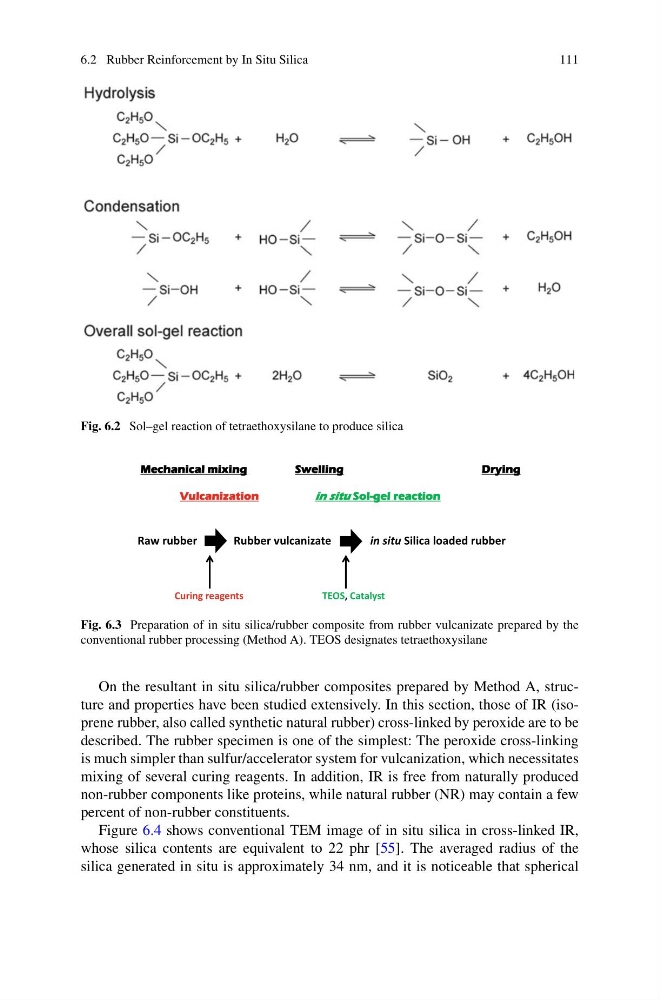
Fig. 6.2 Sol–gel reaction of tetraethoxysilane to produce silica
Mechanical mixing
Swelling
Drying
Vulcanization
in situ Sol-gel reaction
Raw rubber
Rubber vulcanizate
in situ Silica loaded rubber
Curing reagents
TEOS, Catalyst
Fig. 6.3 Preparation of in situ silica/rubber composite from rubber vulcanizate prepared by the
conventional rubber processing (Method A). TEOS designates tetraethoxysilane
On the resultant in situ silica/rubber composites prepared by Method A, structure and properties have been studied extensively. In this section, those of IR (isoprene rubber, also called synthetic natural rubber) cross-linked by peroxide are to be
described. The rubber specimen is one of the simplest: The peroxide cross-linking
is much simpler than sulfur/accelerator system for vulcanization, which necessitates
mixing of several curing reagents. In addition, IR is free from naturally produced
non-rubber components like proteins, while natural rubber (NR) may contain a few
percent of non-rubber constituents.
Figure 6.4 shows conventional TEM image of in situ silica in cross-linked IR,
whose silica contents are equivalent to 22 phr [55]. The averaged radius of the
silica generated in situ is approximately 34 nm, and it is noticeable that spherical
111
Fig. 6.2 Sol–gel reaction of tetraethoxysilane to produce silica
Mechanical mixing
Swelling
Drying
Vulcanization
in situ Sol-gel reaction
Raw rubber
Rubber vulcanizate
in situ Silica loaded rubber
Curing reagents
TEOS, Catalyst
Fig. 6.3 Preparation of in situ silica/rubber composite from rubber vulcanizate prepared by the
conventional rubber processing (Method A). TEOS designates tetraethoxysilane
On the resultant in situ silica/rubber composites prepared by Method A, structure and properties have been studied extensively. In this section, those of IR (isoprene rubber, also called synthetic natural rubber) cross-linked by peroxide are to be
described. The rubber specimen is one of the simplest: The peroxide cross-linking
is much simpler than sulfur/accelerator system for vulcanization, which necessitates
mixing of several curing reagents. In addition, IR is free from naturally produced
non-rubber components like proteins, while natural rubber (NR) may contain a few
percent of non-rubber constituents.
Figure 6.4 shows conventional TEM image of in situ silica in cross-linked IR,
whose silica contents are equivalent to 22 phr [55]. The averaged radius of the
silica generated in situ is approximately 34 nm, and it is noticeable that spherical