

100
5 Reinforcing Mechanism of Rubber by Nanofiller
(evaluated by the Smallwood equation) is contributing to the rubber reinforcement
even at lower CB loadings than 20 phr.
At around 20 phr loading of CB, further clustering of higher CB aggregates via
CNIL may result in some network formation of CB due to the increasing dense
packing of the CB aggregates, and such a process leading to gelation or percolation
is becoming more and more dominant above 20 phr CB. Thus at the final stages
(experimentally 40 phr and 80 phr CBs), the whole system is covered by a CB
network composed of CB, bound rubber (which is inclusive of CNIL, and that of
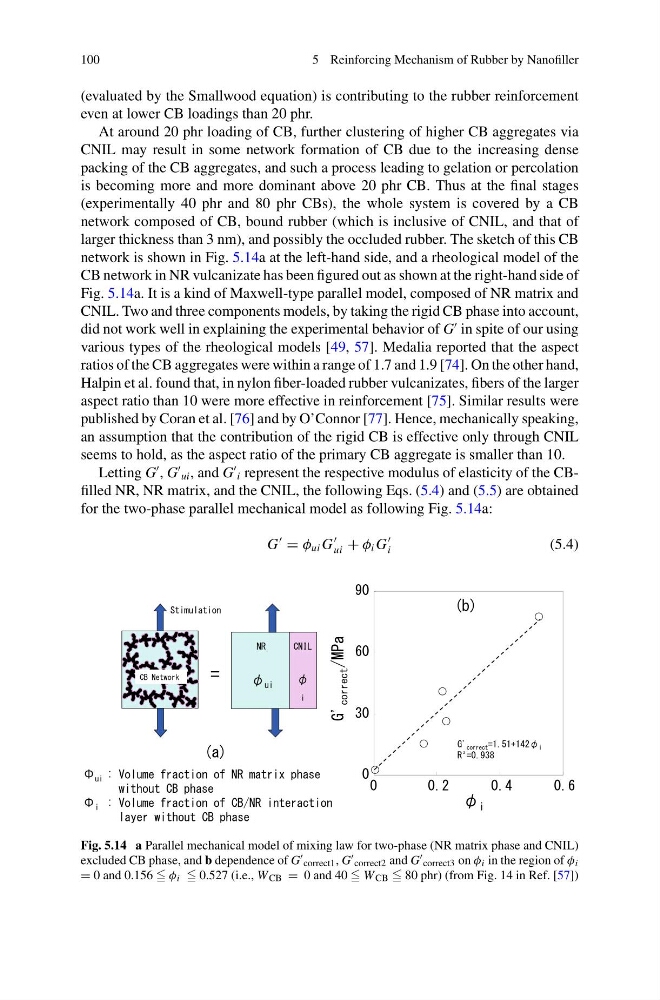
larger thickness than 3 nm), and possibly the occluded rubber. The sketch of this CB
network is shown in Fig. 5.14a at the left-hand side, and a rheological model of the
CB network in NR vulcanizate has been figured out as shown at the right-hand side of
Fig. 5.14a. It is a kind of Maxwell-type parallel model, composed of NR matrix and
CNIL. Two and three components models, by taking the rigid CB phase into account,
did not work well in explaining the experimental behavior of G
in spite of our using
various types of the rheological models [49, 57]. Medalia reported that the aspect
ratios of the CB aggregates were within a range of 1.7 and 1.9 [74]. On the other hand,
Halpin et al. found that, in nylon fiber-loaded rubber vulcanizates, fibers of the larger
aspect ratio than 10 were more effective in reinforcement [75]. Similar results were
published by Coran et al. [76] and by O’Connor [77]. Hence, mechanically speaking,
an assumption that the contribution of the rigid CB is effective only through CNIL
seems to hold, as the aspect ratio of the primary CB aggregate is smaller than 10.
Letting G
, G
ui , and G
i represent the respective modulus of elasticity of the CBfilled NR, NR matrix, and the CNIL, the following Eqs. (5.4) and (5.5) are obtained
for the two-phase parallel mechanical model as following Fig. 5.14a:
G
= φ ui G
ui + φ i G
i
(5.4)
Fig. 5.14 a Parallel mechanical model of mixing law for two-phase (NR matrix phase and CNIL)
excluded CB phase, and b dependence of G correct1 , G correct2 and G correct3 on φ i in the region of φ i
= 0 and 0.156 φ i 0.527 (i.e., W CB = 0 and 40 W CB 80 phr) (from Fig. 14 in Ref. [57])
5 Reinforcing Mechanism of Rubber by Nanofiller
(evaluated by the Smallwood equation) is contributing to the rubber reinforcement
even at lower CB loadings than 20 phr.
At around 20 phr loading of CB, further clustering of higher CB aggregates via
CNIL may result in some network formation of CB due to the increasing dense
packing of the CB aggregates, and such a process leading to gelation or percolation
is becoming more and more dominant above 20 phr CB. Thus at the final stages
(experimentally 40 phr and 80 phr CBs), the whole system is covered by a CB
network composed of CB, bound rubber (which is inclusive of CNIL, and that of
larger thickness than 3 nm), and possibly the occluded rubber. The sketch of this CB
network is shown in Fig. 5.14a at the left-hand side, and a rheological model of the
CB network in NR vulcanizate has been figured out as shown at the right-hand side of
Fig. 5.14a. It is a kind of Maxwell-type parallel model, composed of NR matrix and
CNIL. Two and three components models, by taking the rigid CB phase into account,
did not work well in explaining the experimental behavior of G
in spite of our using
various types of the rheological models [49, 57]. Medalia reported that the aspect
ratios of the CB aggregates were within a range of 1.7 and 1.9 [74]. On the other hand,
Halpin et al. found that, in nylon fiber-loaded rubber vulcanizates, fibers of the larger
aspect ratio than 10 were more effective in reinforcement [75]. Similar results were
published by Coran et al. [76] and by O’Connor [77]. Hence, mechanically speaking,
an assumption that the contribution of the rigid CB is effective only through CNIL
seems to hold, as the aspect ratio of the primary CB aggregate is smaller than 10.
Letting G
, G
ui , and G
i represent the respective modulus of elasticity of the CBfilled NR, NR matrix, and the CNIL, the following Eqs. (5.4) and (5.5) are obtained
for the two-phase parallel mechanical model as following Fig. 5.14a:
G
= φ ui G
ui + φ i G
i
(5.4)
Fig. 5.14 a Parallel mechanical model of mixing law for two-phase (NR matrix phase and CNIL)
excluded CB phase, and b dependence of G correct1 , G correct2 and G correct3 on φ i in the region of φ i
= 0 and 0.156 φ i 0.527 (i.e., W CB = 0 and 40 W CB 80 phr) (from Fig. 14 in Ref. [57])