

98
5 Reinforcing Mechanism of Rubber by Nanofiller
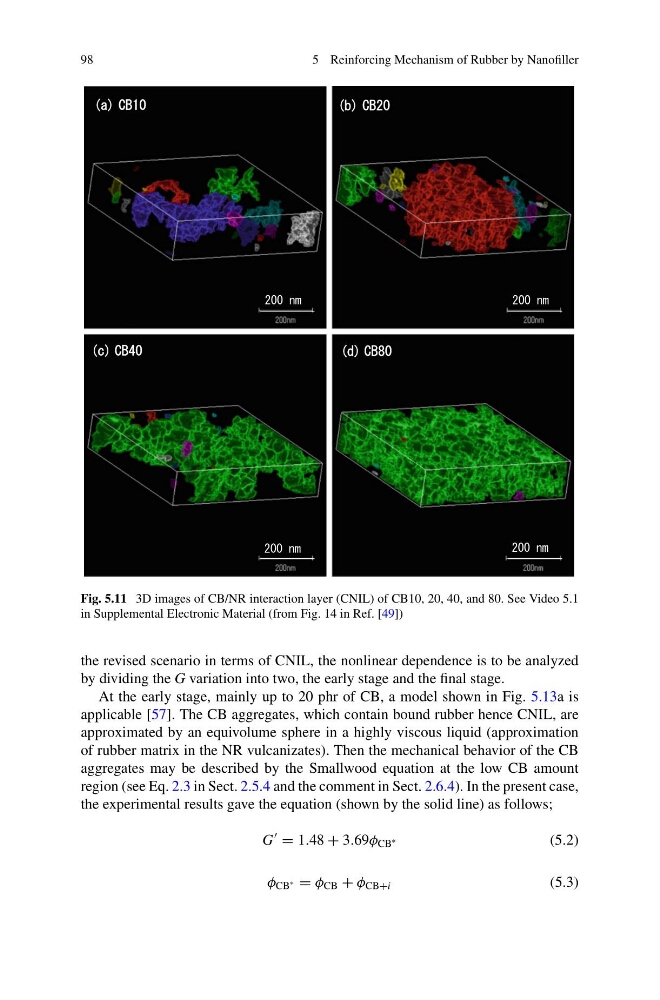
Fig. 5.11 3D images of CB/NR interaction layer (CNIL) of CB10, 20, 40, and 80. See Video 5.1
in Supplemental Electronic Material (from Fig. 14 in Ref. [49])
the revised scenario in terms of CNIL, the nonlinear dependence is to be analyzed
by dividing the G variation into two, the early stage and the final stage.
At the early stage, mainly up to 20 phr of CB, a model shown in Fig. 5.13a is
applicable [57]. The CB aggregates, which contain bound rubber hence CNIL, are
approximated by an equivolume sphere in a highly viscous liquid (approximation
of rubber matrix in the NR vulcanizates). Then the mechanical behavior of the CB
aggregates may be described by the Smallwood equation at the low CB amount
region (see Eq. 2.3 in Sect. 2.5.4 and the comment in Sect. 2.6.4). In the present case,
the experimental results gave the equation (shown by the solid line) as follows;
G
= 1.48 + 3.69φ CB
∗
(5.2)
φ CB
∗ = φ CB + φ CB+i
(5.3)
5 Reinforcing Mechanism of Rubber by Nanofiller
Fig. 5.11 3D images of CB/NR interaction layer (CNIL) of CB10, 20, 40, and 80. See Video 5.1
in Supplemental Electronic Material (from Fig. 14 in Ref. [49])
the revised scenario in terms of CNIL, the nonlinear dependence is to be analyzed
by dividing the G variation into two, the early stage and the final stage.
At the early stage, mainly up to 20 phr of CB, a model shown in Fig. 5.13a is
applicable [57]. The CB aggregates, which contain bound rubber hence CNIL, are
approximated by an equivolume sphere in a highly viscous liquid (approximation
of rubber matrix in the NR vulcanizates). Then the mechanical behavior of the CB
aggregates may be described by the Smallwood equation at the low CB amount
region (see Eq. 2.3 in Sect. 2.5.4 and the comment in Sect. 2.6.4). In the present case,
the experimental results gave the equation (shown by the solid line) as follows;
G
= 1.48 + 3.69φ CB
∗
(5.2)
φ CB
∗ = φ CB + φ CB+i
(5.3)