

94
5 Reinforcing Mechanism of Rubber by Nanofiller
Fig. 5.8 Typical
information on particulate
sample obtained by SAXS
(from Fig. 2 in Ref. [64])
is widely used, which affords the radius of gyration [65].
I (q) = I (0) exp
−R
2
g /3
q
2
(5.1)
where I (0) is the incident light intensity, and R g is the radius of gyration. Further,
analyses of the scattering curve give the shape information, too [66]. Recent studies
on nanofillers in rubber matrix are briefly reviewed in this subsection.
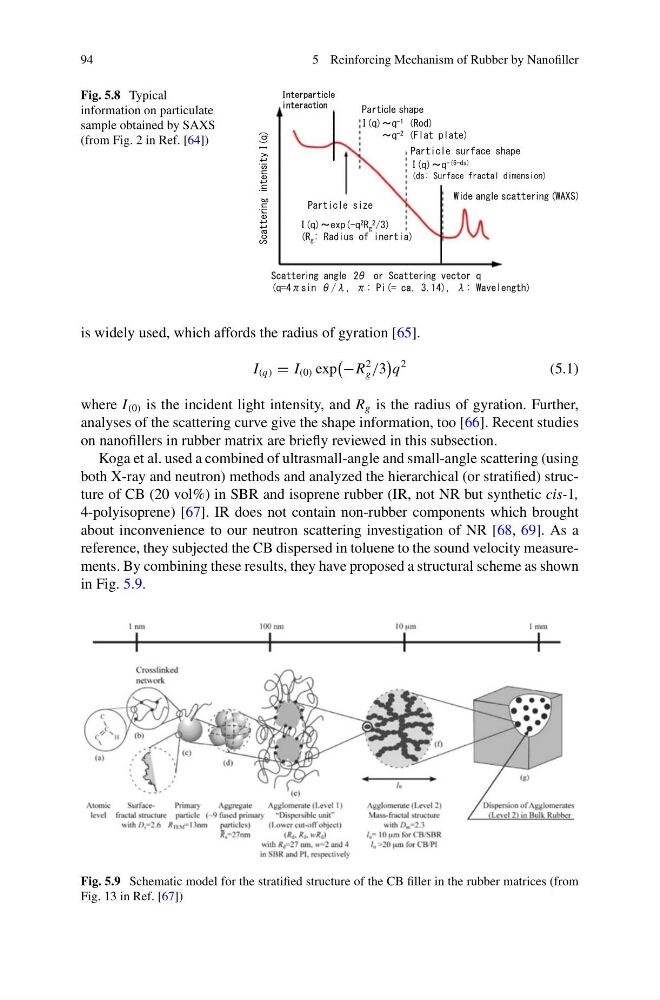
Koga et al. used a combined of ultrasmall-angle and small-angle scattering (using
both X-ray and neutron) methods and analyzed the hierarchical (or stratified) structure of CB (20 vol%) in SBR and isoprene rubber (IR, not NR but synthetic cis-1,
4-polyisoprene) [67]. IR does not contain non-rubber components which brought
about inconvenience to our neutron scattering investigation of NR [68, 69]. As a
reference, they subjected the CB dispersed in toluene to the sound velocity measurements. By combining these results, they have proposed a structural scheme as shown
in Fig. 5.9.
Fig. 5.9 Schematic model for the stratified structure of the CB filler in the rubber matrices (from
Fig. 13 in Ref. [67])
5 Reinforcing Mechanism of Rubber by Nanofiller
Fig. 5.8 Typical
information on particulate
sample obtained by SAXS
(from Fig. 2 in Ref. [64])
is widely used, which affords the radius of gyration [65].
I (q) = I (0) exp
−R
2
g /3
q
2
(5.1)
where I (0) is the incident light intensity, and R g is the radius of gyration. Further,
analyses of the scattering curve give the shape information, too [66]. Recent studies
on nanofillers in rubber matrix are briefly reviewed in this subsection.
Koga et al. used a combined of ultrasmall-angle and small-angle scattering (using
both X-ray and neutron) methods and analyzed the hierarchical (or stratified) structure of CB (20 vol%) in SBR and isoprene rubber (IR, not NR but synthetic cis-1,
4-polyisoprene) [67]. IR does not contain non-rubber components which brought
about inconvenience to our neutron scattering investigation of NR [68, 69]. As a
reference, they subjected the CB dispersed in toluene to the sound velocity measurements. By combining these results, they have proposed a structural scheme as shown
in Fig. 5.9.
Fig. 5.9 Schematic model for the stratified structure of the CB filler in the rubber matrices (from
Fig. 13 in Ref. [67])