

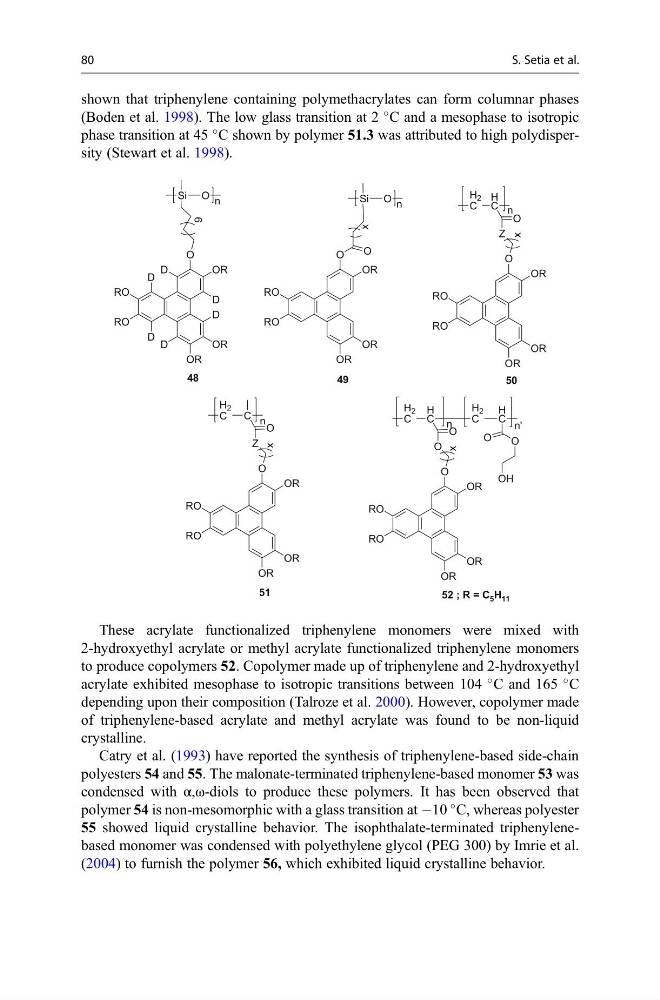
shown that triphenylene containing polymethacrylates can form columnar phases
(Boden et al. 1998). The low glass transition at 2
C and a mesophase to isotropic
phase transition at 45
C shown by polymer 51.3 was attributed to high polydispersity (Stewart et al. 1998).
Si O
RO
RO
OR
OR
OR
O
9
n
RO
RO
OR
OR
OR
O
RO
RO
OR
OR
OR
O
Z
x
H
C
O
RO
RO
OR
OR
OR
O
Z
x
C
O
RO
RO
OR
OR
OR
O
O
x
H
C
O
D
D
D
D
D
D
Si O n
O
x
48
49
50
51
52 ; R = C 5 H 11
H 2
C
H 2
C
H 2
C
H 2
C
H
C
O
O
OH
n
n
n
n'
These acrylate functionalized triphenylene monomers were mixed with
2-hydroxyethyl acrylate or methyl acrylate functionalized triphenylene monomers
to produce copolymers 52. Copolymer made up of triphenylene and 2-hydroxyethyl
acrylate exhibited mesophase to isotropic transitions between 104
C and 165
C
depending upon their composition (Talroze et al. 2000). However, copolymer made
of triphenylene-based acrylate and methyl acrylate was found to be non-liquid
crystalline.
Catry et al. (1993) have reported the synthesis of triphenylene-based side-chain
polyesters 54 and 55. The malonate-terminated triphenylene-based monomer 53 was
condensed with α,ω-diols to produce these polymers. It has been observed that
polymer 54 is non-mesomorphic with a glass transition at À10
C, whereas polyester
55 showed liquid crystalline behavior. The isophthalate-terminated triphenylenebased monomer was condensed with polyethylene glycol (PEG 300) by Imrie et al.
(2004) to furnish the polymer 56, which exhibited liquid crystalline behavior.
80
S. Setia et al.
(Boden et al. 1998). The low glass transition at 2
C and a mesophase to isotropic
phase transition at 45
C shown by polymer 51.3 was attributed to high polydispersity (Stewart et al. 1998).
Si O
RO
RO
OR
OR
OR
O
9
n
RO
RO
OR
OR
OR
O
RO
RO
OR
OR
OR
O
Z
x
H
C
O
RO
RO
OR
OR
OR
O
Z
x
C
O
RO
RO
OR
OR
OR
O
O
x
H
C
O
D
D
D
D
D
D
Si O n
O
x
48
49
50
51
52 ; R = C 5 H 11
H 2
C
H 2
C
H 2
C
H 2
C
H
C
O
O
OH
n
n
n
n'
These acrylate functionalized triphenylene monomers were mixed with
2-hydroxyethyl acrylate or methyl acrylate functionalized triphenylene monomers
to produce copolymers 52. Copolymer made up of triphenylene and 2-hydroxyethyl
acrylate exhibited mesophase to isotropic transitions between 104
C and 165
C
depending upon their composition (Talroze et al. 2000). However, copolymer made
of triphenylene-based acrylate and methyl acrylate was found to be non-liquid
crystalline.
Catry et al. (1993) have reported the synthesis of triphenylene-based side-chain
polyesters 54 and 55. The malonate-terminated triphenylene-based monomer 53 was
condensed with α,ω-diols to produce these polymers. It has been observed that
polymer 54 is non-mesomorphic with a glass transition at À10
C, whereas polyester
55 showed liquid crystalline behavior. The isophthalate-terminated triphenylenebased monomer was condensed with polyethylene glycol (PEG 300) by Imrie et al.
(2004) to furnish the polymer 56, which exhibited liquid crystalline behavior.
80
S. Setia et al.