

Free radical polymerization has also been utilized in preparing triphenylenebased side-chain homopolymers and copolymers with different lateral side chains,
spacers, and polymer backbones. Triphenylene monomer containing acrylate or
methacrylate groups was subjected to free radical polymerization to achieve polymers 50–52. The thermal transitions of these polymers are summarized in Table 12
along with side chains and spacer lengths.
On doping with trinitrofluorenone (TNF), the polymers 50.1 and 51.1 showed
columnar nematic mesophase (Hüser and Spiess 1988). Because of the rigid nature
of methacrylate-based polymer backbone, only polyacrylates 50.2 exhibited liquid
crystalline behavior among 50.2 and 51.2. However, Imrie and Boden groups have
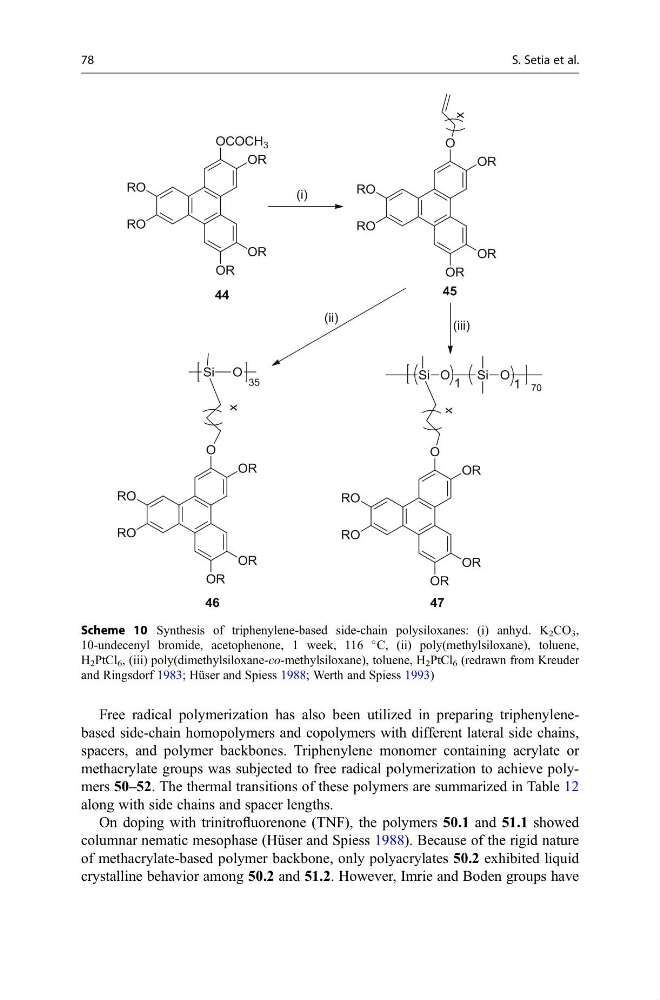
Scheme 10 Synthesis of triphenylene-based side-chain polysiloxanes: (i) anhyd. K 2 CO 3 ,
10-undecenyl bromide, acetophenone, 1 week, 116
C, (ii) poly(methylsiloxane), toluene,
H 2 PtCl 6 , (iii) poly(dimethylsiloxane-co-methylsiloxane), toluene, H 2 PtCl 6 (redrawn from Kreuder
and Ringsdorf 1983; Hüser and Spiess 1988; Werth and Spiess 1993)
78
S. Setia et al.
spacers, and polymer backbones. Triphenylene monomer containing acrylate or
methacrylate groups was subjected to free radical polymerization to achieve polymers 50–52. The thermal transitions of these polymers are summarized in Table 12
along with side chains and spacer lengths.
On doping with trinitrofluorenone (TNF), the polymers 50.1 and 51.1 showed
columnar nematic mesophase (Hüser and Spiess 1988). Because of the rigid nature
of methacrylate-based polymer backbone, only polyacrylates 50.2 exhibited liquid
crystalline behavior among 50.2 and 51.2. However, Imrie and Boden groups have
Scheme 10 Synthesis of triphenylene-based side-chain polysiloxanes: (i) anhyd. K 2 CO 3 ,
10-undecenyl bromide, acetophenone, 1 week, 116
C, (ii) poly(methylsiloxane), toluene,
H 2 PtCl 6 , (iii) poly(dimethylsiloxane-co-methylsiloxane), toluene, H 2 PtCl 6 (redrawn from Kreuder
and Ringsdorf 1983; Hüser and Spiess 1988; Werth and Spiess 1993)
78
S. Setia et al.