

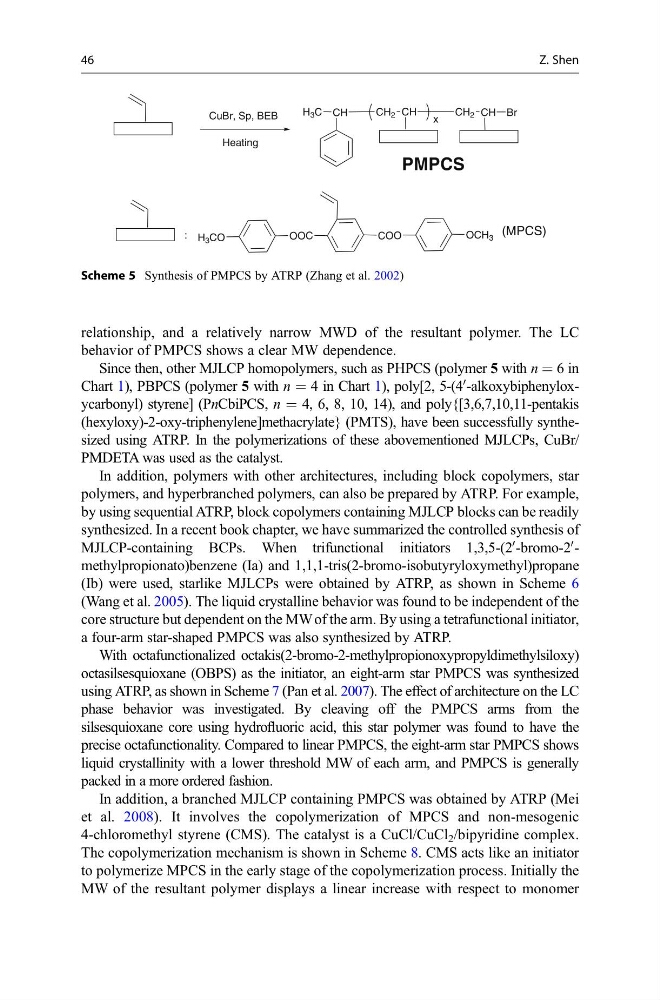
relationship, and a relatively narrow MWD of the resultant polymer. The LC
behavior of PMPCS shows a clear MW dependence.
Since then, other MJLCP homopolymers, such as PHPCS (polymer 5 with n = 6 in
Chart 1), PBPCS (polymer 5 with n = 4 in Chart 1), poly[2, 5-(4
0 -alkoxybiphenyloxycarbonyl) styrene] (PnCbiPCS, n = 4, 6, 8, 10, 14), and poly{[3,6,7,10,11-pentakis
(hexyloxy)-2-oxy-triphenylene]methacrylate} (PMTS), have been successfully synthesized using ATRP. In the polymerizations of these abovementioned MJLCPs, CuBr/
PMDETA was used as the catalyst.
In addition, polymers with other architectures, including block copolymers, star
polymers, and hyperbranched polymers, can also be prepared by ATRP. For example,
by using sequential ATRP, block copolymers containing MJLCP blocks can be readily
synthesized. In a recent book chapter, we have summarized the controlled synthesis of
MJLCP-containing BCPs. When trifunctional initiators 1,3,5-(2
0 -bromo-2
0 -
methylpropionato)benzene (Ia) and 1,1,1-tris(2-bromo-isobutyryloxymethyl)propane
(Ib) were used, starlike MJLCPs were obtained by ATRP, as shown in Scheme 6
(Wang et al. 2005). The liquid crystalline behavior was found to be independent of the
core structure but dependent on the MW of the arm. By using a tetrafunctional initiator,
a four-arm star-shaped PMPCS was also synthesized by ATRP.
With octafunctionalized octakis(2-bromo-2-methylpropionoxypropyldimethylsiloxy)
octasilsesquioxane (OBPS) as the initiator, an eight-arm star PMPCS was synthesized
using ATRP, as shown in Scheme 7 (Pan et al. 2007). The effect of architecture on the LC
phase behavior was investigated. By cleaving off the PMPCS arms from the
silsesquioxane core using hydrofluoric acid, this star polymer was found to have the
precise octafunctionality. Compared to linear PMPCS, the eight-arm star PMPCS shows
liquid crystallinity with a lower threshold MW of each arm, and PMPCS is generally
packed in a more ordered fashion.
In addition, a branched MJLCP containing PMPCS was obtained by ATRP (Mei
et al. 2008). It involves the copolymerization of MPCS and non-mesogenic
4-chloromethyl styrene (CMS). The catalyst is a CuCl/CuCl 2 /bipyridine complex.
The copolymerization mechanism is shown in Scheme 8. CMS acts like an initiator
to polymerize MPCS in the early stage of the copolymerization process. Initially the
MW of the resultant polymer displays a linear increase with respect to monomer
Heating
OOC
COO
H 3 CO
OCH 3
:
CuBr, Sp, BEB
H 3 C CH
CH 2 CH
CH 2 CH Br
x
(MPCS)
PMPCS
Scheme 5 Synthesis of PMPCS by ATRP (Zhang et al. 2002)
46
Z. Shen
behavior of PMPCS shows a clear MW dependence.
Since then, other MJLCP homopolymers, such as PHPCS (polymer 5 with n = 6 in
Chart 1), PBPCS (polymer 5 with n = 4 in Chart 1), poly[2, 5-(4
0 -alkoxybiphenyloxycarbonyl) styrene] (PnCbiPCS, n = 4, 6, 8, 10, 14), and poly{[3,6,7,10,11-pentakis
(hexyloxy)-2-oxy-triphenylene]methacrylate} (PMTS), have been successfully synthesized using ATRP. In the polymerizations of these abovementioned MJLCPs, CuBr/
PMDETA was used as the catalyst.
In addition, polymers with other architectures, including block copolymers, star
polymers, and hyperbranched polymers, can also be prepared by ATRP. For example,
by using sequential ATRP, block copolymers containing MJLCP blocks can be readily
synthesized. In a recent book chapter, we have summarized the controlled synthesis of
MJLCP-containing BCPs. When trifunctional initiators 1,3,5-(2
0 -bromo-2
0 -
methylpropionato)benzene (Ia) and 1,1,1-tris(2-bromo-isobutyryloxymethyl)propane
(Ib) were used, starlike MJLCPs were obtained by ATRP, as shown in Scheme 6
(Wang et al. 2005). The liquid crystalline behavior was found to be independent of the
core structure but dependent on the MW of the arm. By using a tetrafunctional initiator,
a four-arm star-shaped PMPCS was also synthesized by ATRP.
With octafunctionalized octakis(2-bromo-2-methylpropionoxypropyldimethylsiloxy)
octasilsesquioxane (OBPS) as the initiator, an eight-arm star PMPCS was synthesized
using ATRP, as shown in Scheme 7 (Pan et al. 2007). The effect of architecture on the LC
phase behavior was investigated. By cleaving off the PMPCS arms from the
silsesquioxane core using hydrofluoric acid, this star polymer was found to have the
precise octafunctionality. Compared to linear PMPCS, the eight-arm star PMPCS shows
liquid crystallinity with a lower threshold MW of each arm, and PMPCS is generally
packed in a more ordered fashion.
In addition, a branched MJLCP containing PMPCS was obtained by ATRP (Mei
et al. 2008). It involves the copolymerization of MPCS and non-mesogenic
4-chloromethyl styrene (CMS). The catalyst is a CuCl/CuCl 2 /bipyridine complex.
The copolymerization mechanism is shown in Scheme 8. CMS acts like an initiator
to polymerize MPCS in the early stage of the copolymerization process. Initially the
MW of the resultant polymer displays a linear increase with respect to monomer
Heating
OOC
COO
H 3 CO
OCH 3
:
CuBr, Sp, BEB
H 3 C CH
CH 2 CH
CH 2 CH Br
x
(MPCS)
PMPCS
Scheme 5 Synthesis of PMPCS by ATRP (Zhang et al. 2002)
46
Z. Shen