

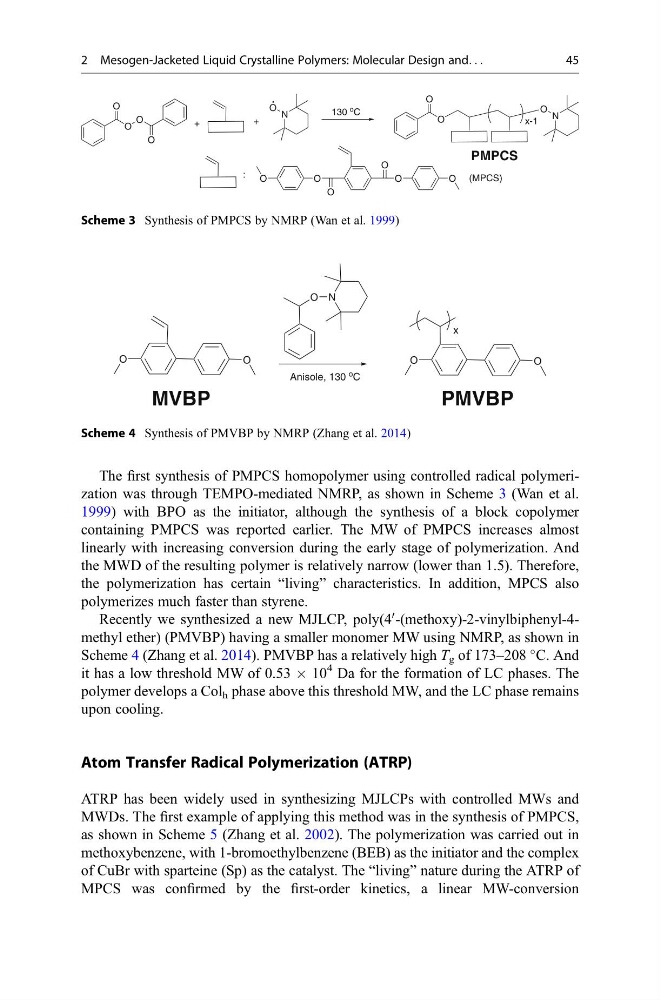
The first synthesis of PMPCS homopolymer using controlled radical polymerization was through TEMPO-mediated NMRP, as shown in Scheme 3 (Wan et al.
1999) with BPO as the initiator, although the synthesis of a block copolymer
containing PMPCS was reported earlier. The MW of PMPCS increases almost
linearly with increasing conversion during the early stage of polymerization. And
the MWD of the resulting polymer is relatively narrow (lower than 1.5). Therefore,
the polymerization has certain “living” characteristics. In addition, MPCS also
polymerizes much faster than styrene.
Recently we synthesized a new MJLCP, poly(4
0 -(methoxy)-2-vinylbiphenyl-4methyl ether) (PMVBP) having a smaller monomer MW using NMRP, as shown in
Scheme 4 (Zhang et al. 2014). PMVBP has a relatively high T g of 173–208
C. And
it has a low threshold MW of 0.53 Â 10
4 Da for the formation of LC phases. The
polymer develops a Col h phase above this threshold MW, and the LC phase remains
upon cooling.
Atom Transfer Radical Polymerization (ATRP)
ATRP has been widely used in synthesizing MJLCPs with controlled MWs and
MWDs. The first example of applying this method was in the synthesis of PMPCS,
as shown in Scheme 5 (Zhang et al. 2002). The polymerization was carried out in
methoxybenzene, with 1-bromoethylbenzene (BEB) as the initiator and the complex
of CuBr with sparteine (Sp) as the catalyst. The “living” nature during the ATRP of
MPCS was confirmed by the first-order kinetics, a linear MW-conversion
O
O
O
O
N
O
130
o C
+
+
O
O
N
O
x-1
:
O
O
O
O
O
O
(MPCS)
PMPCS
Scheme 3 Synthesis of PMPCS by NMRP (Wan et al. 1999)
O
O
O N
Anisole, 130
o C
O
O
MVBP
PMVBP
x
Scheme 4 Synthesis of PMVBP by NMRP (Zhang et al. 2014)
2 Mesogen-Jacketed Liquid Crystalline Polymers: Molecular Design and. . .
45
1999) with BPO as the initiator, although the synthesis of a block copolymer
containing PMPCS was reported earlier. The MW of PMPCS increases almost
linearly with increasing conversion during the early stage of polymerization. And
the MWD of the resulting polymer is relatively narrow (lower than 1.5). Therefore,
the polymerization has certain “living” characteristics. In addition, MPCS also
polymerizes much faster than styrene.
Recently we synthesized a new MJLCP, poly(4
0 -(methoxy)-2-vinylbiphenyl-4methyl ether) (PMVBP) having a smaller monomer MW using NMRP, as shown in
Scheme 4 (Zhang et al. 2014). PMVBP has a relatively high T g of 173–208
C. And
it has a low threshold MW of 0.53 Â 10
4 Da for the formation of LC phases. The
polymer develops a Col h phase above this threshold MW, and the LC phase remains
upon cooling.
Atom Transfer Radical Polymerization (ATRP)
ATRP has been widely used in synthesizing MJLCPs with controlled MWs and
MWDs. The first example of applying this method was in the synthesis of PMPCS,
as shown in Scheme 5 (Zhang et al. 2002). The polymerization was carried out in
methoxybenzene, with 1-bromoethylbenzene (BEB) as the initiator and the complex
of CuBr with sparteine (Sp) as the catalyst. The “living” nature during the ATRP of
MPCS was confirmed by the first-order kinetics, a linear MW-conversion
O
O
O
O
N
O
130
o C
+
+
O
O
N
O
x-1
:
O
O
O
O
O
O
(MPCS)
PMPCS
Scheme 3 Synthesis of PMPCS by NMRP (Wan et al. 1999)
O
O
O N
Anisole, 130
o C
O
O
MVBP
PMVBP
x
Scheme 4 Synthesis of PMVBP by NMRP (Zhang et al. 2014)
2 Mesogen-Jacketed Liquid Crystalline Polymers: Molecular Design and. . .
45