

increased agglomeration of some portion of the clay within the TLCP matrix;
however, the presence of the organoclay was found to have no effect on the location
of the peak, which indicates that perfect exfoliation of the clay layer structure of the
organoclay does not occur in the TLCP matrix (Chang et al. 2006).
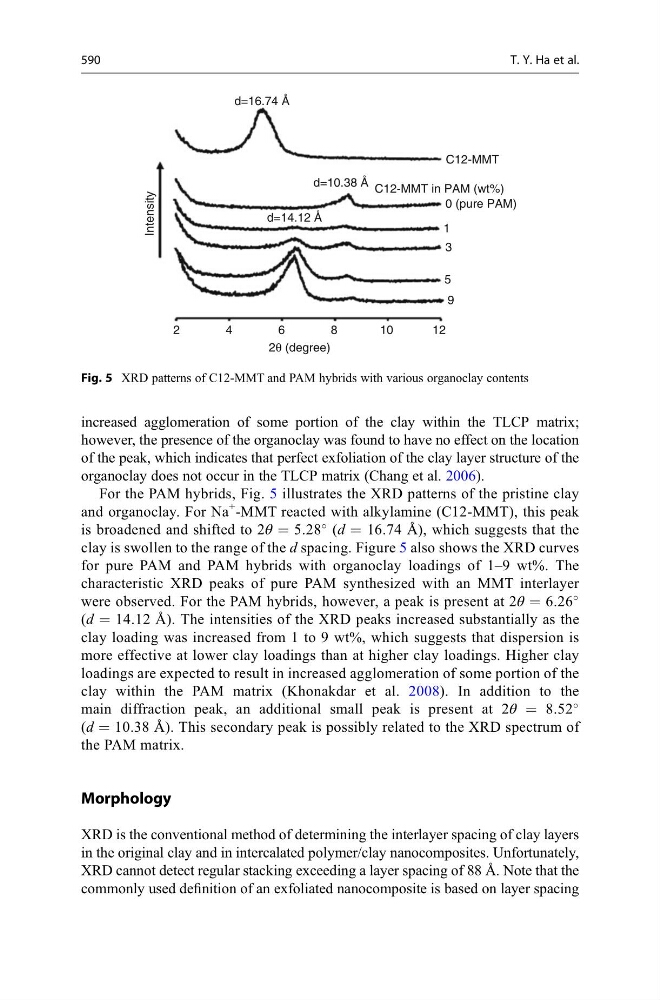
For the PAM hybrids, Fig. 5 illustrates the XRD patterns of the pristine clay
and organoclay. For Na
+ -MMT reacted with alkylamine (C12-MMT), this peak
is broadened and shifted to 2θ = 5.28
(d = 16.74 Å), which suggests that the
clay is swollen to the range of the d spacing. Figure 5 also shows the XRD curves
for pure PAM and PAM hybrids with organoclay loadings of 1–9 wt%. The
characteristic XRD peaks of pure PAM synthesized with an MMT interlayer
were observed. For the PAM hybrids, however, a peak is present at 2θ = 6.26
(d = 14.12 Å). The intensities of the XRD peaks increased substantially as the
clay loading was increased from 1 to 9 wt%, which suggests that dispersion is
more effective at lower clay loadings than at higher clay loadings. Higher clay
loadings are expected to result in increased agglomeration of some portion of the
clay within the PAM matrix (Khonakdar et al. 2008). In addition to the
main diffraction peak, an additional small peak is present at 2θ = 8.52
(d = 10.38 Å). This secondary peak is possibly related to the XRD spectrum of
the PAM matrix.
Morphology
XRD is the conventional method of determining the interlayer spacing of clay layers
in the original clay and in intercalated polymer/clay nanocomposites. Unfortunately,
XRD cannot detect regular stacking exceeding a layer spacing of 88 Å. Note that the
commonly used definition of an exfoliated nanocomposite is based on layer spacing
2
4
6
8
2θ (degree)
10
12
9
5
3
1
0 (pure PAM)
C12-MMT
d=16.74 Å
d=14.12 Å
Intensity
d=10.38 Å C12-MMT in PAM (wt%)
Fig. 5 XRD patterns of C12-MMT and PAM hybrids with various organoclay contents
590
T. Y. Ha et al.