

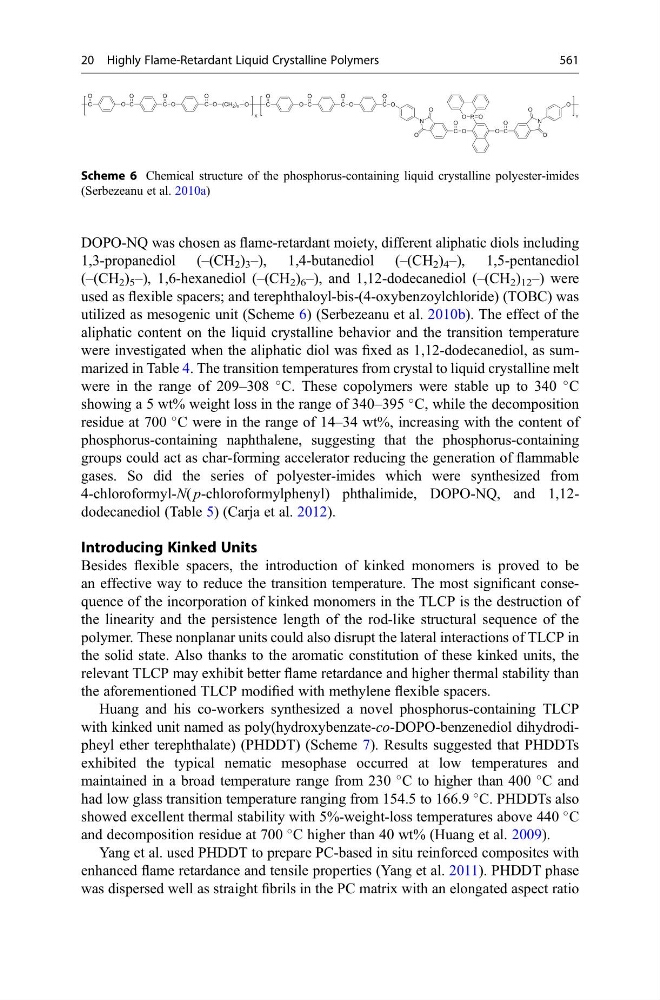
DOPO-NQ was chosen as flame-retardant moiety, different aliphatic diols including
1,3-propanediol (–(CH 2 ) 3 –), 1,4-butanediol (–(CH 2 ) 4 –), 1,5-pentanediol
(–(CH 2 ) 5 –), 1,6-hexanediol (–(CH 2 ) 6 –), and 1,12-dodecanediol (–(CH 2 ) 12 –) were
used as flexible spacers; and terephthaloyl-bis-(4-oxybenzoylchloride) (TOBC) was
utilized as mesogenic unit (Scheme 6) (Serbezeanu et al. 2010b). The effect of the
aliphatic content on the liquid crystalline behavior and the transition temperature
were investigated when the aliphatic diol was fixed as 1,12-dodecanediol, as summarized in Table 4. The transition temperatures from crystal to liquid crystalline melt
were in the range of 209–308
C. These copolymers were stable up to 340
C
showing a 5 wt% weight loss in the range of 340–395
C, while the decomposition
residue at 700
C were in the range of 14–34 wt%, increasing with the content of
phosphorus-containing naphthalene, suggesting that the phosphorus-containing
groups could act as char-forming accelerator reducing the generation of flammable
gases. So did the series of polyester-imides which were synthesized from
4-chloroformyl-N( p-chloroformylphenyl) phthalimide, DOPO-NQ, and 1,12dodecanediol (Table 5) (Carja et al. 2012).
Introducing Kinked Units
Besides flexible spacers, the introduction of kinked monomers is proved to be
an effective way to reduce the transition temperature. The most significant consequence of the incorporation of kinked monomers in the TLCP is the destruction of
the linearity and the persistence length of the rod-like structural sequence of the
polymer. These nonplanar units could also disrupt the lateral interactions of TLCP in
the solid state. Also thanks to the aromatic constitution of these kinked units, the
relevant TLCP may exhibit better flame retardance and higher thermal stability than
the aforementioned TLCP modified with methylene flexible spacers.
Huang and his co-workers synthesized a novel phosphorus-containing TLCP
with kinked unit named as poly(hydroxybenzate-co-DOPO-benzenediol dihydrodipheyl ether terephthalate) (PHDDT) (Scheme 7). Results suggested that PHDDTs
exhibited the typical nematic mesophase occurred at low temperatures and
maintained in a broad temperature range from 230
C to higher than 400
C and
had low glass transition temperature ranging from 154.5 to 166.9
C. PHDDTs also
showed excellent thermal stability with 5%-weight-loss temperatures above 440
C
and decomposition residue at 700
C higher than 40 wt% (Huang et al. 2009).
Yang et al. used PHDDT to prepare PC-based in situ reinforced composites with
enhanced flame retardance and tensile properties (Yang et al. 2011). PHDDT phase
was dispersed well as straight fibrils in the PC matrix with an elongated aspect ratio
Scheme 6 Chemical structure of the phosphorus-containing liquid crystalline polyester-imides
(Serbezeanu et al. 2010a)
20 Highly Flame-Retardant Liquid Crystalline Polymers
561
1,3-propanediol (–(CH 2 ) 3 –), 1,4-butanediol (–(CH 2 ) 4 –), 1,5-pentanediol
(–(CH 2 ) 5 –), 1,6-hexanediol (–(CH 2 ) 6 –), and 1,12-dodecanediol (–(CH 2 ) 12 –) were
used as flexible spacers; and terephthaloyl-bis-(4-oxybenzoylchloride) (TOBC) was
utilized as mesogenic unit (Scheme 6) (Serbezeanu et al. 2010b). The effect of the
aliphatic content on the liquid crystalline behavior and the transition temperature
were investigated when the aliphatic diol was fixed as 1,12-dodecanediol, as summarized in Table 4. The transition temperatures from crystal to liquid crystalline melt
were in the range of 209–308
C. These copolymers were stable up to 340
C
showing a 5 wt% weight loss in the range of 340–395
C, while the decomposition
residue at 700
C were in the range of 14–34 wt%, increasing with the content of
phosphorus-containing naphthalene, suggesting that the phosphorus-containing
groups could act as char-forming accelerator reducing the generation of flammable
gases. So did the series of polyester-imides which were synthesized from
4-chloroformyl-N( p-chloroformylphenyl) phthalimide, DOPO-NQ, and 1,12dodecanediol (Table 5) (Carja et al. 2012).
Introducing Kinked Units
Besides flexible spacers, the introduction of kinked monomers is proved to be
an effective way to reduce the transition temperature. The most significant consequence of the incorporation of kinked monomers in the TLCP is the destruction of
the linearity and the persistence length of the rod-like structural sequence of the
polymer. These nonplanar units could also disrupt the lateral interactions of TLCP in
the solid state. Also thanks to the aromatic constitution of these kinked units, the
relevant TLCP may exhibit better flame retardance and higher thermal stability than
the aforementioned TLCP modified with methylene flexible spacers.
Huang and his co-workers synthesized a novel phosphorus-containing TLCP
with kinked unit named as poly(hydroxybenzate-co-DOPO-benzenediol dihydrodipheyl ether terephthalate) (PHDDT) (Scheme 7). Results suggested that PHDDTs
exhibited the typical nematic mesophase occurred at low temperatures and
maintained in a broad temperature range from 230
C to higher than 400
C and
had low glass transition temperature ranging from 154.5 to 166.9
C. PHDDTs also
showed excellent thermal stability with 5%-weight-loss temperatures above 440
C
and decomposition residue at 700
C higher than 40 wt% (Huang et al. 2009).
Yang et al. used PHDDT to prepare PC-based in situ reinforced composites with
enhanced flame retardance and tensile properties (Yang et al. 2011). PHDDT phase
was dispersed well as straight fibrils in the PC matrix with an elongated aspect ratio
Scheme 6 Chemical structure of the phosphorus-containing liquid crystalline polyester-imides
(Serbezeanu et al. 2010a)
20 Highly Flame-Retardant Liquid Crystalline Polymers
561