

showed smectic phases, while the copolyesters that contained <30 mol%
dodecanediol displayed nematic phases, suggesting that the bulky pendent DOPO
groups (Scheme 1b) strongly decreased the alignment and stacking of the polymer
chains (Chen et al. 2010, 2011, 2013). As a result, the degree of crystallinity
decreased with increasing the content of DOPO-NQ, and the ordered alignment of
the copolyester chains was destroyed from the positionally ordered smectic phase to
a nematic phase with only orientational order
Qian et al. prepared a series of phosphorus-containing main-chain TLCP (Scheme 5)
by using 4,4
0 -dihydroxybiphenyl (BD) as mesogenic unit and DOPO-HQ as flameretardant moiety with sebacoyl dichloride in solution (Qian et al. 2009). In this regard,
methylene repeats in sebacoyl unit could act as the flexible spacer; and it was confirmed
that, by introducing the flexible spacer into the copolyester, both T LC and T i decreased
significantly. Also the incorporation of DOPO group increased the decomposition
residue of the copolyester. Thermal stability of the thermotropic copolyesters, however,
as the authors expressed, decreased because the O=P–O bond is less stable than the
common C–C bond. Another worthy of attention was that, unfortunately, a polyester
with high molecular weight was always hard to be obtained by polycondensation in
solution.
Table 2 Structure composition, thermal transition temperature, liquid crystalline phase, and
decomposition residue of P-TLCP-FS (Zhao et al. 2008)
X: Y
Thermal
transition from
DSC
a
Thermal transition from
POM
b
LC
phase
Residue
(wt%)
c
T g
(
C)
T i
(
C)
K ! LC
0.68: 0.22 149
330
205
Nematic
35
0.58: 0.30 156
274
192
Nematic
43
0.48: 0.36 158
270
185
Nematic
40
T g glass transition temperature, T i isotropic temperature, K solid phase, LC liquid crystalline
a Peak temperatures from DSC were taken as the phase transition temperature
b
Phase transition temperature taken from POM observation, first heating cycle at a heating rate of
10
C min
À1
c Residue at 700
C were detected by TGA at a heating rate of 10
C min
À1 under nitrogen
atmosphere
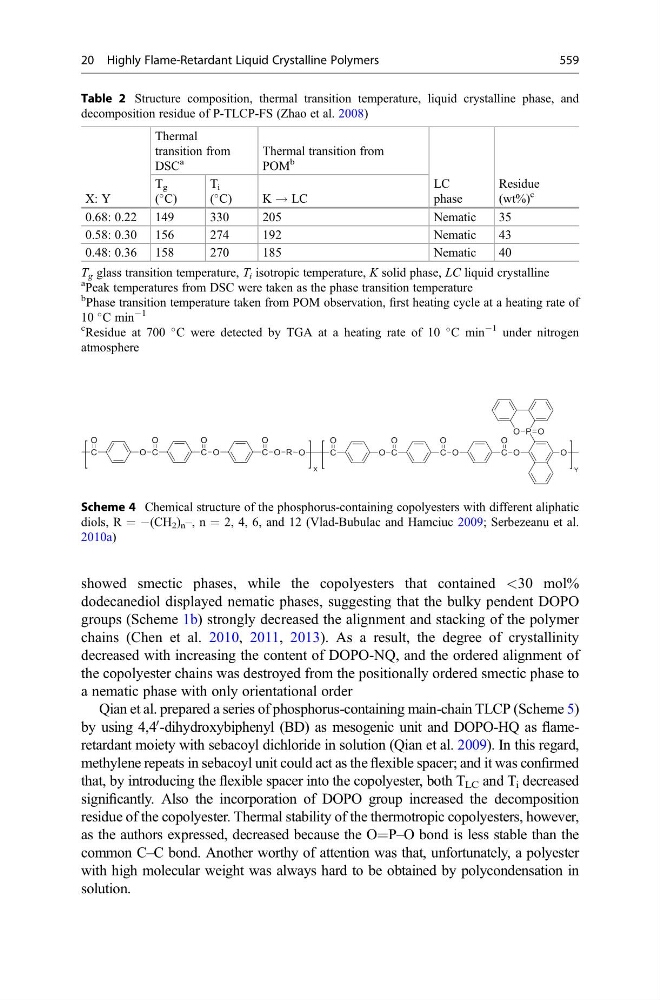
Scheme 4 Chemical structure of the phosphorus-containing copolyesters with different aliphatic
diols, R = À(CH 2 ) n –, n = 2, 4, 6, and 12 (Vlad-Bubulac and Hamciuc 2009; Serbezeanu et al.
2010a)
20 Highly Flame-Retardant Liquid Crystalline Polymers
559
dodecanediol displayed nematic phases, suggesting that the bulky pendent DOPO
groups (Scheme 1b) strongly decreased the alignment and stacking of the polymer
chains (Chen et al. 2010, 2011, 2013). As a result, the degree of crystallinity
decreased with increasing the content of DOPO-NQ, and the ordered alignment of
the copolyester chains was destroyed from the positionally ordered smectic phase to
a nematic phase with only orientational order
Qian et al. prepared a series of phosphorus-containing main-chain TLCP (Scheme 5)
by using 4,4
0 -dihydroxybiphenyl (BD) as mesogenic unit and DOPO-HQ as flameretardant moiety with sebacoyl dichloride in solution (Qian et al. 2009). In this regard,
methylene repeats in sebacoyl unit could act as the flexible spacer; and it was confirmed
that, by introducing the flexible spacer into the copolyester, both T LC and T i decreased
significantly. Also the incorporation of DOPO group increased the decomposition
residue of the copolyester. Thermal stability of the thermotropic copolyesters, however,
as the authors expressed, decreased because the O=P–O bond is less stable than the
common C–C bond. Another worthy of attention was that, unfortunately, a polyester
with high molecular weight was always hard to be obtained by polycondensation in
solution.
Table 2 Structure composition, thermal transition temperature, liquid crystalline phase, and
decomposition residue of P-TLCP-FS (Zhao et al. 2008)
X: Y
Thermal
transition from
DSC
a
Thermal transition from
POM
b
LC
phase
Residue
(wt%)
c
T g
(
C)
T i
(
C)
K ! LC
0.68: 0.22 149
330
205
Nematic
35
0.58: 0.30 156
274
192
Nematic
43
0.48: 0.36 158
270
185
Nematic
40
T g glass transition temperature, T i isotropic temperature, K solid phase, LC liquid crystalline
a Peak temperatures from DSC were taken as the phase transition temperature
b
Phase transition temperature taken from POM observation, first heating cycle at a heating rate of
10
C min
À1
c Residue at 700
C were detected by TGA at a heating rate of 10
C min
À1 under nitrogen
atmosphere
Scheme 4 Chemical structure of the phosphorus-containing copolyesters with different aliphatic
diols, R = À(CH 2 ) n –, n = 2, 4, 6, and 12 (Vlad-Bubulac and Hamciuc 2009; Serbezeanu et al.
2010a)
20 Highly Flame-Retardant Liquid Crystalline Polymers
559