

containing moiety. To decrease the transition temperatures, aliphatic diols as flexible
spacers were incorporated, as illustrated in Scheme 4 and Table 3. The authors
first investigated the LC behaviors of the phosphorus-containing liquid
crystalline copolyesters with different length of aliphatic units (Vlad-Bubulac and
Hamciuc 2009). Results suggested that, all the copolyesters exhibited good thermal
stability with initial decomposition temperature above 375
C, and T g s in the range
of 89–138
C. The degree of crystallinity increases by increasing the number of
methylene repeats, and the copolyester which had the lowest isotropic temperature,
was the polymer containing the longest flexible 12-methylene spacer linkage. As for
the copolyesters containing shorter flexible spacers (say, 2-, 3-, 4- or 6-methylene
units), they exhibited the most birefringent LC textures and showed isotropic
temperature higher than 280
C. Further, the influence of the content of the aliphatic
unit on the phase behavior of the copolyesters was also investigated (where 1,12dodecanediol was utilized as the flexible spacers) (Serbezeanu et al. 2010b). The
authors declared that, the copolyesters that contained >30 mol% dodecanediol
Table 1 Structure composition, thermal transition temperature, liquid crystalline phase, and
decomposition residue of PLCP Ar where the molar ratio between TPA and IPA is 1:1 (Wang et al.
2002; Chen et al. 2002)
X
Thermal transition
from DSC
a
Thermal transition from POM
b
LC phase Residue (wt%)
c
T g (
C)
T LC (
C)
K ! LC
0.80 184
–
290
Nematic
50
0.75 183
290
288
Nematic
41
0.67 185
287
285
Nematic
52
0.60 188
–
284
Nematic
47
0.50 192
–
279
Nematic
49
0.33 192
–
271
Nematic
49
T g glass transition temperature, T LC liquid crystalline temperature, K solid phase, LC liquid
crystalline
a Peak temperatures from DSC were taken as the phase transition temperature; (À) denoted transition
not observed
b
Phase transition temperature taken from POM observation, first heating cycle at a heating rate of
10
C min
À1
c Residue at 640
C were detected by TGA at a heating rate of 10
C min
À1 under nitrogen
atmosphere
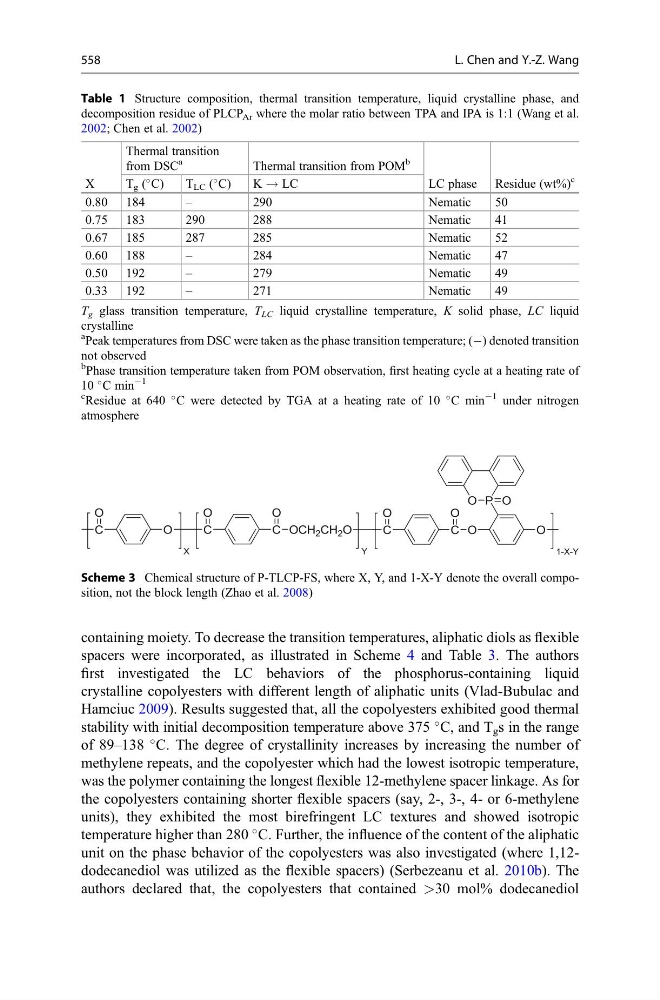
Scheme 3 Chemical structure of P-TLCP-FS, where X, Y, and 1-X-Y denote the overall composition, not the block length (Zhao et al. 2008)
558
L. Chen and Y.-Z. Wang
spacers were incorporated, as illustrated in Scheme 4 and Table 3. The authors
first investigated the LC behaviors of the phosphorus-containing liquid
crystalline copolyesters with different length of aliphatic units (Vlad-Bubulac and
Hamciuc 2009). Results suggested that, all the copolyesters exhibited good thermal
stability with initial decomposition temperature above 375
C, and T g s in the range
of 89–138
C. The degree of crystallinity increases by increasing the number of
methylene repeats, and the copolyester which had the lowest isotropic temperature,
was the polymer containing the longest flexible 12-methylene spacer linkage. As for
the copolyesters containing shorter flexible spacers (say, 2-, 3-, 4- or 6-methylene
units), they exhibited the most birefringent LC textures and showed isotropic
temperature higher than 280
C. Further, the influence of the content of the aliphatic
unit on the phase behavior of the copolyesters was also investigated (where 1,12dodecanediol was utilized as the flexible spacers) (Serbezeanu et al. 2010b). The
authors declared that, the copolyesters that contained >30 mol% dodecanediol
Table 1 Structure composition, thermal transition temperature, liquid crystalline phase, and
decomposition residue of PLCP Ar where the molar ratio between TPA and IPA is 1:1 (Wang et al.
2002; Chen et al. 2002)
X
Thermal transition
from DSC
a
Thermal transition from POM
b
LC phase Residue (wt%)
c
T g (
C)
T LC (
C)
K ! LC
0.80 184
–
290
Nematic
50
0.75 183
290
288
Nematic
41
0.67 185
287
285
Nematic
52
0.60 188
–
284
Nematic
47
0.50 192
–
279
Nematic
49
0.33 192
–
271
Nematic
49
T g glass transition temperature, T LC liquid crystalline temperature, K solid phase, LC liquid
crystalline
a Peak temperatures from DSC were taken as the phase transition temperature; (À) denoted transition
not observed
b
Phase transition temperature taken from POM observation, first heating cycle at a heating rate of
10
C min
À1
c Residue at 640
C were detected by TGA at a heating rate of 10
C min
À1 under nitrogen
atmosphere
Scheme 3 Chemical structure of P-TLCP-FS, where X, Y, and 1-X-Y denote the overall composition, not the block length (Zhao et al. 2008)
558
L. Chen and Y.-Z. Wang