

consistent with the sizes of the gas molecules, such as in the gas critical volume:
73.4 cm
3 mol
À1 (O 2 ), 90.1 cm
3 mol
À1 (N 2 ), and 94.1 cm
3 mol
À1 (CO 2 ) (Poling
et al. 2000). Although the gas permeability and solubility in liquid crystalline polymers are lower than those of crystalline polymers, only the gas diffusivity in liquid
crystalline polymers is comparable with or lower than that of crystalline polymers
like PET and PEN.
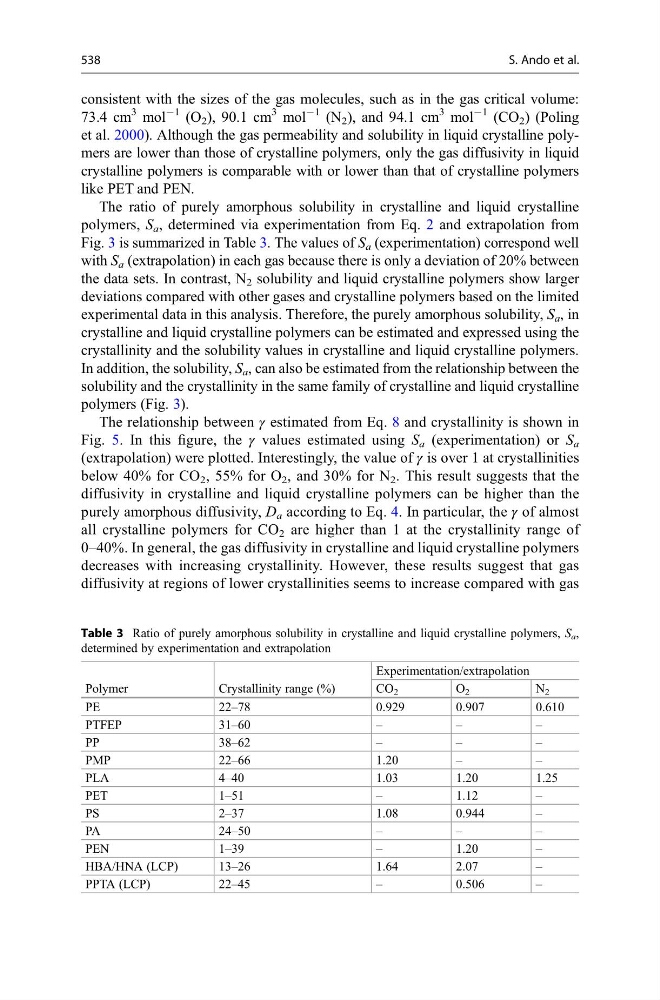
The ratio of purely amorphous solubility in crystalline and liquid crystalline
polymers, S a , determined via experimentation from Eq. 2 and extrapolation from
Fig. 3 is summarized in Table 3. The values of S a (experimentation) correspond well
with S a (extrapolation) in each gas because there is only a deviation of 20% between
the data sets. In contrast, N 2 solubility and liquid crystalline polymers show larger
deviations compared with other gases and crystalline polymers based on the limited
experimental data in this analysis. Therefore, the purely amorphous solubility, S a , in
crystalline and liquid crystalline polymers can be estimated and expressed using the
crystallinity and the solubility values in crystalline and liquid crystalline polymers.
In addition, the solubility, S a , can also be estimated from the relationship between the
solubility and the crystallinity in the same family of crystalline and liquid crystalline
polymers (Fig. 3).
The relationship between γ estimated from Eq. 8 and crystallinity is shown in
Fig. 5. In this figure, the γ values estimated using S a (experimentation) or S a
(extrapolation) were plotted. Interestingly, the value of γ is over 1 at crystallinities
below 40% for CO 2 , 55% for O 2 , and 30% for N 2 . This result suggests that the
diffusivity in crystalline and liquid crystalline polymers can be higher than the
purely amorphous diffusivity, D a according to Eq. 4. In particular, the γ of almost
all crystalline polymers for CO 2 are higher than 1 at the crystallinity range of
0–40%. In general, the gas diffusivity in crystalline and liquid crystalline polymers
decreases with increasing crystallinity. However, these results suggest that gas
diffusivity at regions of lower crystallinities seems to increase compared with gas
Table 3 Ratio of purely amorphous solubility in crystalline and liquid crystalline polymers, S a ,
determined by experimentation and extrapolation
Polymer
Crystallinity range (%)
Experimentation/extrapolation
CO 2
O 2
N 2
PE
22–78
0.929
0.907
0.610
PTFEP
31–60
–
–
–
PP
38–62
–
–
–
PMP
22–66
1.20
–
–
PLA
4–40
1.03
1.20
1.25
PET
1–51
–
1.12
–
PS
2–37
1.08
0.944
–
PA
24–50
–
–
–
PEN
1–39
–
1.20
–
HBA/HNA (LCP)
13–26
1.64
2.07
–
PPTA (LCP)
22–45
–
0.506
–
538
S. Ando et al.
73.4 cm
3 mol
À1 (O 2 ), 90.1 cm
3 mol
À1 (N 2 ), and 94.1 cm
3 mol
À1 (CO 2 ) (Poling
et al. 2000). Although the gas permeability and solubility in liquid crystalline polymers are lower than those of crystalline polymers, only the gas diffusivity in liquid
crystalline polymers is comparable with or lower than that of crystalline polymers
like PET and PEN.
The ratio of purely amorphous solubility in crystalline and liquid crystalline
polymers, S a , determined via experimentation from Eq. 2 and extrapolation from
Fig. 3 is summarized in Table 3. The values of S a (experimentation) correspond well
with S a (extrapolation) in each gas because there is only a deviation of 20% between
the data sets. In contrast, N 2 solubility and liquid crystalline polymers show larger
deviations compared with other gases and crystalline polymers based on the limited
experimental data in this analysis. Therefore, the purely amorphous solubility, S a , in
crystalline and liquid crystalline polymers can be estimated and expressed using the
crystallinity and the solubility values in crystalline and liquid crystalline polymers.
In addition, the solubility, S a , can also be estimated from the relationship between the
solubility and the crystallinity in the same family of crystalline and liquid crystalline
polymers (Fig. 3).
The relationship between γ estimated from Eq. 8 and crystallinity is shown in
Fig. 5. In this figure, the γ values estimated using S a (experimentation) or S a
(extrapolation) were plotted. Interestingly, the value of γ is over 1 at crystallinities
below 40% for CO 2 , 55% for O 2 , and 30% for N 2 . This result suggests that the
diffusivity in crystalline and liquid crystalline polymers can be higher than the
purely amorphous diffusivity, D a according to Eq. 4. In particular, the γ of almost
all crystalline polymers for CO 2 are higher than 1 at the crystallinity range of
0–40%. In general, the gas diffusivity in crystalline and liquid crystalline polymers
decreases with increasing crystallinity. However, these results suggest that gas
diffusivity at regions of lower crystallinities seems to increase compared with gas
Table 3 Ratio of purely amorphous solubility in crystalline and liquid crystalline polymers, S a ,
determined by experimentation and extrapolation
Polymer
Crystallinity range (%)
Experimentation/extrapolation
CO 2
O 2
N 2
PE
22–78
0.929
0.907
0.610
PTFEP
31–60
–
–
–
PP
38–62
–
–
–
PMP
22–66
1.20
–
–
PLA
4–40
1.03
1.20
1.25
PET
1–51
–
1.12
–
PS
2–37
1.08
0.944
–
PA
24–50
–
–
–
PEN
1–39
–
1.20
–
HBA/HNA (LCP)
13–26
1.64
2.07
–
PPTA (LCP)
22–45
–
0.506
–
538
S. Ando et al.