

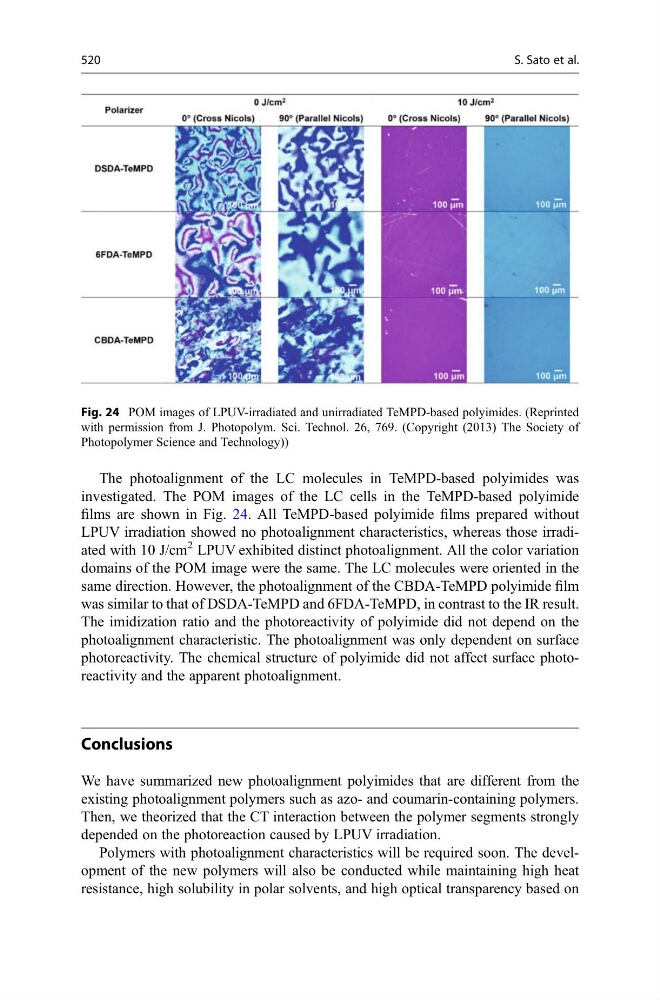
The photoalignment of the LC molecules in TeMPD-based polyimides was
investigated. The POM images of the LC cells in the TeMPD-based polyimide
films are shown in Fig. 24. All TeMPD-based polyimide films prepared without
LPUV irradiation showed no photoalignment characteristics, whereas those irradiated with 10 J/cm
2 LPUV exhibited distinct photoalignment. All the color variation
domains of the POM image were the same. The LC molecules were oriented in the
same direction. However, the photoalignment of the CBDA-TeMPD polyimide film
was similar to that of DSDA-TeMPD and 6FDA-TeMPD, in contrast to the IR result.
The imidization ratio and the photoreactivity of polyimide did not depend on the
photoalignment characteristic. The photoalignment was only dependent on surface
photoreactivity. The chemical structure of polyimide did not affect surface photoreactivity and the apparent photoalignment.
Conclusions
We have summarized new photoalignment polyimides that are different from the
existing photoalignment polymers such as azo- and coumarin-containing polymers.
Then, we theorized that the CT interaction between the polymer segments strongly
depended on the photoreaction caused by LPUV irradiation.
Polymers with photoalignment characteristics will be required soon. The development of the new polymers will also be conducted while maintaining high heat
resistance, high solubility in polar solvents, and high optical transparency based on
Fig. 24 POM images of LPUV-irradiated and unirradiated TeMPD-based polyimides. (Reprinted
with permission from J. Photopolym. Sci. Technol. 26, 769. (Copyright (2013) The Society of
Photopolymer Science and Technology))
520
S. Sato et al.
investigated. The POM images of the LC cells in the TeMPD-based polyimide
films are shown in Fig. 24. All TeMPD-based polyimide films prepared without
LPUV irradiation showed no photoalignment characteristics, whereas those irradiated with 10 J/cm
2 LPUV exhibited distinct photoalignment. All the color variation
domains of the POM image were the same. The LC molecules were oriented in the
same direction. However, the photoalignment of the CBDA-TeMPD polyimide film
was similar to that of DSDA-TeMPD and 6FDA-TeMPD, in contrast to the IR result.
The imidization ratio and the photoreactivity of polyimide did not depend on the
photoalignment characteristic. The photoalignment was only dependent on surface
photoreactivity. The chemical structure of polyimide did not affect surface photoreactivity and the apparent photoalignment.
Conclusions
We have summarized new photoalignment polyimides that are different from the
existing photoalignment polymers such as azo- and coumarin-containing polymers.
Then, we theorized that the CT interaction between the polymer segments strongly
depended on the photoreaction caused by LPUV irradiation.
Polymers with photoalignment characteristics will be required soon. The development of the new polymers will also be conducted while maintaining high heat
resistance, high solubility in polar solvents, and high optical transparency based on
Fig. 24 POM images of LPUV-irradiated and unirradiated TeMPD-based polyimides. (Reprinted
with permission from J. Photopolym. Sci. Technol. 26, 769. (Copyright (2013) The Society of
Photopolymer Science and Technology))
520
S. Sato et al.