

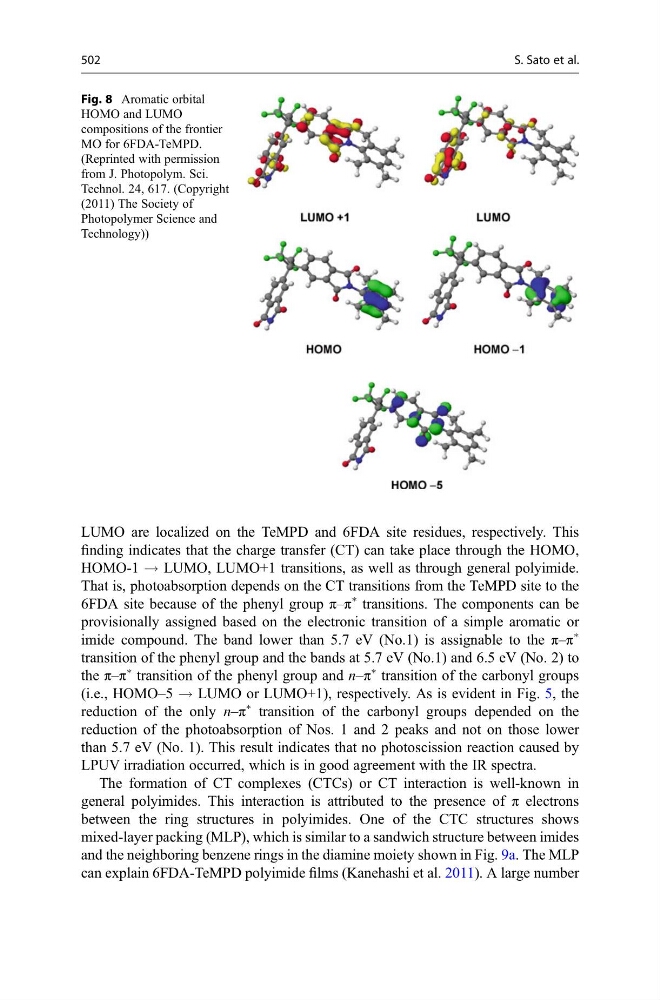
LUMO are localized on the TeMPD and 6FDA site residues, respectively. This
finding indicates that the charge transfer (CT) can take place through the HOMO,
HOMO-1 ! LUMO, LUMO+1 transitions, as well as through general polyimide.
That is, photoabsorption depends on the CT transitions from the TeMPD site to the
6FDA site because of the phenyl group π–π
à transitions. The components can be
provisionally assigned based on the electronic transition of a simple aromatic or
imide compound. The band lower than 5.7 eV (No.1) is assignable to the π–π
Ã
transition of the phenyl group and the bands at 5.7 eV (No.1) and 6.5 eV (No. 2) to
the π–π
à transition of the phenyl group and n–π
à transition of the carbonyl groups
(i.e., HOMO–5 ! LUMO or LUMO+1), respectively. As is evident in Fig. 5, the
reduction of the only n–π
à transition of the carbonyl groups depended on the
reduction of the photoabsorption of Nos. 1 and 2 peaks and not on those lower
than 5.7 eV (No. 1). This result indicates that no photoscission reaction caused by
LPUV irradiation occurred, which is in good agreement with the IR spectra.
The formation of CT complexes (CTCs) or CT interaction is well-known in
general polyimides. This interaction is attributed to the presence of π electrons
between the ring structures in polyimides. One of the CTC structures shows
mixed-layer packing (MLP), which is similar to a sandwich structure between imides
and the neighboring benzene rings in the diamine moiety shown in Fig. 9a. The MLP
can explain 6FDA-TeMPD polyimide films (Kanehashi et al. 2011). A large number
Fig. 8 Aromatic orbital
HOMO and LUMO
compositions of the frontier
MO for 6FDA-TeMPD.
(Reprinted with permission
from J. Photopolym. Sci.
Technol. 24, 617. (Copyright
(2011) The Society of
Photopolymer Science and
Technology))
502
S. Sato et al.
finding indicates that the charge transfer (CT) can take place through the HOMO,
HOMO-1 ! LUMO, LUMO+1 transitions, as well as through general polyimide.
That is, photoabsorption depends on the CT transitions from the TeMPD site to the
6FDA site because of the phenyl group π–π
à transitions. The components can be
provisionally assigned based on the electronic transition of a simple aromatic or
imide compound. The band lower than 5.7 eV (No.1) is assignable to the π–π
Ã
transition of the phenyl group and the bands at 5.7 eV (No.1) and 6.5 eV (No. 2) to
the π–π
à transition of the phenyl group and n–π
à transition of the carbonyl groups
(i.e., HOMO–5 ! LUMO or LUMO+1), respectively. As is evident in Fig. 5, the
reduction of the only n–π
à transition of the carbonyl groups depended on the
reduction of the photoabsorption of Nos. 1 and 2 peaks and not on those lower
than 5.7 eV (No. 1). This result indicates that no photoscission reaction caused by
LPUV irradiation occurred, which is in good agreement with the IR spectra.
The formation of CT complexes (CTCs) or CT interaction is well-known in
general polyimides. This interaction is attributed to the presence of π electrons
between the ring structures in polyimides. One of the CTC structures shows
mixed-layer packing (MLP), which is similar to a sandwich structure between imides
and the neighboring benzene rings in the diamine moiety shown in Fig. 9a. The MLP
can explain 6FDA-TeMPD polyimide films (Kanehashi et al. 2011). A large number
Fig. 8 Aromatic orbital
HOMO and LUMO
compositions of the frontier
MO for 6FDA-TeMPD.
(Reprinted with permission
from J. Photopolym. Sci.
Technol. 24, 617. (Copyright
(2011) The Society of
Photopolymer Science and
Technology))
502
S. Sato et al.