

nomenclature: LCBBCx-25 k represents LC brush block copolymer, where x represents weight percentage (wt %) of NBCB 12 and 25 k represents total MW of
copolymers. The composition, molecular weight, and PDI of LCBBC are compiled
in Table 1.
Thermal Properties
The thermal gravimetric analysis (TGA) was used to study the thermal stability of
the copolymer sample. The LCBBC73–25 k undergoes thermal degradation beginning (onset) at 370
C with a total mass loss of 4.9%. 50% of the copolymer degrades
at 416
C. There is a small amount (8%) of inert residue remaining at 600
C (Fig. 3).
Thermal properties of LCBBCs are investigated using differential scanning
calorimetry (DSC) as shown in Fig. 4. Transition temperature and enthalpy values
corresponding to (LCBBC73–25 k) are shown in Table 2. The copolymer
(LCBBC73–25 k) is initially heated to 150
C, cooled to – 40
C, and reheated to
150
C. The first heating cycle is used to eliminate the thermal history of the sample.
Distinct T g and T Cl transitions can be seen in second cooling cycle of DSC thermograms (Fig. 4) and presented in Table 2. T g is a characteristic of norbornene
backbone, while T LC represents liquid crystalline order.
7.5
2.12
1.13
1.00
0.50
0.46
2.21
0.13
5.43
0.12
0.32
0.91
0.34
0.87
1.76
2.34
1.59
8.81
7.0
6.5
6.0
5.5
5.0
4.5
4.0
3.5
3.0
2.5
2.0
1.5 ppm
7.584
7.461
6.930
5.290
5.179
3.934
3.601
3.330
3.046
2.861
2.442
1.911
1.739
1.579
1.418
1.221
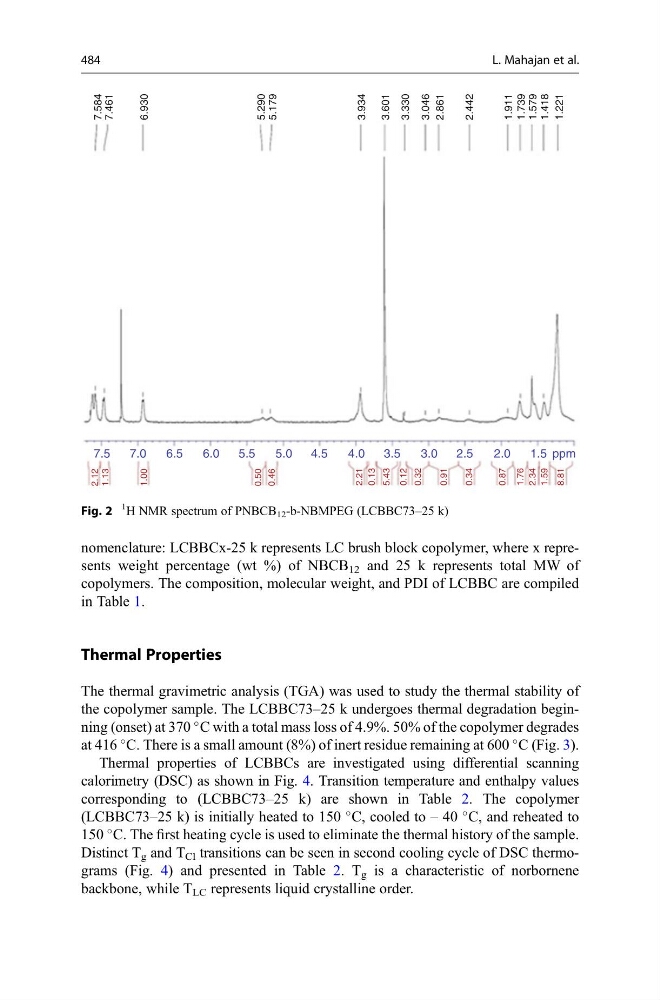
Fig. 2
1
H NMR spectrum of PNBCB 12 -b-NBMPEG (LCBBC73–25 k)
484
L. Mahajan et al.
copolymers. The composition, molecular weight, and PDI of LCBBC are compiled
in Table 1.
Thermal Properties
The thermal gravimetric analysis (TGA) was used to study the thermal stability of
the copolymer sample. The LCBBC73–25 k undergoes thermal degradation beginning (onset) at 370
C with a total mass loss of 4.9%. 50% of the copolymer degrades
at 416
C. There is a small amount (8%) of inert residue remaining at 600
C (Fig. 3).
Thermal properties of LCBBCs are investigated using differential scanning
calorimetry (DSC) as shown in Fig. 4. Transition temperature and enthalpy values
corresponding to (LCBBC73–25 k) are shown in Table 2. The copolymer
(LCBBC73–25 k) is initially heated to 150
C, cooled to – 40
C, and reheated to
150
C. The first heating cycle is used to eliminate the thermal history of the sample.
Distinct T g and T Cl transitions can be seen in second cooling cycle of DSC thermograms (Fig. 4) and presented in Table 2. T g is a characteristic of norbornene
backbone, while T LC represents liquid crystalline order.
7.5
2.12
1.13
1.00
0.50
0.46
2.21
0.13
5.43
0.12
0.32
0.91
0.34
0.87
1.76
2.34
1.59
8.81
7.0
6.5
6.0
5.5
5.0
4.5
4.0
3.5
3.0
2.5
2.0
1.5 ppm
7.584
7.461
6.930
5.290
5.179
3.934
3.601
3.330
3.046
2.861
2.442
1.911
1.739
1.579
1.418
1.221
Fig. 2
1
H NMR spectrum of PNBCB 12 -b-NBMPEG (LCBBC73–25 k)
484
L. Mahajan et al.