

to deform into exotic three-dimensional shapes prescribed by the original director
pattern (de Haan et al. 2012; McConney et al. 2013; Ware et al. 2015).
To finish, another class of photodeformation in LCPs has been recently revealed
by Broer and coworkers. Liquid crystalline polymeric coatings patterned with
homeotropic and planarly aligned cholesteric regions lead to a surface deformation
of the film. These systems exploit again the order disruption ability of the photogenerated cis isomer. While UV-induced order decrease make homeotropic regions
to diminish their thickness, the pitch of helical structures in cholesteric liquid crystals
vertically expands leading to a modulated surface topography. Dynamic control of
the topography over large areas generated with these coatings can find applications
in the fields of responsive photonics, topology-modulated friction, or switchable
wettability (Liu et al. 2012).
Summary and Outlook
When light is applied to azobenzene containing liquid crystalline polymeric materials, transformations and motions of the photosensitive units take place at a molecular level. Cooperative effects of liquid crystalline polymers can amplify these lightinduced molecular motions leading to enhanced macroscopic properties. Precise
tailoring of the macromolecular scaffolds and functionalization with photosensitive
azobenzene moieties have led to optimized systems for specific applications.
As representative applications examples, rational molecular design of block
copolymer systems having photoresponsive liquid crystalline blocks has led to
highly diluted azobenzene materials suitable for volume holographic recording.
Photoalignment of block copolymer morphologies has also been demonstrated to
be of great potential in the nanopatterning of surfaces. Finally, the transduction of
light into mechanical deformation of azobenzene containing LCPs reveals the ability
of these systems to turn molecular changes into motions at much larger length scales.
The molecular dimensional change upon azobenzene isomerization in the order of
the nanometer is able to turn into film deformations of centimeters. Photoinduced
bending, coiling, helicoidal, and other three-dimensional deformations have been
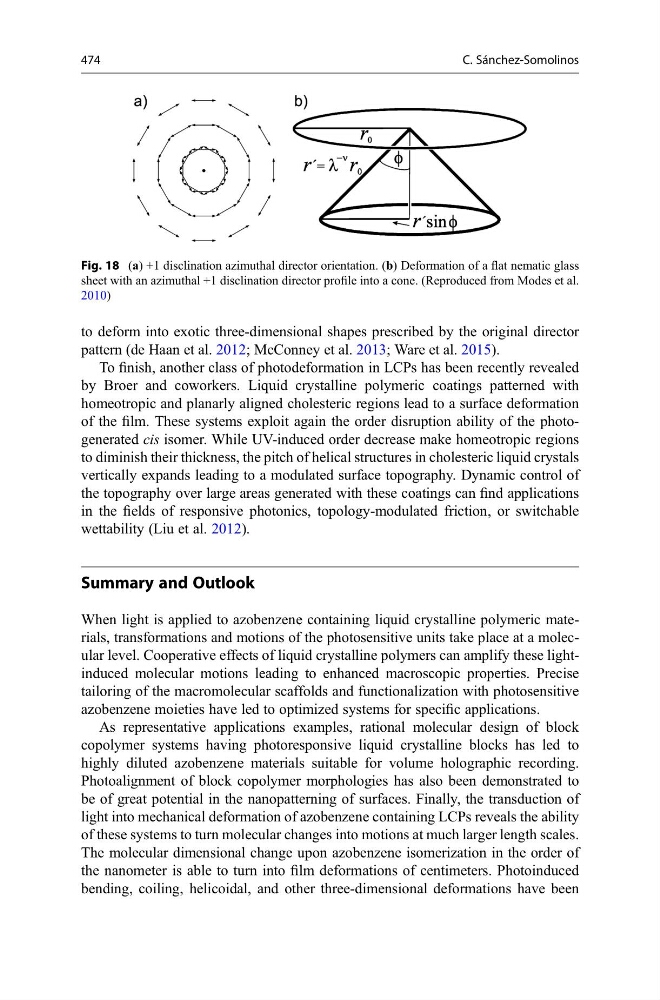
Fig. 18 (a) +1 disclination azimuthal director orientation. (b) Deformation of a flat nematic glass
sheet with an azimuthal +1 disclination director profile into a cone. (Reproduced from Modes et al.
2010)
474
C. Sánchez-Somolinos
pattern (de Haan et al. 2012; McConney et al. 2013; Ware et al. 2015).
To finish, another class of photodeformation in LCPs has been recently revealed
by Broer and coworkers. Liquid crystalline polymeric coatings patterned with
homeotropic and planarly aligned cholesteric regions lead to a surface deformation
of the film. These systems exploit again the order disruption ability of the photogenerated cis isomer. While UV-induced order decrease make homeotropic regions
to diminish their thickness, the pitch of helical structures in cholesteric liquid crystals
vertically expands leading to a modulated surface topography. Dynamic control of
the topography over large areas generated with these coatings can find applications
in the fields of responsive photonics, topology-modulated friction, or switchable
wettability (Liu et al. 2012).
Summary and Outlook
When light is applied to azobenzene containing liquid crystalline polymeric materials, transformations and motions of the photosensitive units take place at a molecular level. Cooperative effects of liquid crystalline polymers can amplify these lightinduced molecular motions leading to enhanced macroscopic properties. Precise
tailoring of the macromolecular scaffolds and functionalization with photosensitive
azobenzene moieties have led to optimized systems for specific applications.
As representative applications examples, rational molecular design of block
copolymer systems having photoresponsive liquid crystalline blocks has led to
highly diluted azobenzene materials suitable for volume holographic recording.
Photoalignment of block copolymer morphologies has also been demonstrated to
be of great potential in the nanopatterning of surfaces. Finally, the transduction of
light into mechanical deformation of azobenzene containing LCPs reveals the ability
of these systems to turn molecular changes into motions at much larger length scales.
The molecular dimensional change upon azobenzene isomerization in the order of
the nanometer is able to turn into film deformations of centimeters. Photoinduced
bending, coiling, helicoidal, and other three-dimensional deformations have been
Fig. 18 (a) +1 disclination azimuthal director orientation. (b) Deformation of a flat nematic glass
sheet with an azimuthal +1 disclination director profile into a cone. (Reproduced from Modes et al.
2010)
474
C. Sánchez-Somolinos