

deformation, helicoid or coil, as well as the handedness, depends for a given system
on geometrical aspects such as the width of the ribbon, the angle of the director at the
mid-plane with respect the long direction of the ribbon and the handedness of the TN
structure. The ability of these light responsive curling actuators to perform mechanical work has been tested in different configurations. The winding of the coils have
demonstrated to work against gravity lifting weight. More sophisticated constructs
consisting of one single ribbon having a small central flat region connecting two
coils of different handedness have shown to perform piston-like movement under the
action of light. Illumination with UV produces winding of one the coils and
unwinding of the other so the central flat region effectively moves while visible
light recovers the system to the original state (Iamsaard et al. 2014).
As presented in this section, most of the work in the field of photoactuators has
been done in samples with a stripe geometry presenting contraction, bending or
coiling deformations. The theoretical work of Warner on the deformation behavior
of nematic glass sheets having a nonhomogeneous director field in the plane has
brought a new paradigm in the field of soft liquid crystalline polymeric actuators. A
change in the order parameter leads to stretches that the film cannot accommodate in
the plane so it deforms into the third dimension. In particular, the mechanical response
of nematic glass sheets with disclination type director fields with topological charge
+1 has been theoretically described by Warner and coworkers (Modes et al. 2010). As
an example, nematic glass thin sheets having an azimuthal distribution of the director
deform upon disorder increase from a flat to a conical shape with the disclination
defect at the cone apex (Fig. 18). This and other complex two- and three-dimensional
patterns have been materialized in soft liquid crystalline materials and demonstrated
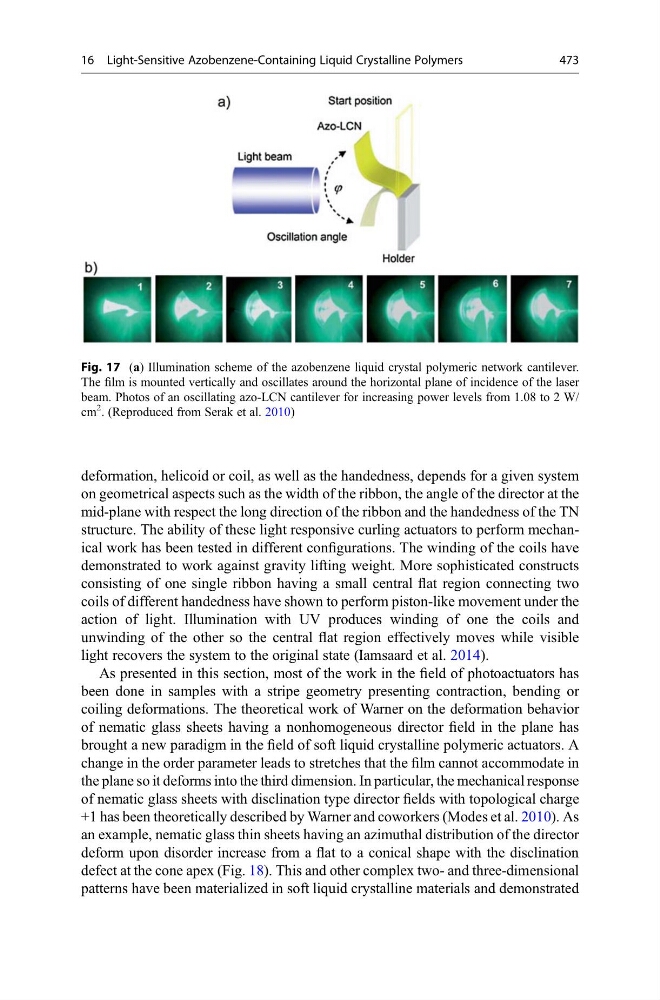
Fig. 17 (a) Illumination scheme of the azobenzene liquid crystal polymeric network cantilever.
The film is mounted vertically and oscillates around the horizontal plane of incidence of the laser
beam. Photos of an oscillating azo-LCN cantilever for increasing power levels from 1.08 to 2 W/
cm
2
. (Reproduced from Serak et al. 2010)
16 Light-Sensitive Azobenzene-Containing Liquid Crystalline Polymers
473
on geometrical aspects such as the width of the ribbon, the angle of the director at the
mid-plane with respect the long direction of the ribbon and the handedness of the TN
structure. The ability of these light responsive curling actuators to perform mechanical work has been tested in different configurations. The winding of the coils have
demonstrated to work against gravity lifting weight. More sophisticated constructs
consisting of one single ribbon having a small central flat region connecting two
coils of different handedness have shown to perform piston-like movement under the
action of light. Illumination with UV produces winding of one the coils and
unwinding of the other so the central flat region effectively moves while visible
light recovers the system to the original state (Iamsaard et al. 2014).
As presented in this section, most of the work in the field of photoactuators has
been done in samples with a stripe geometry presenting contraction, bending or
coiling deformations. The theoretical work of Warner on the deformation behavior
of nematic glass sheets having a nonhomogeneous director field in the plane has
brought a new paradigm in the field of soft liquid crystalline polymeric actuators. A
change in the order parameter leads to stretches that the film cannot accommodate in
the plane so it deforms into the third dimension. In particular, the mechanical response
of nematic glass sheets with disclination type director fields with topological charge
+1 has been theoretically described by Warner and coworkers (Modes et al. 2010). As
an example, nematic glass thin sheets having an azimuthal distribution of the director
deform upon disorder increase from a flat to a conical shape with the disclination
defect at the cone apex (Fig. 18). This and other complex two- and three-dimensional
patterns have been materialized in soft liquid crystalline materials and demonstrated
Fig. 17 (a) Illumination scheme of the azobenzene liquid crystal polymeric network cantilever.
The film is mounted vertically and oscillates around the horizontal plane of incidence of the laser
beam. Photos of an oscillating azo-LCN cantilever for increasing power levels from 1.08 to 2 W/
cm
2
. (Reproduced from Serak et al. 2010)
16 Light-Sensitive Azobenzene-Containing Liquid Crystalline Polymers
473