

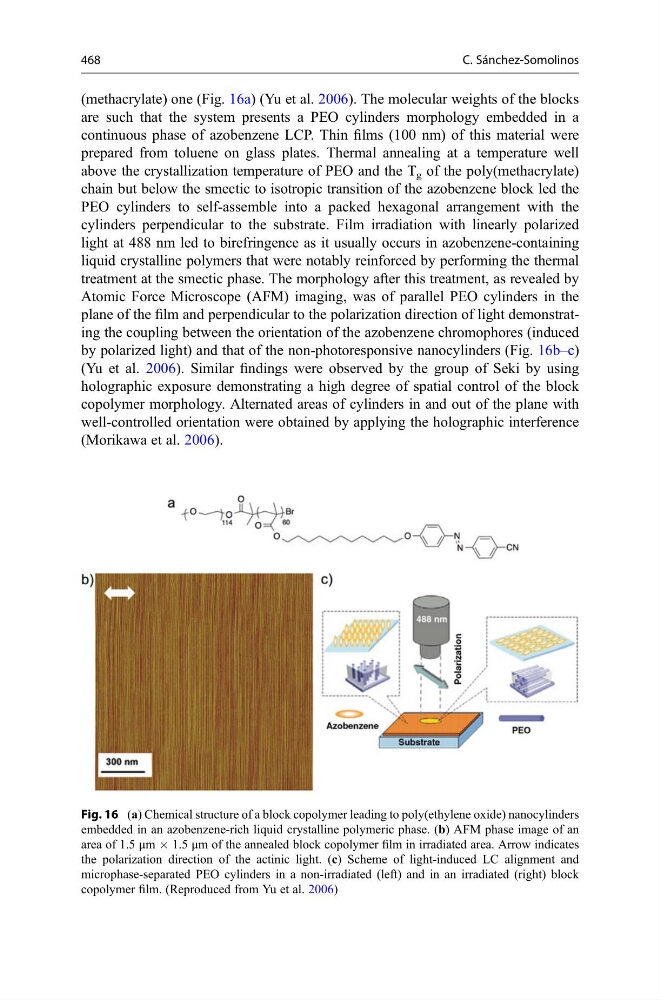
(methacrylate) one (Fig. 16a) (Yu et al. 2006). The molecular weights of the blocks
are such that the system presents a PEO cylinders morphology embedded in a
continuous phase of azobenzene LCP. Thin films (100 nm) of this material were
prepared from toluene on glass plates. Thermal annealing at a temperature well
above the crystallization temperature of PEO and the T g of the poly(methacrylate)
chain but below the smectic to isotropic transition of the azobenzene block led the
PEO cylinders to self-assemble into a packed hexagonal arrangement with the
cylinders perpendicular to the substrate. Film irradiation with linearly polarized
light at 488 nm led to birefringence as it usually occurs in azobenzene-containing
liquid crystalline polymers that were notably reinforced by performing the thermal
treatment at the smectic phase. The morphology after this treatment, as revealed by
Atomic Force Microscope (AFM) imaging, was of parallel PEO cylinders in the
plane of the film and perpendicular to the polarization direction of light demonstrating the coupling between the orientation of the azobenzene chromophores (induced
by polarized light) and that of the non-photoresponsive nanocylinders (Fig. 16b–c)
(Yu et al. 2006). Similar findings were observed by the group of Seki by using
holographic exposure demonstrating a high degree of spatial control of the block
copolymer morphology. Alternated areas of cylinders in and out of the plane with
well-controlled orientation were obtained by applying the holographic interference
(Morikawa et al. 2006).
Fig. 16 (a) Chemical structure of a block copolymer leading to poly(ethylene oxide) nanocylinders
embedded in an azobenzene-rich liquid crystalline polymeric phase. (b) AFM phase image of an
area of 1.5 μm  1.5 μm of the annealed block copolymer film in irradiated area. Arrow indicates
the polarization direction of the actinic light. (c) Scheme of light-induced LC alignment and
microphase-separated PEO cylinders in a non-irradiated (left) and in an irradiated (right) block
copolymer film. (Reproduced from Yu et al. 2006)
468
C. Sánchez-Somolinos
are such that the system presents a PEO cylinders morphology embedded in a
continuous phase of azobenzene LCP. Thin films (100 nm) of this material were
prepared from toluene on glass plates. Thermal annealing at a temperature well
above the crystallization temperature of PEO and the T g of the poly(methacrylate)
chain but below the smectic to isotropic transition of the azobenzene block led the
PEO cylinders to self-assemble into a packed hexagonal arrangement with the
cylinders perpendicular to the substrate. Film irradiation with linearly polarized
light at 488 nm led to birefringence as it usually occurs in azobenzene-containing
liquid crystalline polymers that were notably reinforced by performing the thermal
treatment at the smectic phase. The morphology after this treatment, as revealed by
Atomic Force Microscope (AFM) imaging, was of parallel PEO cylinders in the
plane of the film and perpendicular to the polarization direction of light demonstrating the coupling between the orientation of the azobenzene chromophores (induced
by polarized light) and that of the non-photoresponsive nanocylinders (Fig. 16b–c)
(Yu et al. 2006). Similar findings were observed by the group of Seki by using
holographic exposure demonstrating a high degree of spatial control of the block
copolymer morphology. Alternated areas of cylinders in and out of the plane with
well-controlled orientation were obtained by applying the holographic interference
(Morikawa et al. 2006).
Fig. 16 (a) Chemical structure of a block copolymer leading to poly(ethylene oxide) nanocylinders
embedded in an azobenzene-rich liquid crystalline polymeric phase. (b) AFM phase image of an
area of 1.5 μm  1.5 μm of the annealed block copolymer film in irradiated area. Arrow indicates
the polarization direction of the actinic light. (c) Scheme of light-induced LC alignment and
microphase-separated PEO cylinders in a non-irradiated (left) and in an irradiated (right) block
copolymer film. (Reproduced from Yu et al. 2006)
468
C. Sánchez-Somolinos