

Photoalignment of Microphase Separated Block Copolymer
Morphologies
Another promising area of application of azobenzene containing LCPs is nanofabrication. In this field, it is important to count with suitable techniques for the
preparation of complex patterns with dimensions in the range of tens of
nm. Top-down lithographic techniques, such as electron or ion beam lithographies,
are able to produce these small-size patterns; however, they need expensive and
sophisticated equipment and long time and complex production processes. On the
other hand, bottom-up approaches make use of self-assembly to generate these
patterns over large areas through cost-effective methods. Within this family of
techniques, block copolymer lithography relies on the self-organization of block
copolymer microdomains with a long-range order. This technique has become very
attractive since it is cost-effective, can cover large and non-flat areas, and it is
compatible with conventional top-down technologies; however, it is still difficult
to have a precise control of the orientation of the morphologies so that the appropriate patterns can be transferred to the underlying substrate.
Azobenzene-containing liquid crystalline block copolymers bring together the
self-organizing properties of liquid crystals and block copolymers together with the
ability of azobenzene molecules to respond under the action of light. In this sense,
these materials are an interesting platform to bring together the benefits of bottom-up
block-copolymer lithography with top-down photolithography crossing in this way
several length scales. Pursuing this goal, several groups have attempted to gain
control on the photoalignment of morphologies of this type of block copolymers.
The group of Ikeda prepared a block copolymer consisting on a hydrophilic poly
(ethylene oxide) (PEO) block and an hydrophobic azobenzene containing poly
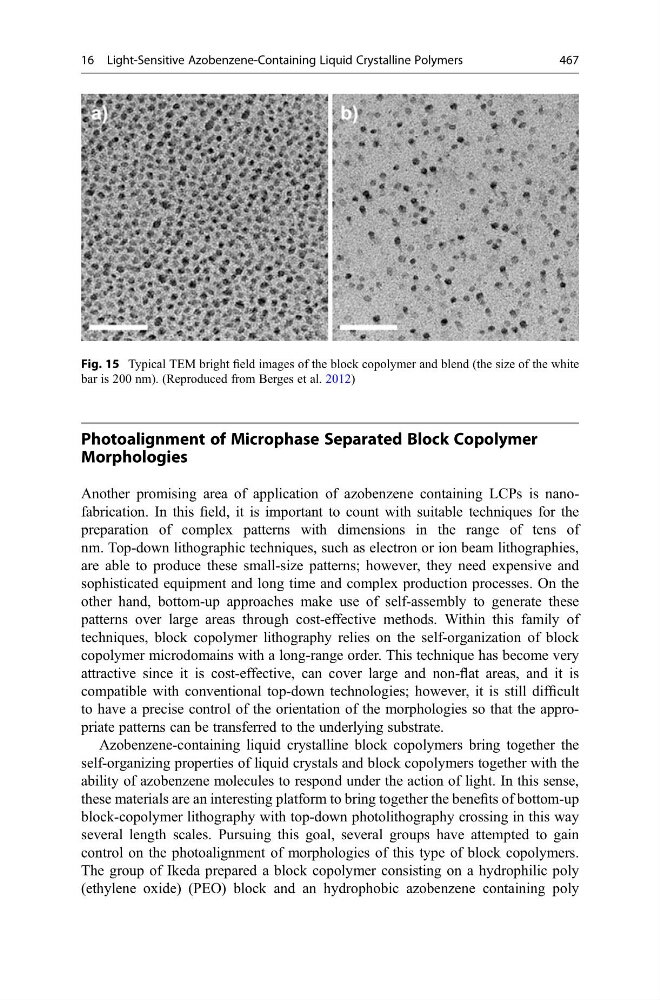
Fig. 15 Typical TEM bright field images of the block copolymer and blend (the size of the white
bar is 200 nm). (Reproduced from Berges et al. 2012)
16 Light-Sensitive Azobenzene-Containing Liquid Crystalline Polymers
467
Morphologies
Another promising area of application of azobenzene containing LCPs is nanofabrication. In this field, it is important to count with suitable techniques for the
preparation of complex patterns with dimensions in the range of tens of
nm. Top-down lithographic techniques, such as electron or ion beam lithographies,
are able to produce these small-size patterns; however, they need expensive and
sophisticated equipment and long time and complex production processes. On the
other hand, bottom-up approaches make use of self-assembly to generate these
patterns over large areas through cost-effective methods. Within this family of
techniques, block copolymer lithography relies on the self-organization of block
copolymer microdomains with a long-range order. This technique has become very
attractive since it is cost-effective, can cover large and non-flat areas, and it is
compatible with conventional top-down technologies; however, it is still difficult
to have a precise control of the orientation of the morphologies so that the appropriate patterns can be transferred to the underlying substrate.
Azobenzene-containing liquid crystalline block copolymers bring together the
self-organizing properties of liquid crystals and block copolymers together with the
ability of azobenzene molecules to respond under the action of light. In this sense,
these materials are an interesting platform to bring together the benefits of bottom-up
block-copolymer lithography with top-down photolithography crossing in this way
several length scales. Pursuing this goal, several groups have attempted to gain
control on the photoalignment of morphologies of this type of block copolymers.
The group of Ikeda prepared a block copolymer consisting on a hydrophilic poly
(ethylene oxide) (PEO) block and an hydrophobic azobenzene containing poly
Fig. 15 Typical TEM bright field images of the block copolymer and blend (the size of the white
bar is 200 nm). (Reproduced from Berges et al. 2012)
16 Light-Sensitive Azobenzene-Containing Liquid Crystalline Polymers
467