

and a non-absorbent amorphous one has been proposed (Häckel et al. 2005).
Depending on the chemical composition of the blocks and their molecular weights,
these materials can self-organize into different morphologies such as lamellar,
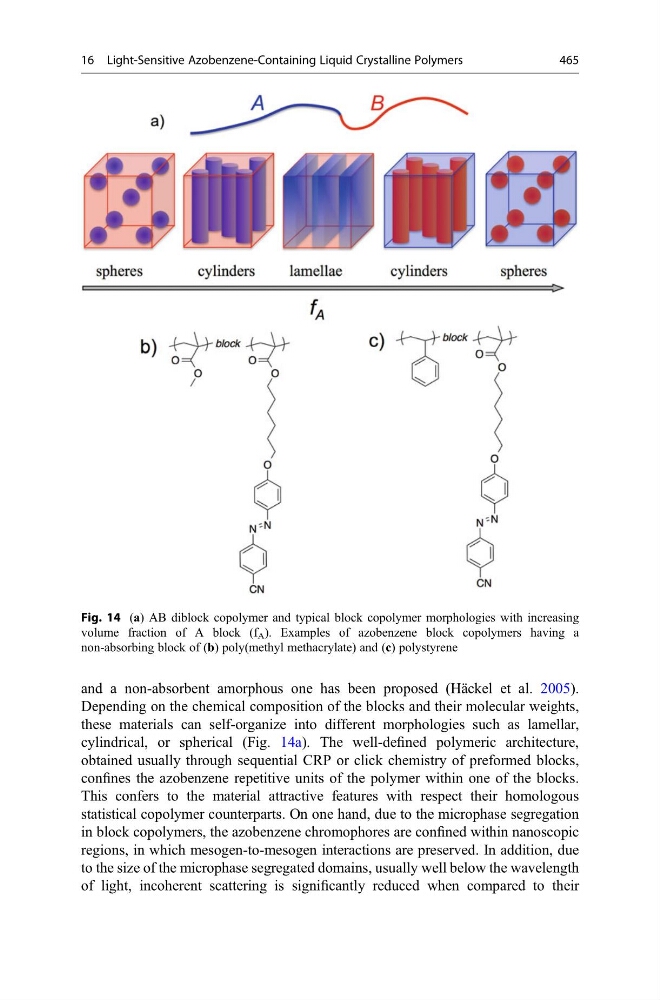
cylindrical, or spherical (Fig. 14a). The well-defined polymeric architecture,
obtained usually through sequential CRP or click chemistry of preformed blocks,
confines the azobenzene repetitive units of the polymer within one of the blocks.
This confers to the material attractive features with respect their homologous
statistical copolymer counterparts. On one hand, due to the microphase segregation
in block copolymers, the azobenzene chromophores are confined within nanoscopic
regions, in which mesogen-to-mesogen interactions are preserved. In addition, due
to the size of the microphase segregated domains, usually well below the wavelength
of light, incoherent scattering is significantly reduced when compared to their
Fig. 14 (a) AB diblock copolymer and typical block copolymer morphologies with increasing
volume fraction of A block (f A ). Examples of azobenzene block copolymers having a
non-absorbing block of (b) poly(methyl methacrylate) and (c) polystyrene
16 Light-Sensitive Azobenzene-Containing Liquid Crystalline Polymers
465
Depending on the chemical composition of the blocks and their molecular weights,
these materials can self-organize into different morphologies such as lamellar,
cylindrical, or spherical (Fig. 14a). The well-defined polymeric architecture,
obtained usually through sequential CRP or click chemistry of preformed blocks,
confines the azobenzene repetitive units of the polymer within one of the blocks.
This confers to the material attractive features with respect their homologous
statistical copolymer counterparts. On one hand, due to the microphase segregation
in block copolymers, the azobenzene chromophores are confined within nanoscopic
regions, in which mesogen-to-mesogen interactions are preserved. In addition, due
to the size of the microphase segregated domains, usually well below the wavelength
of light, incoherent scattering is significantly reduced when compared to their
Fig. 14 (a) AB diblock copolymer and typical block copolymer morphologies with increasing
volume fraction of A block (f A ). Examples of azobenzene block copolymers having a
non-absorbing block of (b) poly(methyl methacrylate) and (c) polystyrene
16 Light-Sensitive Azobenzene-Containing Liquid Crystalline Polymers
465