

physical blending of photoresponsive liquid crystalline polymers with a
non-absorbing, good optical-quality amorphous polymeric matrix.
Side chain methacrylate random copolymers with an azobenzene monomer and a
mesogenic non-absorbing one (sometimes even a third different non-absorbing
monomer) have been explored for volume holography (Bieringer et al. 1995;
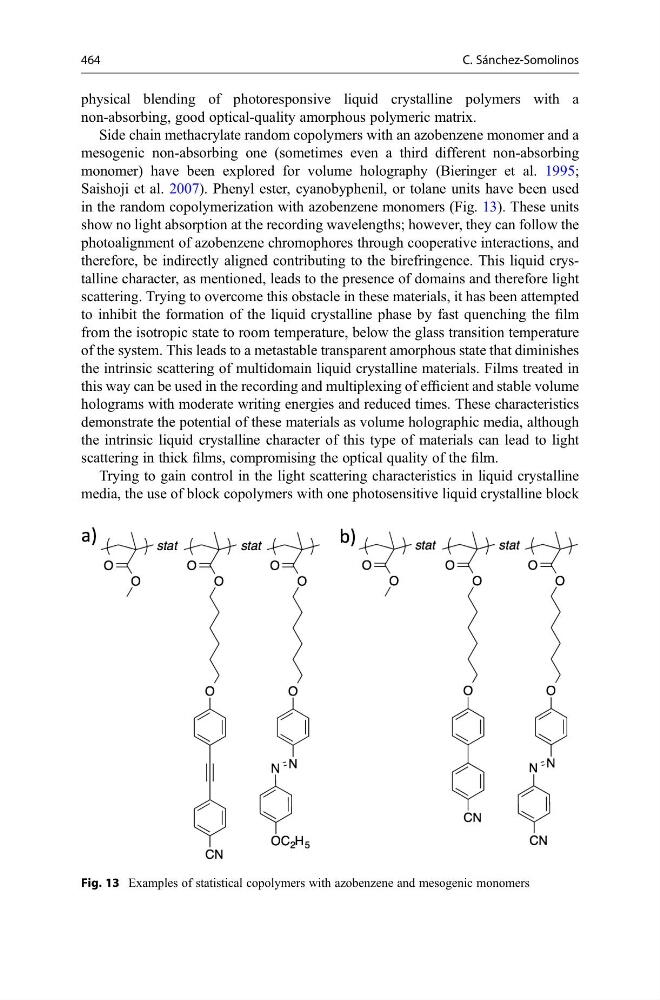
Saishoji et al. 2007). Phenyl ester, cyanobyphenil, or tolane units have been used
in the random copolymerization with azobenzene monomers (Fig. 13). These units
show no light absorption at the recording wavelengths; however, they can follow the
photoalignment of azobenzene chromophores through cooperative interactions, and
therefore, be indirectly aligned contributing to the birefringence. This liquid crystalline character, as mentioned, leads to the presence of domains and therefore light
scattering. Trying to overcome this obstacle in these materials, it has been attempted
to inhibit the formation of the liquid crystalline phase by fast quenching the film
from the isotropic state to room temperature, below the glass transition temperature
of the system. This leads to a metastable transparent amorphous state that diminishes
the intrinsic scattering of multidomain liquid crystalline materials. Films treated in
this way can be used in the recording and multiplexing of efficient and stable volume
holograms with moderate writing energies and reduced times. These characteristics
demonstrate the potential of these materials as volume holographic media, although
the intrinsic liquid crystalline character of this type of materials can lead to light
scattering in thick films, compromising the optical quality of the film.
Trying to gain control in the light scattering characteristics in liquid crystalline
media, the use of block copolymers with one photosensitive liquid crystalline block
Fig. 13 Examples of statistical copolymers with azobenzene and mesogenic monomers
464
C. Sánchez-Somolinos
non-absorbing, good optical-quality amorphous polymeric matrix.
Side chain methacrylate random copolymers with an azobenzene monomer and a
mesogenic non-absorbing one (sometimes even a third different non-absorbing
monomer) have been explored for volume holography (Bieringer et al. 1995;
Saishoji et al. 2007). Phenyl ester, cyanobyphenil, or tolane units have been used
in the random copolymerization with azobenzene monomers (Fig. 13). These units
show no light absorption at the recording wavelengths; however, they can follow the
photoalignment of azobenzene chromophores through cooperative interactions, and
therefore, be indirectly aligned contributing to the birefringence. This liquid crystalline character, as mentioned, leads to the presence of domains and therefore light
scattering. Trying to overcome this obstacle in these materials, it has been attempted
to inhibit the formation of the liquid crystalline phase by fast quenching the film
from the isotropic state to room temperature, below the glass transition temperature
of the system. This leads to a metastable transparent amorphous state that diminishes
the intrinsic scattering of multidomain liquid crystalline materials. Films treated in
this way can be used in the recording and multiplexing of efficient and stable volume
holograms with moderate writing energies and reduced times. These characteristics
demonstrate the potential of these materials as volume holographic media, although
the intrinsic liquid crystalline character of this type of materials can lead to light
scattering in thick films, compromising the optical quality of the film.
Trying to gain control in the light scattering characteristics in liquid crystalline
media, the use of block copolymers with one photosensitive liquid crystalline block
Fig. 13 Examples of statistical copolymers with azobenzene and mesogenic monomers
464
C. Sánchez-Somolinos