

great importance also in this field of photoresponsive materials. Atomic Transfer
Radical Polymerization (ATRP) and Reversible Addition Fragmentation chain Transfer
(RAFT) polymerization has allowed to obtain materials with better control of the
macromolecular architecture and the molecular weight.
This same type of acrylate-based mesogenic monomers has also been processed
by in situ photopolymerization (Broer et al. 1989). Reactive mesogens as the ones
shown in Fig. 6a–d or mixtures of them are oriented in their low molecular weight
state. A small percentage of a radical photoinitiator is included in the initial reactive
composition so irradiation with UV light leads to polymerization freezing to a large
extent the initial orientation of the mesogens. The incorporation of monomers with
two acrylate end functionalities in the reactive mixture leads to cross-linking
between polymeric chains in these systems resulting in liquid crystalline elastomers
or mesogenic networks with a more stable molecular organization against temperature (Fig. 6e).
Besides radical polymerization, melt transesterification of azo functionalized diol
and diester precursors has also been employed for the preparation of different series
of azobenzene containing side chain liquid crystalline polyesters (Fig. 7) showing
interesting photoresponse (Hvilsted et al. 1995).
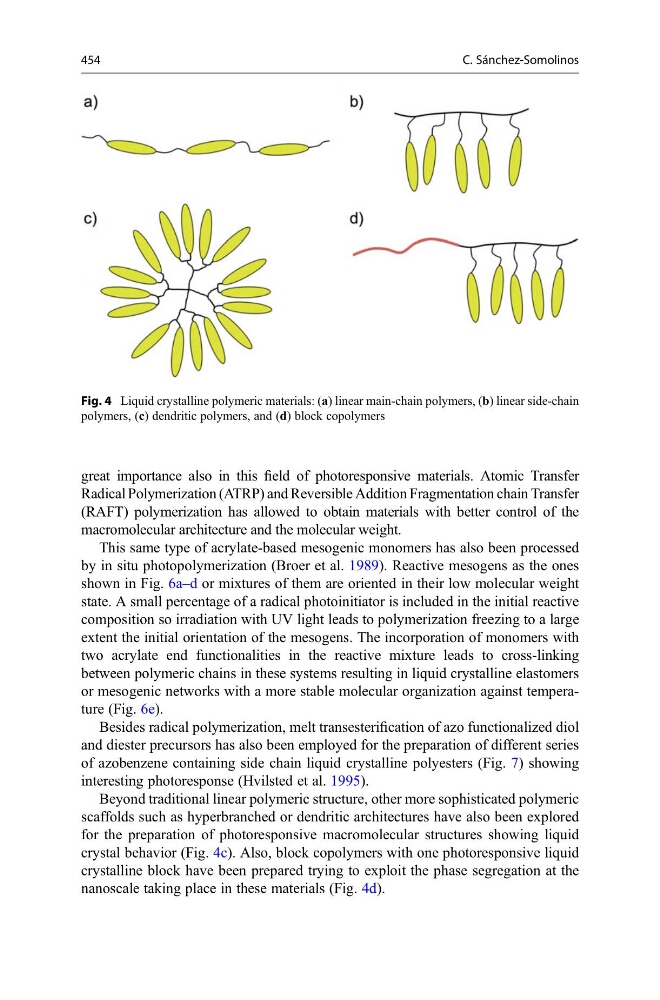
Beyond traditional linear polymeric structure, other more sophisticated polymeric
scaffolds such as hyperbranched or dendritic architectures have also been explored
for the preparation of photoresponsive macromolecular structures showing liquid
crystal behavior (Fig. 4c). Also, block copolymers with one photoresponsive liquid
crystalline block have been prepared trying to exploit the phase segregation at the
nanoscale taking place in these materials (Fig. 4d).
Fig. 4 Liquid crystalline polymeric materials: (a) linear main-chain polymers, (b) linear side-chain
polymers, (c) dendritic polymers, and (d) block copolymers
454
C. Sánchez-Somolinos
Radical Polymerization (ATRP) and Reversible Addition Fragmentation chain Transfer
(RAFT) polymerization has allowed to obtain materials with better control of the
macromolecular architecture and the molecular weight.
This same type of acrylate-based mesogenic monomers has also been processed
by in situ photopolymerization (Broer et al. 1989). Reactive mesogens as the ones
shown in Fig. 6a–d or mixtures of them are oriented in their low molecular weight
state. A small percentage of a radical photoinitiator is included in the initial reactive
composition so irradiation with UV light leads to polymerization freezing to a large
extent the initial orientation of the mesogens. The incorporation of monomers with
two acrylate end functionalities in the reactive mixture leads to cross-linking
between polymeric chains in these systems resulting in liquid crystalline elastomers
or mesogenic networks with a more stable molecular organization against temperature (Fig. 6e).
Besides radical polymerization, melt transesterification of azo functionalized diol
and diester precursors has also been employed for the preparation of different series
of azobenzene containing side chain liquid crystalline polyesters (Fig. 7) showing
interesting photoresponse (Hvilsted et al. 1995).
Beyond traditional linear polymeric structure, other more sophisticated polymeric
scaffolds such as hyperbranched or dendritic architectures have also been explored
for the preparation of photoresponsive macromolecular structures showing liquid
crystal behavior (Fig. 4c). Also, block copolymers with one photoresponsive liquid
crystalline block have been prepared trying to exploit the phase segregation at the
nanoscale taking place in these materials (Fig. 4d).
Fig. 4 Liquid crystalline polymeric materials: (a) linear main-chain polymers, (b) linear side-chain
polymers, (c) dendritic polymers, and (d) block copolymers
454
C. Sánchez-Somolinos