

under moderate illumination conditions. The efficiency of light-induced conversion
between isomers and the rate of thermal back isomerization of the cis isomer to the
trans are both strongly dependent on the azo substituents. While azobenzene type cis
isomer can have a lifetime of several hours, the aminoazobenzene type has lifetime
of minutes and the pseudostilbene seconds or less.
It is important to emphasize that isomerization leads to radical changes in shape of
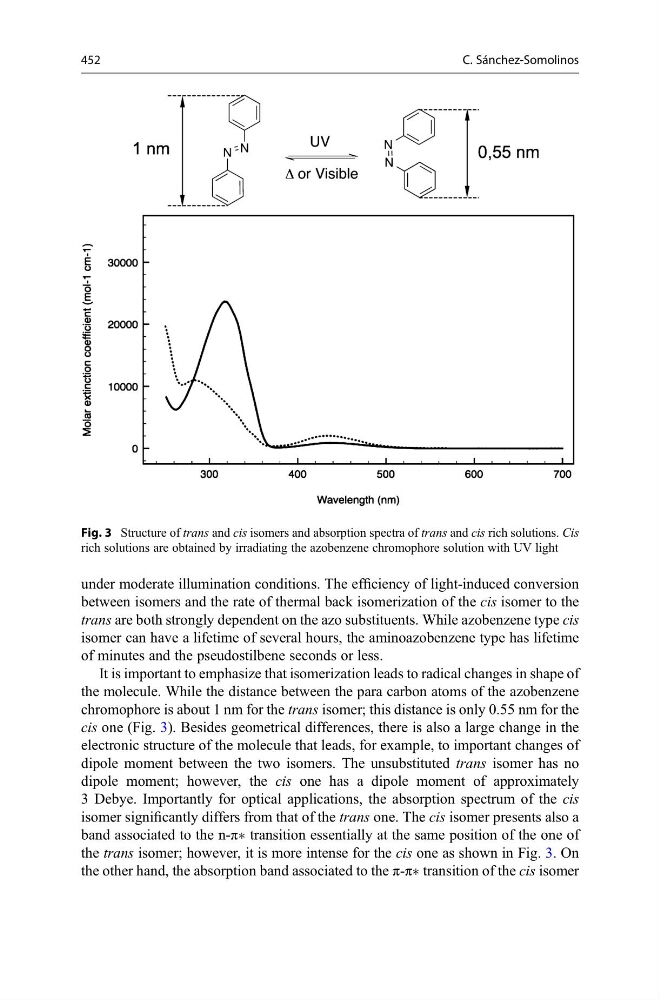
the molecule. While the distance between the para carbon atoms of the azobenzene
chromophore is about 1 nm for the trans isomer; this distance is only 0.55 nm for the
cis one (Fig. 3). Besides geometrical differences, there is also a large change in the
electronic structure of the molecule that leads, for example, to important changes of
dipole moment between the two isomers. The unsubstituted trans isomer has no
dipole moment; however, the cis one has a dipole moment of approximately
3 Debye. Importantly for optical applications, the absorption spectrum of the cis
isomer significantly differs from that of the trans one. The cis isomer presents also a
band associated to the n-πà transition essentially at the same position of the one of
the trans isomer; however, it is more intense for the cis one as shown in Fig. 3. On
the other hand, the absorption band associated to the π-πà transition of the cis isomer
Fig. 3 Structure of trans and cis isomers and absorption spectra of trans and cis rich solutions. Cis
rich solutions are obtained by irradiating the azobenzene chromophore solution with UV light
452
C. Sánchez-Somolinos
between isomers and the rate of thermal back isomerization of the cis isomer to the
trans are both strongly dependent on the azo substituents. While azobenzene type cis
isomer can have a lifetime of several hours, the aminoazobenzene type has lifetime
of minutes and the pseudostilbene seconds or less.
It is important to emphasize that isomerization leads to radical changes in shape of
the molecule. While the distance between the para carbon atoms of the azobenzene
chromophore is about 1 nm for the trans isomer; this distance is only 0.55 nm for the
cis one (Fig. 3). Besides geometrical differences, there is also a large change in the
electronic structure of the molecule that leads, for example, to important changes of
dipole moment between the two isomers. The unsubstituted trans isomer has no
dipole moment; however, the cis one has a dipole moment of approximately
3 Debye. Importantly for optical applications, the absorption spectrum of the cis
isomer significantly differs from that of the trans one. The cis isomer presents also a
band associated to the n-πà transition essentially at the same position of the one of
the trans isomer; however, it is more intense for the cis one as shown in Fig. 3. On
the other hand, the absorption band associated to the π-πà transition of the cis isomer
Fig. 3 Structure of trans and cis isomers and absorption spectra of trans and cis rich solutions. Cis
rich solutions are obtained by irradiating the azobenzene chromophore solution with UV light
452
C. Sánchez-Somolinos