

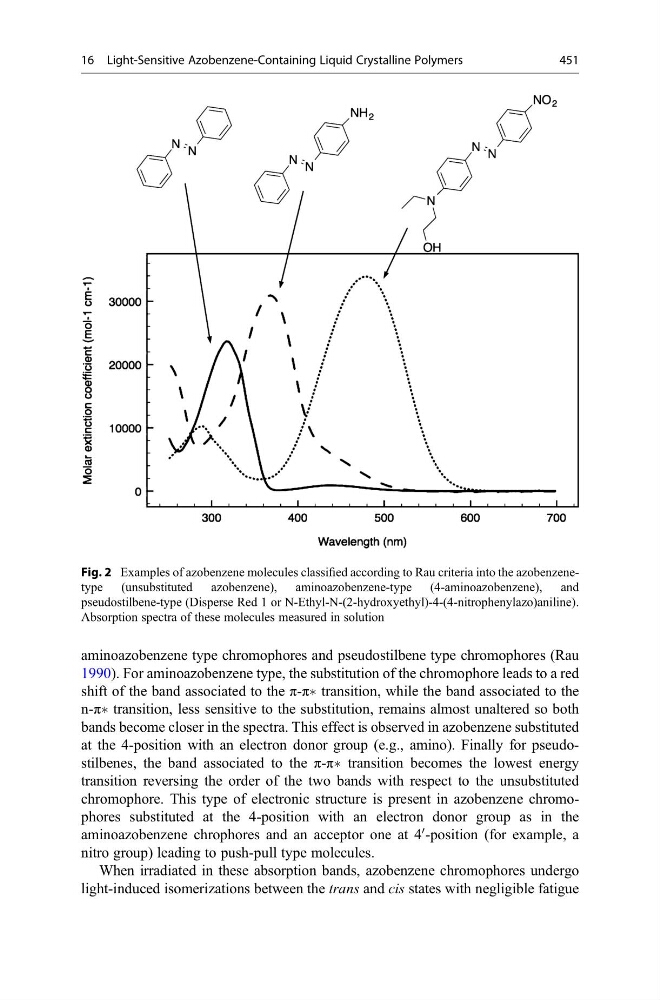
aminoazobenzene type chromophores and pseudostilbene type chromophores (Rau
1990). For aminoazobenzene type, the substitution of the chromophore leads to a red
shift of the band associated to the π-πà transition, while the band associated to the
n-πà transition, less sensitive to the substitution, remains almost unaltered so both
bands become closer in the spectra. This effect is observed in azobenzene substituted
at the 4-position with an electron donor group (e.g., amino). Finally for pseudostilbenes, the band associated to the π-πà transition becomes the lowest energy
transition reversing the order of the two bands with respect to the unsubstituted
chromophore. This type of electronic structure is present in azobenzene chromophores substituted at the 4-position with an electron donor group as in the
aminoazobenzene chrophores and an acceptor one at 4
0 -position (for example, a
nitro group) leading to push-pull type molecules.
When irradiated in these absorption bands, azobenzene chromophores undergo
light-induced isomerizations between the trans and cis states with negligible fatigue
Fig. 2 Examples of azobenzene molecules classified according to Rau criteria into the azobenzenetype (unsubstituted azobenzene), aminoazobenzene-type (4-aminoazobenzene), and
pseudostilbene-type (Disperse Red 1 or N-Ethyl-N-(2-hydroxyethyl)-4-(4-nitrophenylazo)aniline).
Absorption spectra of these molecules measured in solution
16 Light-Sensitive Azobenzene-Containing Liquid Crystalline Polymers
451
1990). For aminoazobenzene type, the substitution of the chromophore leads to a red
shift of the band associated to the π-πà transition, while the band associated to the
n-πà transition, less sensitive to the substitution, remains almost unaltered so both
bands become closer in the spectra. This effect is observed in azobenzene substituted
at the 4-position with an electron donor group (e.g., amino). Finally for pseudostilbenes, the band associated to the π-πà transition becomes the lowest energy
transition reversing the order of the two bands with respect to the unsubstituted
chromophore. This type of electronic structure is present in azobenzene chromophores substituted at the 4-position with an electron donor group as in the
aminoazobenzene chrophores and an acceptor one at 4
0 -position (for example, a
nitro group) leading to push-pull type molecules.
When irradiated in these absorption bands, azobenzene chromophores undergo
light-induced isomerizations between the trans and cis states with negligible fatigue
Fig. 2 Examples of azobenzene molecules classified according to Rau criteria into the azobenzenetype (unsubstituted azobenzene), aminoazobenzene-type (4-aminoazobenzene), and
pseudostilbene-type (Disperse Red 1 or N-Ethyl-N-(2-hydroxyethyl)-4-(4-nitrophenylazo)aniline).
Absorption spectra of these molecules measured in solution
16 Light-Sensitive Azobenzene-Containing Liquid Crystalline Polymers
451