

Hydrogen-Bonded Liquid Crystalline Azo Polymer
Reversible photoresponsive behavior is observed with main-chain photoactive azo
polymer which is able to form hydrogen bond via hydrogen-bonding moiety such as
amino groups in the backbones. Hydrogen bonds are known to be ideal noncovalent
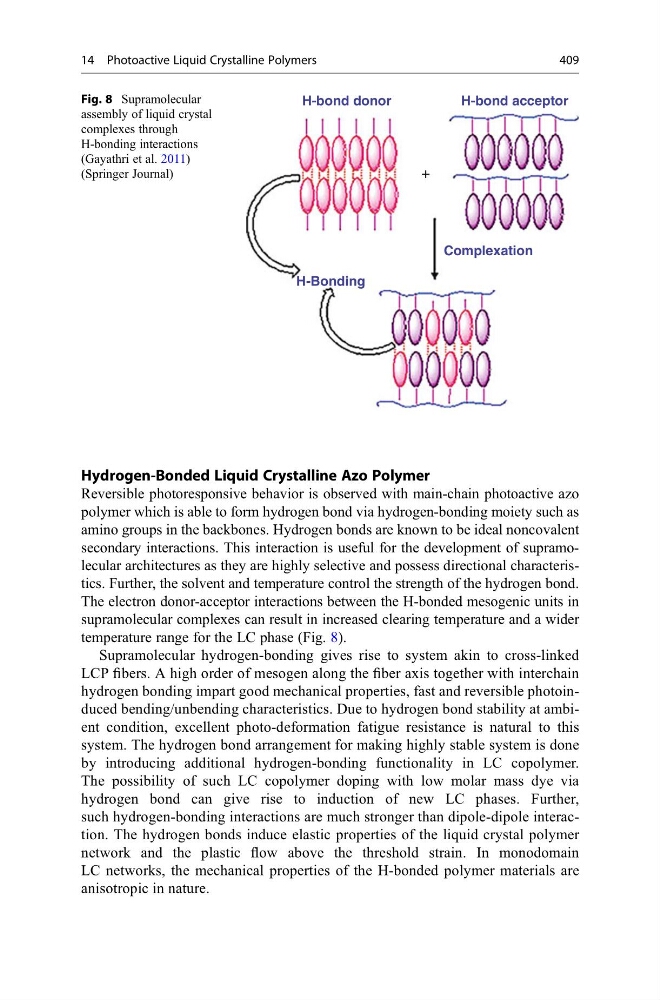
secondary interactions. This interaction is useful for the development of supramolecular architectures as they are highly selective and possess directional characteristics. Further, the solvent and temperature control the strength of the hydrogen bond.
The electron donor-acceptor interactions between the H-bonded mesogenic units in
supramolecular complexes can result in increased clearing temperature and a wider
temperature range for the LC phase (Fig. 8).
Supramolecular hydrogen-bonding gives rise to system akin to cross-linked
LCP fibers. A high order of mesogen along the fiber axis together with interchain
hydrogen bonding impart good mechanical properties, fast and reversible photoinduced bending/unbending characteristics. Due to hydrogen bond stability at ambient condition, excellent photo-deformation fatigue resistance is natural to this
system. The hydrogen bond arrangement for making highly stable system is done
by introducing additional hydrogen-bonding functionality in LC copolymer.
The possibility of such LC copolymer doping with low molar mass dye via
hydrogen bond can give rise to induction of new LC phases. Further,
such hydrogen-bonding interactions are much stronger than dipole-dipole interaction. The hydrogen bonds induce elastic properties of the liquid crystal polymer
network and the plastic flow above the threshold strain. In monodomain
LC networks, the mechanical properties of the H-bonded polymer materials are
anisotropic in nature.
H-bond donor
H-bond acceptor
Complexation
H-Bonding
+
Fig. 8 Supramolecular
assembly of liquid crystal
complexes through
H-bonding interactions
(Gayathri et al. 2011)
(Springer Journal)
14 Photoactive Liquid Crystalline Polymers
409
Reversible photoresponsive behavior is observed with main-chain photoactive azo
polymer which is able to form hydrogen bond via hydrogen-bonding moiety such as
amino groups in the backbones. Hydrogen bonds are known to be ideal noncovalent
secondary interactions. This interaction is useful for the development of supramolecular architectures as they are highly selective and possess directional characteristics. Further, the solvent and temperature control the strength of the hydrogen bond.
The electron donor-acceptor interactions between the H-bonded mesogenic units in
supramolecular complexes can result in increased clearing temperature and a wider
temperature range for the LC phase (Fig. 8).
Supramolecular hydrogen-bonding gives rise to system akin to cross-linked
LCP fibers. A high order of mesogen along the fiber axis together with interchain
hydrogen bonding impart good mechanical properties, fast and reversible photoinduced bending/unbending characteristics. Due to hydrogen bond stability at ambient condition, excellent photo-deformation fatigue resistance is natural to this
system. The hydrogen bond arrangement for making highly stable system is done
by introducing additional hydrogen-bonding functionality in LC copolymer.
The possibility of such LC copolymer doping with low molar mass dye via
hydrogen bond can give rise to induction of new LC phases. Further,
such hydrogen-bonding interactions are much stronger than dipole-dipole interaction. The hydrogen bonds induce elastic properties of the liquid crystal polymer
network and the plastic flow above the threshold strain. In monodomain
LC networks, the mechanical properties of the H-bonded polymer materials are
anisotropic in nature.
H-bond donor
H-bond acceptor
Complexation
H-Bonding
+
Fig. 8 Supramolecular
assembly of liquid crystal
complexes through
H-bonding interactions
(Gayathri et al. 2011)
(Springer Journal)
14 Photoactive Liquid Crystalline Polymers
409